| Passing Drills |
 |
|
|
|
| Passing Drill: Pass and Move |
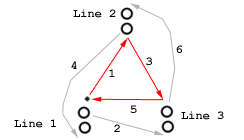
| Description: There are three lines of players behind three cones, arranged in a triangle. The player at the front passes to the ball to the player at the front of the next line and then follows the pass and joins the back of the line he passed to. This continues on going around the circle. Explanation: The drill includes many aspects of passing. First of all of the passes are made in a trianlge which is the basis of all ball movement. Secondly the players are forced to move straight after passing the ball which encouraged passing and moving. |
| Task: Keep the ball moving from cone to cone and join the back of the line to which you passed. Purpose: Technique and rhythm Complexity: Simple |
 |
|
|
|
|
| Passing Drill: Combination Passing |
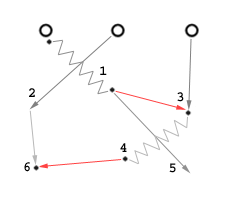
| Description: Three evenly placed players advance the ball through a combination of passing a driblling. Is easier than the diagram makes it out to be. Explanation: Combination plays are very useful for young players as they teach many of the fundamentals of attacking. Using width for example is important as it splits a opposition defence. The drill also encourages different combinations of passing and moving. |
| Task: To advance with the ball while preserving width Purpose: Maintaining attacking shape, passing to space Complexity: Medium |
 |
|
|
|
|
| Passing Drill: Keep Away |
| Description: Two teams of players try to maintain possesion of the bal in a confined area. The first team to complete a set number of passes(probably 10) wins. Explanation: This drill is used to develop passing in a dynamic game-like atmosphere. It demands that players spread out while in possesion of the ball and and compress while defending. The drill is flexible. More passes can be added to make a win and rule such as no pass backs(passing to the player who passed to you) mean the complexity of the drill can be increased. |
| Task: Maintain possesion of the ball and compelte a set number of passes. Purpose: Vision, on ball and off ball movement Complexity: Medium |
|
|
|
|
 |
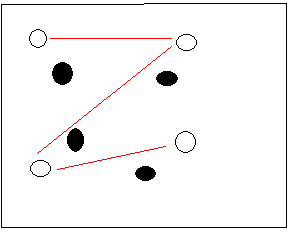 |
| Please excuse the rubbish diagram, I did this one myself |