




Melissa Marcelo
What exactly is a kibbutz? The kibbutz is an agricultural farming community that is based on common ownership of the means of production and consumption. This was known as Israel's proud and characteristic farming organization. The formal term for the kibbutz is "an organization for settlement which maintains a collective society of members organized on the basis of general ownership of possessions". The kibbutz believes in self-labor, equality, and all work together as a team in all areas of production, consumption, and education. The kibbutz originates in Israel, and it is a social system. It is Israel's original form of a commune. The first kibbutz was formed because of economic necessity. They needed to join together a group's small resources so they could build up the land and reconnect the Jewish people to the land. The kibbutz communes are scattered all over Israel stretching from the Lebanese border in the north to near the Red Sea in the south. Kibbutzim, as it is also known, was established wherever land could be bought, usually on swamps or desolate wastelands.
The kibbutz commune is different from other communes in several ways. This group stays together as a group because they all want to achieve common goals. The kibbutz commune has been an important part of the Jewish national liberation movement, who established the state of Israel. The kibbutz are a positive group that have had a major role in rebuilding a Hebrew folk-culture, and making good use of their land and soil. Also, they are multi-generational, and have over 100 members in each commune. This makes it more difficult for them to have one-on-one interactions with each other, like other communes have.
There are several basic principals and structures of the kibbutz. There is a common ownership of the means of production and consumption. They all have general responsibility and help each other out as a group, and there is democratic and independent management within the group. They are self-employed, without hired labor, and there is a connection of each individual kibbutz to a nationwide movement, and a connection of that movement to the Zionist-socialist political parties and the Workers' Federation.
There are 267 rural kibbutzim, 5 urban kibbutzim, and 5 communal villages. About 115,000 people live in, which is about 2% of the entire population, 3% of the Jewish population. The smallest kibbutz only has 14 members, plus 14 children. The largest kibbutz known as the Yagur has a population of 1,186. Givat Brenner is the second largest with a population of 1,159. The two largest of the kibbutz federations, Takam that is 60% of the kibbutz population and Kibbutz Artzi, which is 32%, are actually in the process of coming together to form "The Kibbutz Movement".
The Kibbutz system of communal childcare became institutionalized in Israel in the early 1950s. The original members of the Kibbutz usually had their children cared for by what was known as a "metapelet", or a female caretaker. This was so that as many adults as possible could go out and do economically productive work. A communal sleeping arrangement for children also reflected the founders' idea of the kibbutz, which stressed that a person should work as opposed to identifying personally with the family unit. In the past few years, because of vast socioeconomic changes, most kibbutzim have shifted from communal to familial sleeping arrangements. What is interesting is that young adults who live with their families move out at the age of 15 years and return to a communal sleeping arrangement in a "youth house", where they spend most of their free time.
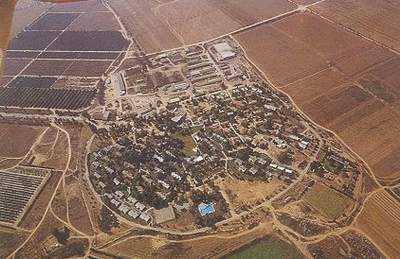
Picture from www.communa.org.il/e-israel.htm
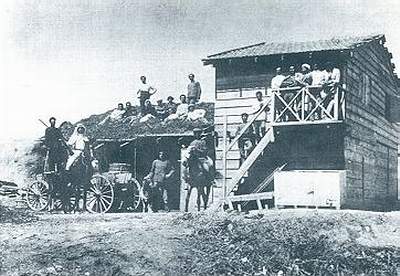
Picture from www.communa.org.il/e-israel.htm