| Not only the most difficult but also the most important part of
training is evaluating the student's progress. As instructors, we must be
sure that we have taught a skill that can be evaluated. Any goals we choose have a
certain number of problem solving steps associated with it. In evaluating the student's
progress on any of these steps, we, as instructors, must guard ourselves against
instructing. We must be careful to word the problem so that the student will clearly
understand it. During the evaluation, any communication, other than of a
social nature, makes it impossible to evaluate that skill. As the student gets closer to
the final flight test more time should be given to evaluation. The problems assigned
should be more complex -- the periods of instructor silence should be longer. During the last training period before the flight test, the instructor should act the part of the examiner -- remembering to give problems only and no solutions. The most difficult part of evaluating is seeing something going badly and not immediately suggesting a solution to the worsening condition. I do not advocate aircraft damage or personal injury -- that is where the instructor's experience is important. The flight test guide for any flight test lists the skill requirements that must be evaluated by both the instructor and examiner. The most common error resulting in bad accidents is the take-off and climb-out phase. It is that unseen force, down draft, that causes much of the problem. In order to demonstrate the viciousness of that force; find a fairly good size lake on a windy day. Approach the lake downwind at normal approach airspeed --- set up a constant descent rate of about 200 feet per minute --- trim for hands-off condition --- set it all up to clear the trees at the shoreline by about 25 feet. With everything set, just sit back and watch the descent rate on the vertical speed indicator after passing the shoreline. Observe everything carefully -- it will really make a believer out of the student. It's the best method of demonstrating the effects of downdraft that I have ever used. After the student has seen the effects of downdraft, his perception of landing and take-off areas and problems associated with these areas should be apparent in the evaluation process. Much too often the majority of seaplane training is done on fairly large lakes. When this is done, the student gets almost no chance at solving real problems such as:
The ultimate problem to assign a student would be to handle all details from working a weight and balance problem to a tie-down at a pre determined spot on another lake a short distance away.
Points certainly worth mentioning:
Hopefully, these observations will give some guidance to the instructor and the student along the watery road to the seaplane rating.
|
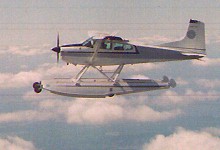 Even though life
preserver jackets are not listed on the equipment checklist from either flight test guide,
they are required by regulation. As a good float plane pilot friend of mine will testify,
"It's a good thing they are required". I know from personal experience that he
will not pull away from shore unless all occupants are wearing life jackets.
He has good reason for the rule, Coast Guard approved life preservers are a required item
for each occupant of the aircraft while on the water --- it's the law.
Even though life
preserver jackets are not listed on the equipment checklist from either flight test guide,
they are required by regulation. As a good float plane pilot friend of mine will testify,
"It's a good thing they are required". I know from personal experience that he
will not pull away from shore unless all occupants are wearing life jackets.
He has good reason for the rule, Coast Guard approved life preservers are a required item
for each occupant of the aircraft while on the water --- it's the law. All of the
information I've given you also pertains to Commercial Seaplane rating. However, the
appropriate Practical Test Standards must be used while preparing for the flight
test.
All of the
information I've given you also pertains to Commercial Seaplane rating. However, the
appropriate Practical Test Standards must be used while preparing for the flight
test.