| Annotations by Gerald Roberts On any given tournament day, there are factors beyond rating that decide the fate of each game. Among them are physical barriers: not getting enough sleep the night before, eating one too many donuts that morning, or general health conditions. Time and again, players will run into trivial things that trip them up against their opponent: an oversight in the opening, a swashbuckling trap in the middlegame, or endgame swindles that rob you of a half point. Then, there are just times when you are having either an "on" or "off" day, and there's nothing that's going to change that. On the day of this tournament, I was simply that: "on". Two rounds before this game, I took down a 1550 player with my Exchange Lopez. Then, I managed to squeeze a full point out of a 1950 player through blind luck. In this last round game, I was playing for first place against Mat Leach, a strong local player on the rise, who at this time outrated me by a few hundred points at 1646. However, as you will see, however "on" you may be, Caissa can always come back to bite you in the butt and swing things the other way... Goshen Winter Unrated December 16th, 2006 Ruy Lopez, Exchange (C68) Gerald Roberts (1360) Mat Leach (1646) 1. e4 e5 2. Nf3 Nc6 3. Bb5 a6 4. Bxc6 dxc6 The Ruy Lopez (or Spanish) Exchange has become a favorite opening of mine over the past year. Bobby Fischer used it as his weapon during his reign over international play in the late 1960s-early 1970s. However, sometime in-between then and now, the opening seems to have lost its respect, and many players, no matter the class, regard Bxc6 as bad. The resulting structures resemble the now-trendy Bb5 Sicilian lines, so maybe its only a matter of time before this move comes back into fashion. For those Lopez players out there, Bxc6 is a way to cut your opening preparation down 75%, so give it a whirl. 5. 0-0 Here, I've experimented a bit with 5. Nxe4 on Fritz, and remarkably, white manages to hold a slight advantage in every line. However, 0-0 is universally regarded as the correct move here. 5...Bg4 6. h3 Bh5 Here, there is no need to retreat the bishop. If black instead plays 6...h5! here, white can't even take the bishop or else he'll be mated along the h-file in a handful of moves. 7. d4!? (see diagram) Fritz hates this move at first, but it comes around if you leave it running for awhile. With this dramatic pawn break, I tempt black into playing to win a pawn. However, doing so, as you will see, isn't so cut-and-dry. I think I can get away with this because, essentially, after ...Bxf3, I will have won a tempo from black. 7...Bxf3 And he goes for it. If instead 7...exd4, then 8. Qxd4 Bxf3 9. Qxd8+ Rxd8 10. gxf3 and I personally believe that my doubled f pawns have enough control over the center to justify them being slightly weakened. 8. Qxf3 exd4 9. Rd1! This move would be played also if 8...Qxd4. Already, Fritz says equality has been restored. 9. � Bc5 10. c3 The point of this system. Obviously 10...dxc3 isn't possible because of the pin on the d-file. Even if black had played 9...Qf6, trying to consolidate, he can't hold the extra pawn. Get out your board and try, but you won't have any luck. 10. � d3 An interesting choice. Rather than allowing me to have two center pawns to his none, he opts for my ensuing rook capture with tempo. 11. Rxd3 Qf6 12. Bf4 Bb6 I really don't want to trade off my nice queen and develop his knight for him in the same move. 13. Na3 Ne7 (see diagram) 14. e5? Qe6 An innacuracy on my part. Either Nc4 or Qg3 would have continued the pressure on the queenside. Now, my e5 pawn will face a little difficulty in staying safe. 15. Nc2 Ng6 16. Bh2 I have to keep an eye on the e5 pawn or else I'm busted. 16. �0-0 17. Nd4 Bxd4 18. cxd4 I think Mat was counting on my d pawn being very weak here. Otherwise, he had no reason for giving me my protection for e5, a completely dominant pawn center, and getting rid of a bishop that he's already wasted two moves on. To his credit though, I now must walk a very thin rope. 18. �Rd8 19. b3 Preparing Rad1 without having to worry about the a pawn. 19...c5?! (see diagram) Uh-oh, my pawn is pinned, right? 20. d5! Qe8 21. Re1 Qb5 22. Qe4 Qb4 23. Qxb4 cxb4 Simplifying into a game where I believe that his weak queenside majority is no match for my dominance in the center. 24. e6? Rc8 Another innaccuracy on my part. 24. f4 or even 24. d6 would have maintained the initiative. If black plays fxe6 here, I don't have much left. However, he sees the threat against the c7 pawn and gets distracted. 25. Bxc7!! (see diagram) In my chess 'career' thus far, this is definitely one of my favorite 10 moves. Fritz will tell you that the position is dead equal, dead drawn right now, but you know what? My opponents can't calculate perfect variations like Fritz. Maybe when I'm Vladimir Kramnik I'll worry about how to beat Fritz, but until then, I'm content with flashy tactics like these. Note that 25...Rxc7 is difficult because of the rolling pawns. In fact, black will have to sac his knight to stop them. Mat, of course, saw this and played--- 25. � fxe6 26. d6 Nf4 27. Rd4 Nd5 28. Rxe6 Nxc7 29. dxc7 Rxc7 30. Rxb4 Rc1 + I had to think about this continuation when I decided to immediately take the pawn at b4. After about 10 minutes, I found that black can't get away with pawn grabbing here, because my attack comes just a half move faster than his will. 31. Kh2 Rxf2 32. Rxb7 Rcc2 (see diagram) 33. Re8+! The following continuation is forced. 33...Rf8 34. Ree7! Rfc8 35. Rxg7+ Kf8 36. Rxh7 Kg8 Black must now always be careful or else there will be mate along the back rank. 37. a4 a5 38. Ra7 Rb2 39. Rhb7 A multi-purpose move. Preparing for Rxa5 without having to worry about dropping the b pawn or the rook on its old h7 square. 39. �Kh8 40. Rxa5 Rd8 41. R5a7 Kg8 42.a5 Kf8 43. a6 Re8 Black has no useful moves here. My time was quickly going off the clock here, though, since I could not find a useful plan at first. 44. Rf7+ Kg8 45. Rae7 I want to get down to a pawn endgame if possible. Then, I could win without thought. Soon, I begin to play without thought anyways. 45...Ra8 46. a7 Rxb3 47. Rb7 Ra3 48. Rhc7 R3xa7 He had no choice. Either take it or be mated very, very soon. And its not like it matters, but Fritz gives me a 9 point advantage here. 49. Rxa7 Re8 50. Ra4 Kf8 51. Rac4 Re2 52. h4 Kg8 Ah, I'm going to win. Just gotta get closer. 53. h5 Kh8 There's mate in 8 here. I don't see it, but I creep closer anyways! 54. h6 Rd2 Closer!!!! 55. h7 Rxg2+ DRAW 1/2-1/2 Too close. (see diagram) Obviously, I hadn't seen a desperado rook in tournament play before and completely thought it was over. I was in such disbelief that I made him play it out another 30-40 moves, with him chasing me around the board. And of course, I can't take the stupid thing because then his king is stalemated in the corner. To make matters worse, he beat me out on the tiebreaks (I beat Les Kistler and Jeff Bauman and still had bad tiebreaks!!) and got the first place trophy. In a lot of ways, I am upset about not getting the full point, but at least I learned my lesson in an unrated game rather than in the final round of some big money tournament. Besides, it was fun to outplay him, if even for a short while. I'm sure that another day will come where I'll catch an opportunity to make up for it. |
 |
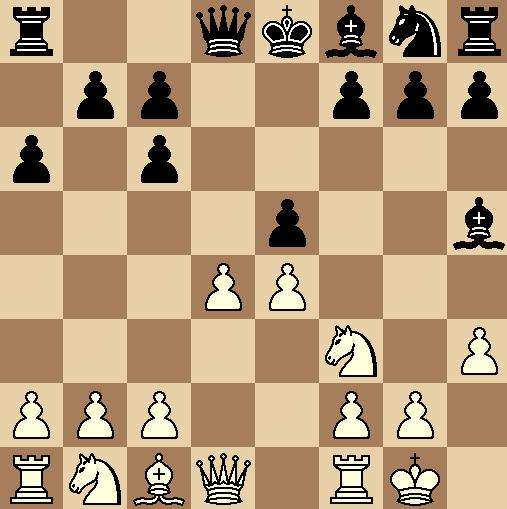 |
| after 7. d4!? |
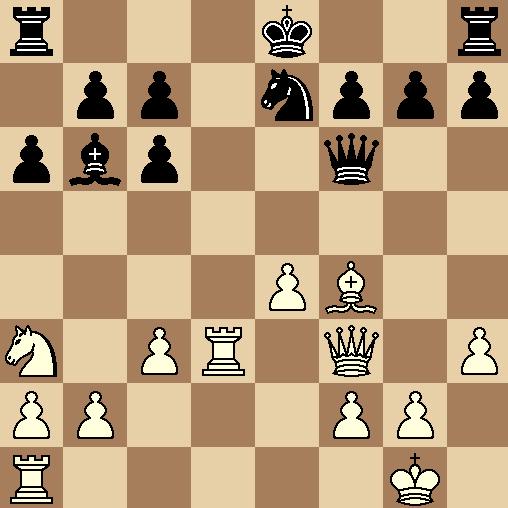 |
| after 13...Ne7 |
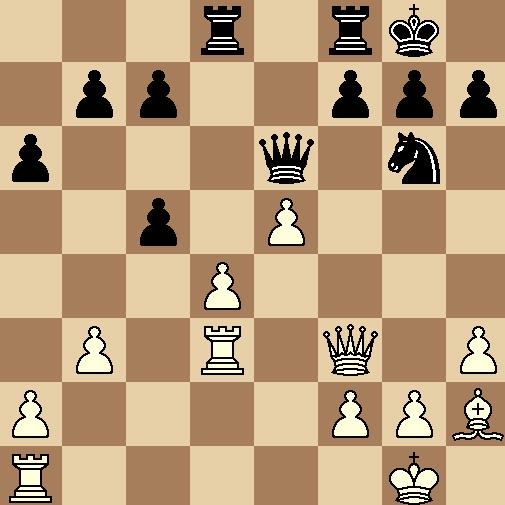 |
| after 19...c5?! |
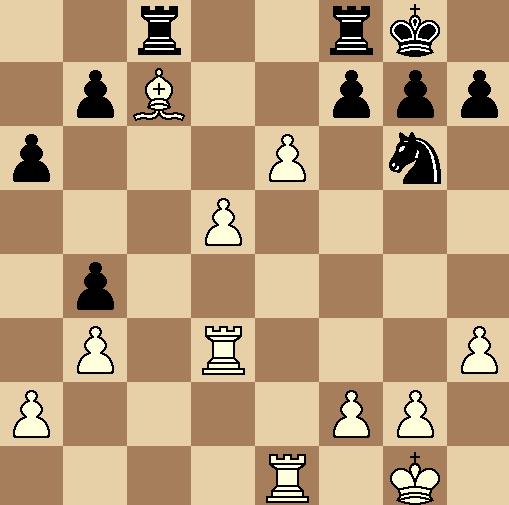 |
| after 25. Bxc7!! |
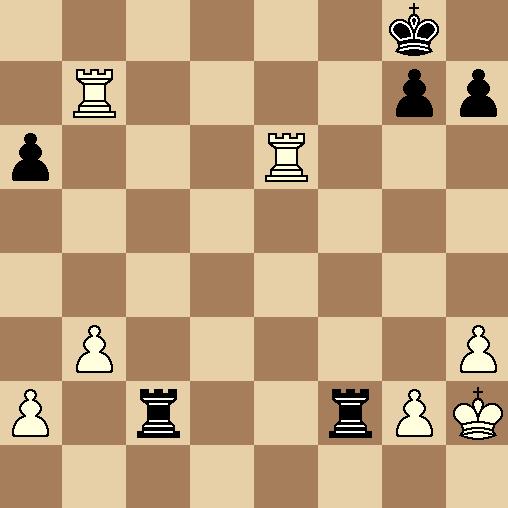 |
| after 32...Rcc2 |
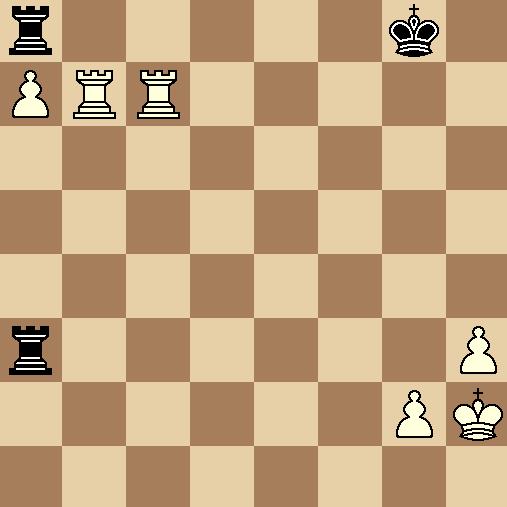 |
| after 48. Rhc7 |
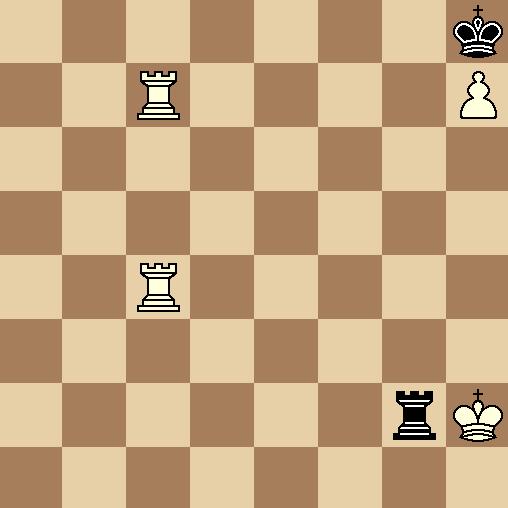 |
| FINAL POSITION after 55...Rxg2+!! 1/2-1/2 |
 |
 |
 |
 |
 |
 |
 |
| Copyright 2007. All Rights Reserved. |
 |

|
 |
 |