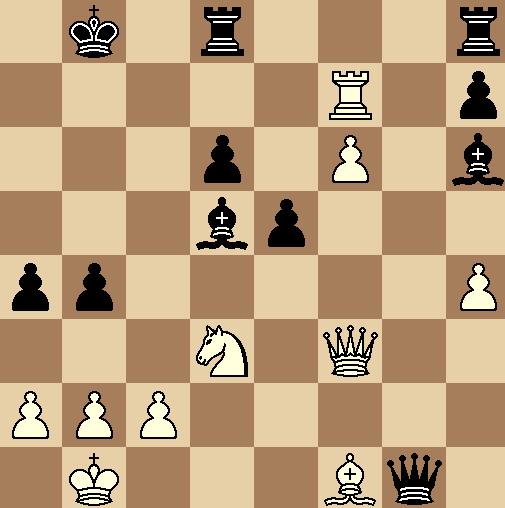
| Annotations by Gerald Roberts In theory, a player with an extremely good memory could play chess quite well in two of its three phases, without knowing much about the game itself. NCO or any other opening book covers so many lines so deep that this person could theoretically play perfect chess for 20 or 30 moves, in some instances. Endgame play is much the same. I do believe that computer programs out there now have tablebases that allow them to play perfectly in any endgame with five, maybe six pieces on the board. However, middlegame play is not so simple. From this realm of the chess game come the great works of the imagination and intense concentration: sacrifices, beautiful combinations, and artful maneuvering of one's pieces. And sometimes, when you think you've found a great move, it turns out to be unsound and in some cases, an all-out blunder. In this game, I find myself toe to toe, again, with Les Kistler. This was our first meeting since my lucky win over him in the Goshen Unrated Tournament of December, 2006. And like every other time that I've played him, the game takes place in the fourth round of an unrated tournament. What you'll see in this game is how I turn a favorable position into a losing one by thinking that I could outplay an opponent who, at this time, is simply a better player. Warsaw Unrated Sicilian, Najdorf (B99) Gerald Roberts (1360) Les Kistler (1950) 1. e4 c5 2. Nf3 d6 3. d4 cxd4 4. Nxd4 Nf6 5. Nc3 a6 6. Bg5 e6 7. f4 Be7 8. Qf3 Qc7 9. 0-0-0 Nd7 Alright, I don't think I need to comment much on the opening. This position is a standard Najdorf Sicilian that can be reached by several move orders and has been played countless amounts of times between Grandmasters. This is what I was talking about in my introduction. Thus far, there's no reason that an outsider viewing this game would know that we're not two super-GMs duking it out at Corus or Linares. Les and I both played this fairly quickly, as we knew the book line quite well. Not long before this game, Les had this exact same position as white against John Cole in the South Bend Club Championships (the game is annotated by Les on this site as well). Here, my book knowledge runs out and I'm forced to come up with a constructive plan of my own. 10. f5 [LES KISTLER] says- Not a blunder, but this pawn advance (apparently attractive because of the attack on e6) allows Black to gain control of e5. Two standard book moves here are 10. g4 and 10. Bd3. Most of my opponents prefer the pawn move. Very few of them select the bishop move. 10...e5 [LES KISTLER] says- My unpleasant interaction with Carl Burt had some effect on my play in this game, and I was not really concentrating. Moving this pawn is usually bad in the Sicilian (except some of the 6. Be2 lines) because it allows White to plant a piece on d5. Much better is 10. � Ne5! 11. Qe2 b5 good play for Black. 11. Bxf6 (see diagram) 11...Nxf6 Not 11...exd4 12. Nd5! threatening the queen and winning the e7 bishop with ease. For some reason, I felt that I needed to complicate the position as much as possible, despite the fact that my opponent outrates me by about 600 ELO points and can navigate through complications much easier than I can. 12.Nb3 b5 13. Kb1 Bb7 My prophylactic 13. Kb1 just gets my king off the same file as the black queen. Meanwhile, I find that I must give up control of the d5 square, which is one of my only plusses in the position. 14. Nd5 Nxd5 15. exd5 Qb6 16. h4 a5 The gameplan here is simple. Similar to many Sicilian positions (or any other game with opposite side castling), the winner of this game will most likely be who can initiate their wing attack first. Black wants to mate me on the queenside, and white is trying to stir up counterplay on the kingside. With his heavy pieces bearing down on the a and b files behind his pawns, I knew that danger was lurking here, but also knew that I wasn't going to get mated before my pawn storm hit. 17. g4 a4 18. Nc1 b4 19. g5 After the game, Les commented that he underestimated the speed at which my pawns rushed forward. Although Fritz has preferred his position slightly for the past 10 moves, it still says the game is roughly equal. 19...0-0-0?! (see diagram) At this moment, the alarms in my head were all going off and telling me that black shouldn't be able to get away with this move. Black was correct believing that he shouldn't castle kingside here, but castling queenside is also a bad idea. Although he escapes my pawn onslaught, he puts his king in a vulnerable position and leaves the f7 pawn extremely weakened. I think the king belongs in the center here for quite some time, but then you have to wonder if the h8 rook is ever going to get into the game. 20. f6! gxf6 21. gxf6 Bf8 22. Bh3+ Kb8 23. Rhg1 Objectively, this is not the best move on the board, but something was telling me that black messed up by castling and that I needed to find a way to punish him right away. The correct move to do this would have been Qh5!, putting pressure on the weakness at f7 and white has a good game. 23...Bh6 24. Rg7!!? (see diagram) I dare black to take my rook. As it turns out, black can get away with taking it, but play is very sharp and white is the one with all the play for about 5-10 moves. I expected play to continue 24...Bxg7 25. fxg7 Rhg8 26. Qxf7 and I thought I would be crushing black until I found the crucial maneuver 26...Qc7, ending my attack. Still in that position I've got a bishop and pawn for my rook, and black's king isn't any safer than mine, so I think I could've handled it. 24...Qc7 Trying to prepare to capture my rook. He played a similar rook move against John Cole in their game at the SBCC and didn't think it wise to accept the rook here after John declined it in their game. 25. Rdg1 Qc4 Forgetting about my rook and shifting his attention to the control of the d5 square. And this is where I sat calculating for about 20 minutes. Unlike our previous encounters, I hadn't played horribly in the first 25 moves and I knew that my position was equal here, if not better. I had already played a great opening by studying long Sicilian lines, and with my rook lift to g7, I had successfully added complications to the position and arguably held the initiative here because of it. Obviously, I'm going to lose my pawn at d5, and I realize that his pawn at f7 is hanging. Furthermore, I know that any pawn capture will subsequently get my queen and rook forked after his bishop captures my pawn. Still, I kept looking for a way to make it work, and after several minutes, mustered up the courage to play my next move. 26. Rxf7?! Bxd5 (see diagram) And now I played the move that I thought would save everything... 27. Bf1?? I have the right idea here, but go about it all wrong. My intention of course, is to swap the queens off the board. Once they come off, I have a dominating rook on the 7th rank, a passed pawn not far behind, and I'm not even down material. However, Les smells a fish here, takes a short think, and proceeds to crush me. 27...Qc5!! Not a hard move to find, but in all my variations, I hadn't even considered the fact that he could simply retreat the queen. More importantly, he now eyes my rook at g1, which just happens to be hanging. My position is lost here, and I know it, but I proceed in disbelief, or perhaps, disgust with myself. The correct plan (not really correct, but more in line with what I wanted the position to feel like) was to play 27. Be6!!, when he can't take the bishop due to mate(!!) at g7. However, even then, he has the brilliant desperado 27... Qxc2+! where he will soon be a pawn up in an otherwise equal position. 28. Nd3?? Qxg1 (see diagram) WHITE RESIGNS 0-1 I'm down a rook with no compensation, so I do the only think that I can do. It's always disappointing to lose a game to someone you've beaten before, especially when you know that you might've beaten them that game. More important than feeling sorry for yourself, though, is coming to realize how far you've already come, knowing how far you still have to go, and having a game that lets you know what you need to do in order to get there. And for anybody out there who finds it frustrating to lose to a more experienced player over and over again, just know that because you continue to lose, its only a matter of time before that trend begins to tip in your favor. Sometimes, you just need to pay your dues before you can stumble upon greatness. |
 |
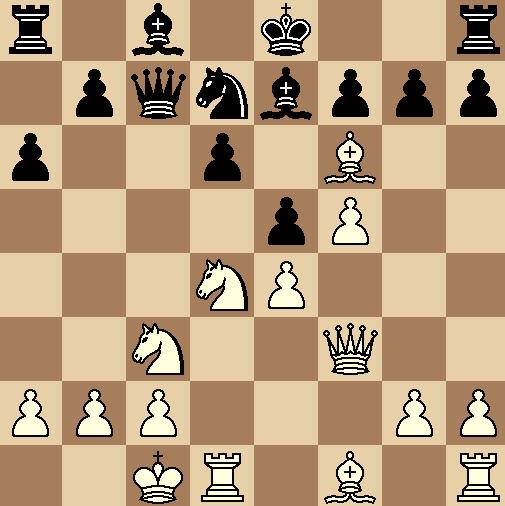
| after 11. Bxf6 |
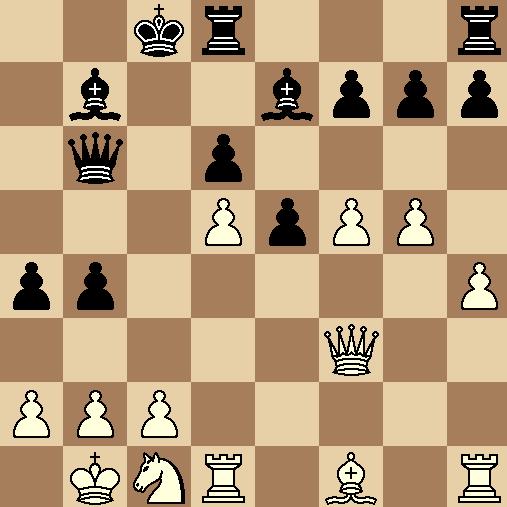
| after 19...0-0-0?! |
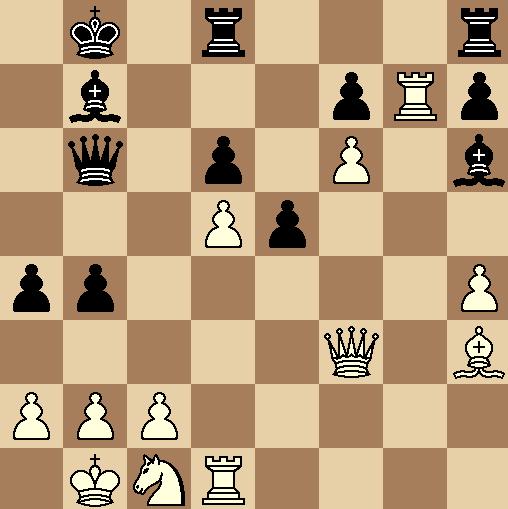
| after 24. Rg7!!? |
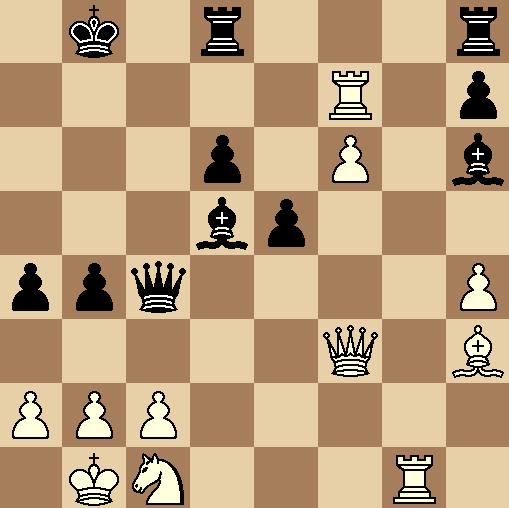
| after 26...Bxd5 |
| FINAL POSITION after 28...Qxg1 0-1 |
 |
 |
 |
 |
 |
 |
 |
 |
 |
 |
 |
 |
| Copyright 2007. All Rights Reserved. |
 |

|
 |
 |