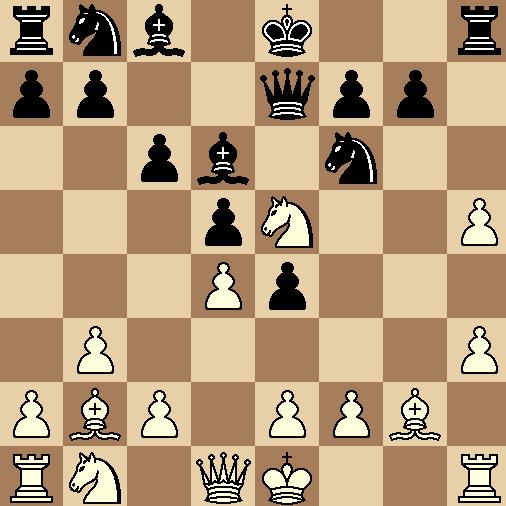
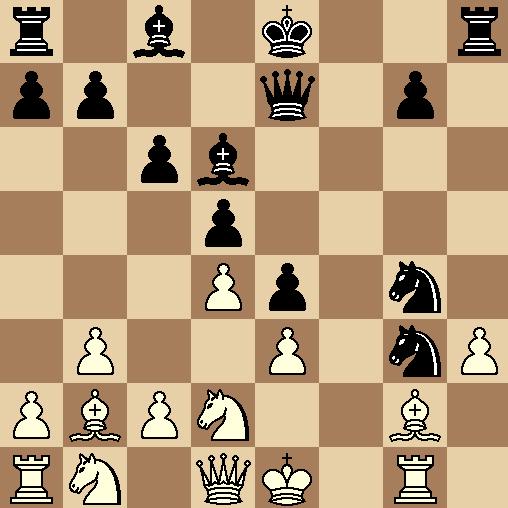
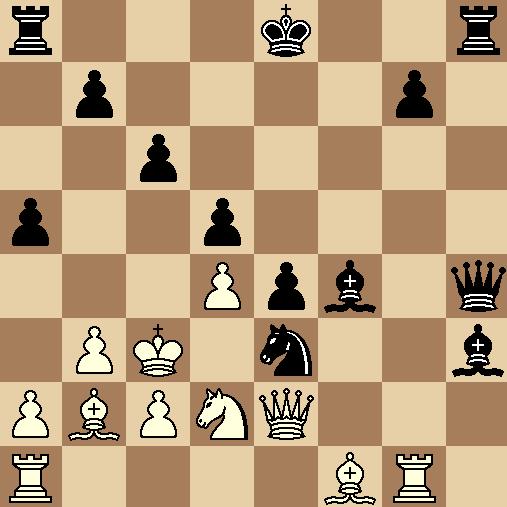
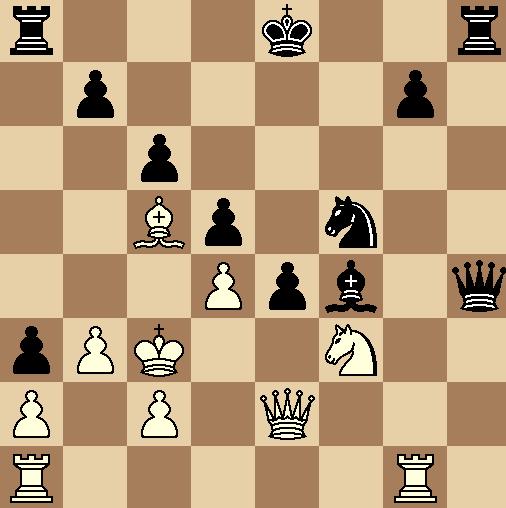
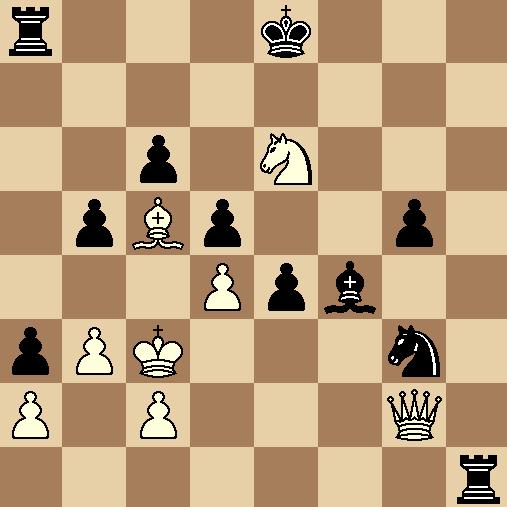
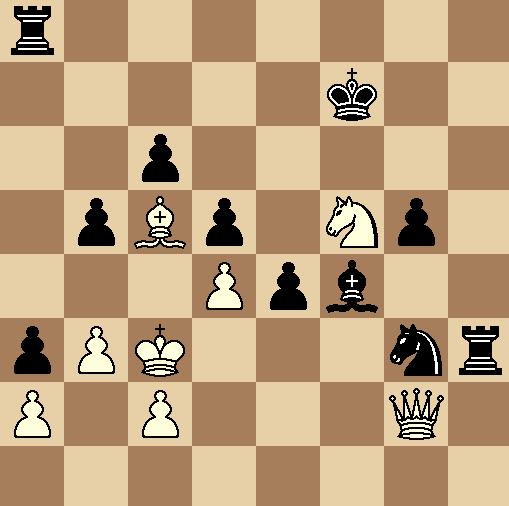
| Annotations by Gerald Roberts If you look through the games on this site, you will find my most instructive wins, usually showing off some flashy combination or deep understanding. However, to say that all of my games follow along these lines is simply untrue. Sometimes, I get outplayed slightly. Sometimes, I lose a won position. And sometimes, I get crushed by opponents rated a thousand points higher than me. This is one of those games. Not long ago, my opponent won the Arnold Denker Tournament of High School Champions. In the past few years, John Cole has established himself as the area's best player. Besides Emory Tate, he may be the strongest player in all of Indiana. This game, played in a simultaneous exhibition on April 25, 2006, shows exactly what the difference is between a club player and a master. Elkhart County Chess Club-Simul Grob's Attack (A00) Gerald Roberts (1101) John Cole (2330) 1. g4 Before you jump to any conclusions about how much of a patzer I must have been, just wait a minute. This move, known as the Grob, is a much trickier opening than most people realize, which makes it a valuable weapon against players who know book lines and not principles. John, of course, knows both, but I had been studying the opening and playing it quite extensively for about six months before this game. 1...d5 2. Bg2 c6 Yes, I have a pawn hanging, but that is the whole point of my opening. If black grabs the pawn, he will end up losing either his c or d pawn whether he likes it or not. Then, though I have weakened my kingside, I have one more center pawn than my opponent, which serves as some kind of compensation. Also, notice how much scope my g2 bishop already has. The c6 line that he plays neutralizes my light squared bishop's power. 3. h3 h5 4. gxh5 Nf6 I can't defend my pawn, so he's in no rush to take it. 5. b3 This move is quite poor, but already I was having trouble finding a constructive plan. I needed to develop my queenside pieces, and this was simply one avenue to take in order to get there. To tell the truth, despite having played the Grob so many times before this, nobody had declined the pawn after playing 1...d5. While I was the one trying to get him out of book, he took me out of mine much faster. 5...e5 6. Bb2 Bd6 I admit that here I was a bit frightened by his big pawn center, but I had done enough study with hypermodern play to know that I was about =/+ 7. Nf3 Qe7 8. d4 e4 9. Ne5 (see diagram) Pay attention to how many moves I make with my knight. At this juncture in my chess studies, I really didn't have much concept of what a tempo was. Going back through this game, I'm ashamed that I wasted so many of them, but I guess we all have to start somewhere. 9. � Nd7 10. Ng4 Nxh5 11. e3 f5 12. Nh2 An unnecessary retreat. Black can't take my knight because after 12...fxg4 13. hxg4, black finds that his own knight is pinned to his h8 rook. 12...Ndf6 13. Nf1 f4 14. Nfd2 fxe3 15. fxe3 Ng3 I'm already completely lost, and it's only been 15 moves! So much for surviving the opening. Black's knights are all set to invade my kingside, and his queen isn't far off, either. Meanwhile, my d2 knight has seen the entire board, so the game isn't a complete waste. 16. Rg1 Ng4 (see diagram) Ugh...my position has deteriorated so quickly that he can already make maneuvers like this. I can take the knight with 17. hxg4, but I was afraid of the complications following 17...Qh4 and the nasty discoveries with the knight and queen. 17. Nf1 Nxf1 18. Bxf1 Nxe3 19. Qe2 Qh4+ Not the most accurate move order, but he is playing a simul and its not like he's hard pressed to find the most forcing continuation here. 20. Kd2 Bf4 It's really quite fascinating how quickly and perfectly black's pieces coordinate and join in on the attack. Of course, during the game, I was a little less appreciative of the beauty of the moves and a little more focused on how to swindle my way out of this. 21.Kc3 Bxh3 22. Nd2 a5! I actually thought this was a wasteful move on his part when he played it. However, the importance of this pawn thrust reveals itself shortly. 23. Ba3 Bxf1 24. Nxf1 Nf5 25. Bc5 a4 26. Nd2 a3 27. Nf3? (see diagram) This was probably my best move of the game, and even this one is a blunder. I had the right idea of utilizing the pin along the e-file, but went about it completely the wrong way. One thing that I found that helped me progress from a Class E player to a Class C player was forgetting about one move threats if there was no other point to it. Here, my knight is hardly better at f3 than it was at d2, but I played it simply because it would force black to move his queen. He is, of course, happy to comply, because I just chase it to a better square. The correct move that I should have played, in case you were wondering, was 27. Nxe4! where ...dxe4 is met by Qxe4 check and the regaining of my piece, but with pawn extra in my favor. 27...Qh3 28. Rh1 Qxh1 29. Rxh1 Rxh1 Two rooks for a queen is generally a bad idea (and it was here as well), but I just wanted his queen off the board at all costs. I kept telling myself that I still stood a fighting chance if only I could get my queen across his pawn barrier. 30. Qg2 Ng3 31. Ng5 b5 Of course, not 31...Bxg5 32. Qxg3. The way that all his pieces work together so fluidly (if that's even a word) is quite impressive. 32. Ne6 g5 (see diagram) 33. Ng7+? A horrible move, but one that I thought about for quite some time. I considered Nxg5, winning a pawn, but that was really the least of my concerns here. The correct continuation would have been 33. Nxf4! gxf4 34. Bd6!! with at least some counterplay. In fact, Fritz says that in that line, I'm only 1.4 pawns down, compared to the move played, where I'm down a full 5.1 pawns. 33...Kf7 34. Nf5?! And here, I thought I was going to win a piece. After all, his knight is now attacked twice, and he can't capture my knight because it is overloaded guarding the rook at h1. John calmly looked at the position for about two or three minutes. I was so happy with myself thinking that I finally tripped him up. As it turns out, he was just calculating the final line to make sure that it was winning for him. 34...Rh3!!! WHITE RESIGNS 0-1 Here, I'm completely busted. Just look- 35. Qxh3 Ne2+ 36. Kb4 Bd2+ 37. c3 Bxc3+ 38. Qxc3 Nxc3 39. Kxc3. In that situation, I'm down three pawns and have two pieces against his rook (supposed to be better for me, but I know that I couldn't coordinate them perfectly enough to make a difference). Notice how black's a3 pawn was the key ingredient to making his final combination work. Genius! Although obviously upset over losing, I felt the game was definitely a good experience because it showed me how much work still has to be done to improve my game. Often times, more is learned from your losses than from your wins, so don't sweat it when an opponent who's obviously better than you wipes you off the board. Instead, analyze your mistakes and take that experience to the board with you next time. |
 |
| after 9. Ne5 |
| after 16...Ng4 |
| after 22...a5! |
| after 27. Nf3? |
| after 32...g5 |
| FINAL POSITION after 34...Rh3!!! |
 |
 |
 |
 |
 |
 |
 |
 |
 |
 |
 |
 |
 |
| Copyright 2007. All Rights Reserved. |
 |

|
 |
 |