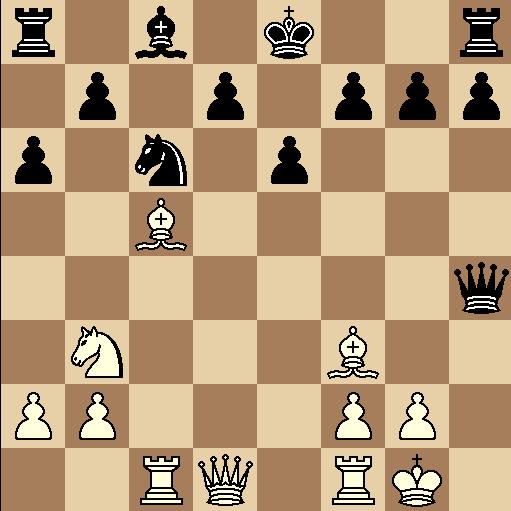
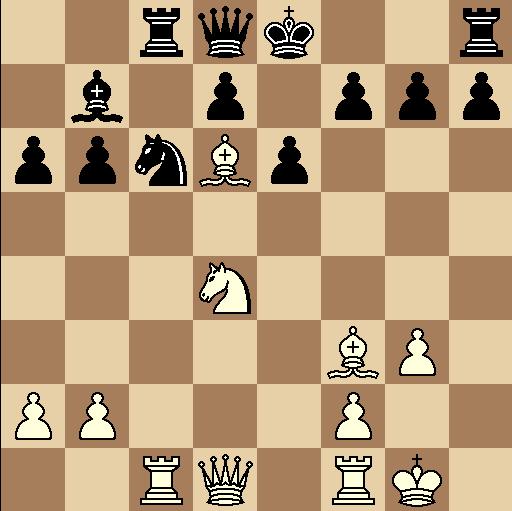
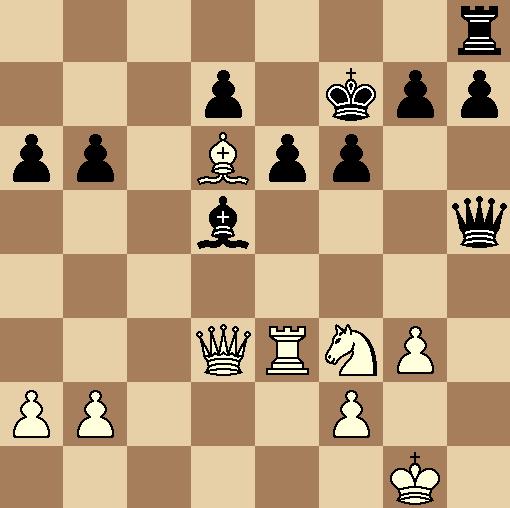
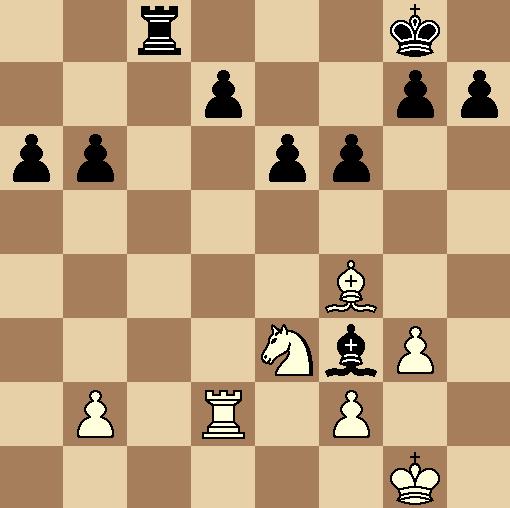
| Annotations by Gerald Roberts The following game was played between myself and a class A player, Les Kistler. Les Kistler is a very strong player whose rating has exceeded 2000 many times. In the 2006 US Amateur Team Midwest tournament, his team placed first, with Les scoring impressively on board 4. This game, played at an unrated tournament in Goshen, Indiana, is very instructive because it shows both exactly how not to handle a game against a much higher rated opponent, and then precisely how to shed away the intimidation factor and play good chess. Sicilian, Kan (B41) Les Kistler (1968) Gerald Roberts (1360) 1. e4 c5 Last year at this tournament, I played Les as black at board 1 in round 4, the exact same situation as this game. Since I lost that game with a French in about 40 moves, I was afraid to play my pet line again. Thus, I decided to steer towards a Sicilian, even though I had never played it in praxis before. In retrospect, this was a very poor idea since the Sicilian demands a certain amount of book knowledge which I did not possess. 2. Nf3 e6 Inspired to play this rather than the usual �d6 because there was so much discussion I remembered about it from a recent game, The World v. GM Arno Nickel (Chessgames.com, 2006). 3. d4 cxd4 4. Nxd4 a6 5. c4 Bc5 6. Nb3 Ba7 7. Nc3 Nc6 8. Be2 Nf6 9. 0-0 I had seen enough games to know that we were basically still in a book line up to now. However, I was somehow convinced that his game was already +1.00 or better. I decided that if I was going to lose this game, at least I would have some fun with it. 9. � Bb8 I chose this move specifically because I had a tactical idea in mind (which you will soon see). Apparently, the position right now is only +/=, but I thought I was already lost. 10. Be3 Taking the diagonal that I just left. 10. � Nxe4?? This sacrifice is definitely not sound, so I do not attribute my impending victory on it. Even though I was not lost before this, technically, I should be after this move. I suppose my reasoning behind it was that it would force Les to think for a couple of minutes, thus giving me a shot at winning on time (it was G/45 or something close to that effect). 11. Nxe4 Bxh2+ 12. Kxh2 Qh4+ 13. Kg1 Qxe4 This was the natural continuation of my plan. Now, I find myself down a knight for two pawns with my queen stuck in the middle of the board. 14. Bf3 Qxc4 15. Rc1 Qh4 My opponent sacrifices a pawn to complete his development and control over the center. Even though material is now equal, I knew his position was dominating mine. I decided that I would now play very cautiously in an attempt to slowly improve my position and maybe come out with a drawish endgame. 16. Bc5 So much for castling. I need to get my king to safety right away if I want to have a chance in this game. (See Diagram) 16. �b6?!! I originally thought this was a great move. I figured that sacrificing my pawn was more than a fair enough price to pay for the safety of my king. Later on, I found out that this move fails to 17. Qd6!! when 17. � bxc5 is followed by 18. Bxc6 dxc6 19. Qxc6+. On the bright side, however, he took quite some time off of his clock and did not find that continuation. 17. g3 I think he might have been afraid to take the pawn because of 17. � 0-0, when my king is safe, or 17. �Bb7 followed by a knight trip from c6-e5-g4 with mating threats at h2. As it turns out, the Bb7 plan fails horribly, but in these short time controls, he simply couldn�t evaluate if something was there or not. He decides, instead, to play it safe, since his position is already winning. 17. �Qd8 My queen is no longer in danger, and the b6 pawn is no longer en prise. Here, however, white has a win with Bxc6, when �dxc6 will soon allow him to take my b6 pawn for free and with tempo. 18. Bd6 Absolutely ending my hopes of castling and severely limiting any plan that I might hope to generate. My dark squares, so to speak, are a mess. 18. �Bb7 19. Nd4 Rc8 Applying pressure to the queenside. His moves are dictating mine, which is almost a sure sign that I am losing. However, the position here is only +/= (Fritz 5.32) and if I play correctly, I should be able to hold. (See Diagram) 20. Nf5!? Obviously, exf5 fails to Re1+. However, I note the move as !? simply because he took 10 minutes to find it. Already, he has only 15 minutes left to my 30. 20. �Qf6 21. Bxc6 Rxc6 22. Rxc6 Bxc6 23. Nd4 Simplifying into a game where he believes (correctly, I might add) that his d6 bishop is more than enough to win this game. 23. �Bd5 24. Re1 Qh6 I need to keep my bishop if I have any shot to draw this game. 24. �Bxa2 obviously fails to b3, trapping the bishop. From this point on, most of my moves are with tempo. I am improving my position slowly and developing with threats. 25. Nf3 Stopping mate at h1. 25. � Qh5 26. Re3 f6! Now, after applying pressure to his kingside, I find myself in a position where king safety is not far off. I know that after Kf7 and Rc8, my position is easily manageable. 27. Qd3? Kf7!! This was his last chance. With 26. Rc3, he would still have a small advantage. Now, the tides have turned. From here on out, my Fritz gives me the advantage!!! (See Diagram) 28. Nh4 Rc8 29. Re1 Bc4 30. Qd2?? Bxa2 I asked Les about this move, and he said that he simply did not see the pawn capture. Needless to say, I now have four pawns to compensate for that knight sac back at move 11. 31. Bf4 Trying to trick me. The maneuver g5, forking the two pieces, obviously fails to Qxd7 followed by Qxc8. 31. �Qd5 32. Qe2 Bc4 33. Qg4 Bb5 I was a little bit worried about all of his pieces being on my kingside, but I could not find anything, so I just kept on putting my pieces on the best squares that I could find. 34. Rd1 Qe4 35. Qh5+ Kg8 36. Ng2?? Here, I had a clear win with Be2, but failed to see because we were both short of time and I already had an idea of what I wanted to play in mind (my own form of chess blindness). 36. �Bc6 37. Ne3 Stopping my threat of mate at g2. 37. �Qf3 38. Qxf3 Bxf3 39. Rd2 Here, I was more than happy to exchange pieces, even though you are not supposed to relieve the pressure if you are the one attacking. I wanted to simplify things as much as possible just to make the ensuing endgame less dangerous in these blitz-like time controls we had now reached (I had 5 minutes to his 2 or 3). (See Diagram) 39. �Rc1+ 40. Nf1 Rd1 41.Rxd1 Bxd1 42. Ne3 TIME 0-1 And this is the point where I stopped notating. He had less than one minute of time, and writing down my moves had brought me down to nearly two minutes. In the next few moves, I centralized my king and dropped my bishop at d1, which probably would have made me lose, except his time was out. In a lot of ways, I feel lucky for the way that I won this game, but chess is all about making mistakes. The one who makes the next to last mistake is the winner, and in this case, that person was me. I went on to draw my last game with an opponent rated roughly 300 points above me, and took home joint first place with him. |
 |
 |
 |
 |
 |
| after 16. Bc5 |
| after 19. ...Rc8 |
| after 27. ...Kf7!! |
| after 39. Rd2 |
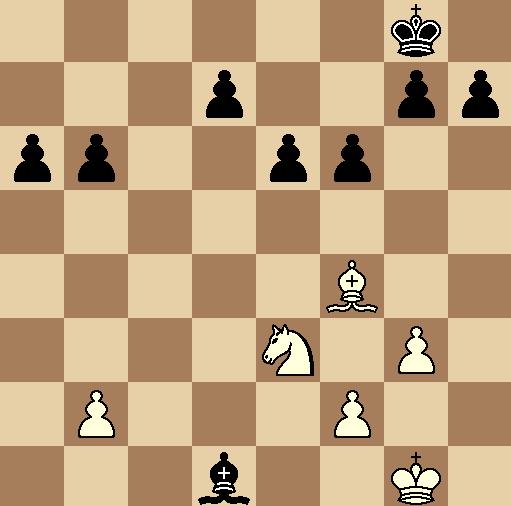
| FINAL POSITION after 42. Ne3 |
 |
 |
 |
 |
 |
 |
 |
 |
| Copyright 2007. All Rights Reserved. |
 |

|
 |
 |