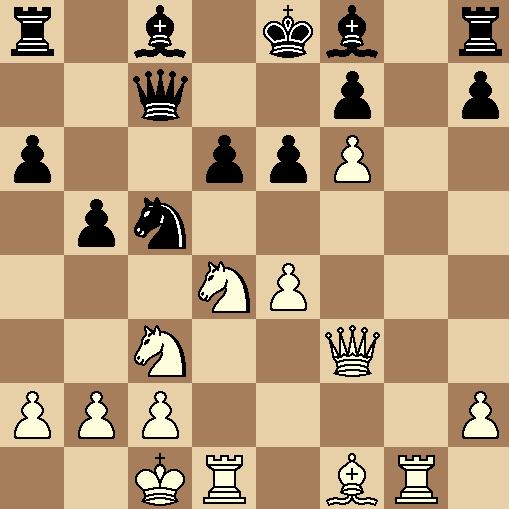
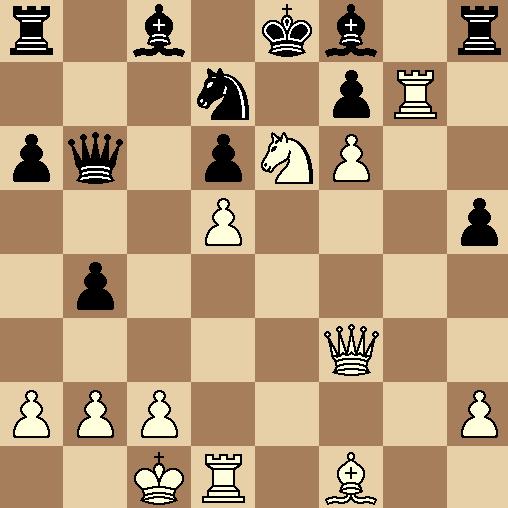
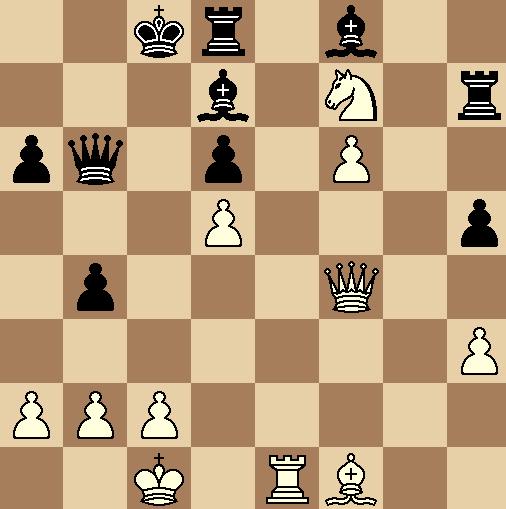
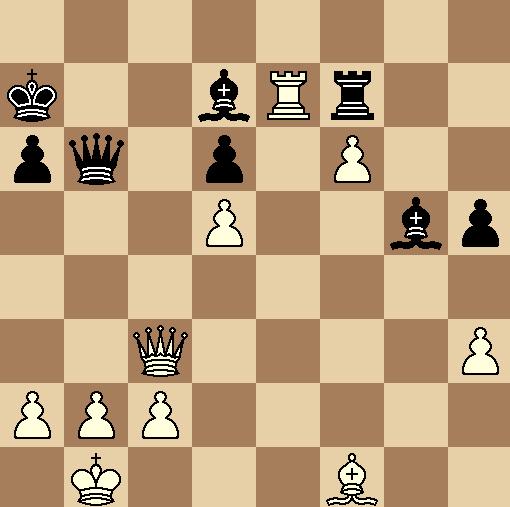
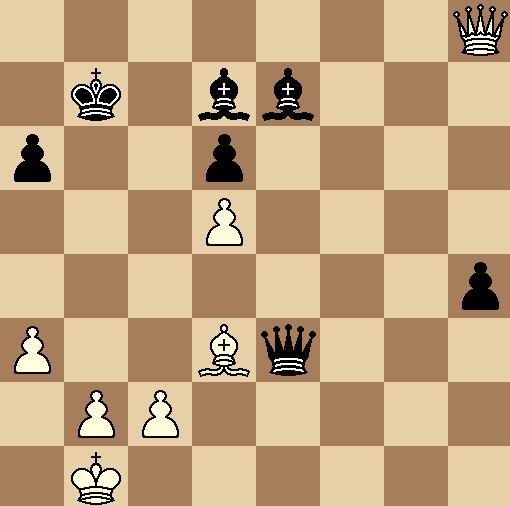
| Annotations provided by Les Kistler John has beaten the starch out of me so many times (and in so many ways) that it�s not even funny anymore. I console myself by knowing that I can sometimes nick him for a draw or a (very rare) win in G/5 or G/10 tournaments, but the last time I beat John in a USCF-rated tournament game was in February 1997, at a South Bend vs. Elkhart club match. That was ten whole years ago, and John was still a rising player. I might add that only a few months after my win, he crushed me twice in a row to show me who was really boss even though I still outrated him by at least 400 points! As the underdog nowadays, I can take great risks against John without much worry. After the game, I explained to John and Harold that I played this way because I didn�t want to �die an old man in my bed.� With this attitude, I sat down intending to play an exciting game worthy of my better days from about10�15 years ago. Sicilian, Najdorf (B96) Les Kistler (1968) John Cole (2330) 1. e4 c5 2. Nf3 d6 3. d4 cxd4 4. Nxd4 Nf6 5. Nc3 a6 6. Bg5 e6 7. f4 Nbd7 8. Qf3 Qc7 9. O O-O Be7 10. g4 b5 All of this is very economical on the clock. I used very little time up to move 17, just enough for the mechanical actions of making the moves and writing them down. I know the right moves, but so does John; plus, he understands the main lines better. I don�t remember what I did last time I played John as White in a Najdorf Sicilian. It probably was not this main line. 11. Bxf6 Nxf6 Kistler�Doss (Indianapolis 1992), Kinnaird�Kistler (Rosemont 1996), and Kistler�Dondon (Northbrook 2005) went 11. � gf6!?. The Doss game was a draw (he was much younger and lower�rated then!) while the Kinnaird game was a beautiful win for me with a rook sac that led to mate. I also won the against Dondon. [The pawn recapture 11. � gf6?! is currently suspect. White reroutes his knights quickly to hit the weaknesses with Ne2�f4xe6. ��Greg Steele] 12. g5 Nd7 13. f5 Nc5 Before the discovery of Perenyi�s move (16. Rg1), another book line was 13. � Bxg5+ (played in Rosenau�Kistler, Valparaiso 1976, D. Miller�Kistler, Goshen 1979, and Colias�Kistler, Hammond 1986). In the 1970s, capturing this pawn was thought to be bad, while later analysis claimed that it was playable, but held no winning chances for Black. 14. f6 gxf6 15. gxf6 Bf8 16. Rg1 (see diagram) As white, I sprang this move (Perenyi�s variation) on Shapiro (Logansport 1990) and wiped him out. A year later, the game Kistler�Avgoustoglou (South Bend 1991) ended in a draw in this line. 16. � h5 17. Rg7 b4 The rook is taboo. 18. Nd5! This is supposed to be the right move. After the first knight is captured, the second knight is jammed into c6 with murderous threats. 18. � exd5 19. exd5 Nd7! Neither John nor I understood this variation as well as we should�ve. John and I thought this was a bad move, but Greg Steels says it�s the only move. I guess we know much less than we thought! 20. Ne6? Exciting, but insufficient. What I didn�t notice was the fairly obvious 20. Nc6! Ne5[? This is an old line and insufficient. 20. � Bb7! is a new move played by Vallejo Pons at super�GM level after being played in high level correspondence. ��Steele] 21. Nxe5 de 22. d6! Qb7 23. d7+!! Kd8 24. dc=Q+ Kxc8 25. Rd8+! Kc7 26. Rd7+. (It wasn�t necessary to go this far, but you get the idea.) 20. � Qb6 (see diagram) Steady, steaaady. 21. Ng5 I dismissed 21. Rxf7!? without looking far enough. After 21. � Kxf7 22. Ng5+ (1) 22. � Kg8?? 23. f7+ Kg7 24. Ne6+ Kh6 25. Qf4+ Kh7 26. Bd3#. (2) 22. � Ke8 23. f7+ [23. Re1+ Ne5 24. Rxe5+ de 25. d6 Bh6! 26. Qxa8 Qd8 spells the end of White�s dreams since after 27. Qxd8+ Kxd8 there�s no fork on f7.] 23. � Ke7 24. Re1+ Ne5 25. Rxe5+ de 26. d6+ Qxd6 27. Qxa8 Bh6! once again dashes White�s hopes because of the pinned knight. 21. � Ne5 22. Re1 Bg4 23. Qf4 O-O-O Well, I figured that was about it�he�s castled and now his king is no longer on the firing range. There�s a little play left, but only enough to restore material balance with a hopeless ending for White, nothing more. 24. h3(?) Pretty wimpy, considering the violent stuff I was playing earlier. This makes the h3 pawn a target and takes away h3 as an avenue for my own bishop. 24. � Bd7 25. Rxf7 Nxf7 26. Nxf7 Rh7 (see diagram) Uh�oh. If I regain the exchange by 27. Nxd8 Bh6 finishes me off. But John was angry with himself for overlooking the queen check which removes her from the dangerous diagonal. 27. Qc4+ Kb8 28. Nxd8 Qxd8 29. Qxb4+ A tough decision�capturing on a6 makes the black king look more exposed, but 29. Qxa6 Bc8 allows Black�s rook to join the defense along the seventh rank. 29. � Ka7 30. Qa3 Qb6 31. Qd3 Rf7 32. Qc3 My intended 32. Qg6 doesn�t help because of 32. � Qf2! 33. Rd1 Qxf6 etc. 32. � Bh6+ 33. Kb1 Bg5 34. Re7!? (see diagram) I held out a few faint hopes that his bishops would be too restricted to work in this position, but that proves to be a mirage. 34. � Rxe7 35. fxe7 Bxe7 36. a3 Kb7 37. Be2 h4 38. Qg7 Qe3 39. Bd3 Bxh3 40. Qh8 Meaningless is 40. Qc3 (threatening 41. Bxa6+ winning his queen) because of 40. � Qc5, among other good moves. 40. � Bd7 (see diagram) One final point: 41. Bxa6+ Kxa6 42. Qa8+ Qa7 ties up all loose ends. Therefore, WHITE RESIGNS (0�1). In the post�mortem few of the spectators weighed in with their opinions. While John and I understood a little bit of what was happening on the board, we didn�t see everything�and only a little more than the onlookers! |
| after 16. Rg1 |
| after 20...Qb6 |
| after 26. ...Rh7 |
| after 34. Re7!? |
| FINAL POSITION after 40. ...Bd7 |
 |
 |
 |
 |
 |
 |
 |
 |
 |
 |
 |
 |
 |
| Copyright 2007. All Rights Reserved. |
 |

|
 |
 |