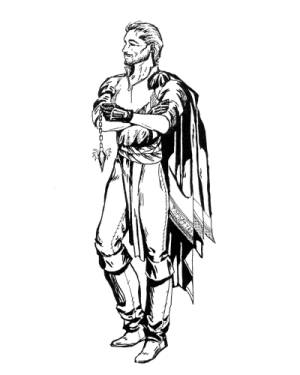
Simon was born out of wedlock. His mother was a young waitress at a restaurant in the town of Magellan, not far from the capital of Lazlo. She always refused to say who his biological father was, except to say that he was from Lazlo. When Simon was three, his mother married a local shopkeeper. The two of them had several more children. Simon always considered his mothers husband his dad, and all his half brothers and half sisters considered him just the eldest child.
Simon showed his great intelligence early. After 3 years of school, he was studying with the 6th graders and it was becoming very clear that his small town school could not do justice to such a gifted child. At age 9 his parents applied for a scholarship to the Winterbourn academy, a prestigious private boarding school in Lazlo. Each year Winterbourn awarded two full scholarships to children who would not normally be able to afford such a school.
His dad took him to Lazlo on the train. Along with the scholarship application his dad submitted three letters of recommendation. Simon knew that one was from his school principal, and one was from his parish priest. The third letter Simon never had an opportunity to examine. His dad refused to say anything about it to him. The letter was written on vellum, and had an ornate seal. The Winterbourn headmaster was visibly impressed with the seal and signature, and at one point made mention of the letter from �his excellency�. Simon suspects that the letter of recommendation may have been written by his biological father. It is the only such incident in his life that he can recall where he thinks his biological father may have been involved. Years latter, Simon had an opportunity to covertly examine his application packet, but the third letter was missing.
There were 9 kids competing for the two scholarships that year. The faculty examined the children for 3 days, not so much testing what they knew, but how they learned. Simon easily won a place.
He enjoyed his days at Winterbourn immensely. The curriculum was challenging, and his home town was close enough that he could return home on every extended school holiday. He always received top marks in math�s and sciences, and in other subjects received marks ranging from good to exemplary. After two years, a teacher thought to have Simon tested for magical talent. He scored off the charts, and the next term the Winterbourn headmaster arranged for him to transfer to a different boarding school, the Longfellow academy.
Longfellow, is even more expensive and prestigious than Winterbourn, and does not normally offer scholarships, but it is not totally unknown for them to accept charity students. The new school had two instructors who taught magic. Not everybody at Longfellow was studying magic, but Longfellow was one of the few schools where magic was on the curriculum.
For the first time in his life, Simon studied a subject that truly challenged him. Most other subjects came easily to him. They were simply a matter of assimilating information, understanding where it fit, and making use of it. Simon was good at that. Magic was different. The underlying principals are not intuitive. There is a force in magic, and that force does not want to be understood. The principals of magic can not be learned, or taught, or recorded in a book. They have to be discovered anew by each mage who dares to try.
Most spell casters learn their magic by rote. Almost anybody can be taught to cast a few simple spells in the right circumstance, but it is a rare mind that does not go insane trying to understand magic. Simon had trouble in his magic classes. The instructors taught the students to learn by rote, and not to even try to understand the underlying principles of the spells. Simon learned a few spells that way, but it was difficult and unsatisfying. He wanted to learn how magic worked, not just how to work magic!
Against his instructors advice, Simon embarked on a study of the underlying principles of magic. At the start of his third year at Longfellows, he signed up for no classes or lectures, He immersed himself in self-guided study of magic. For 14 months he studied, fasted, meditated, and studied more. Simon worked right through the school holidays and had practically no contact with anybody except the magic instructors, who did not so much instruct him in his quest, as attempt to guild him and keep him alive and sane. At the end of 14 months, he emerged half starved, but with an understanding of the principals behind spells of the college of communication and empathy and the college of mind control. His understanding allowed him to learn spells within those colleges well and easily. Since then he has added over a dozen colleges to his repertory, and each new college is easier to learn than the previous.
During those times of his life when he engages in meditations and fasting, he often has visions, nightmares almost, that leave him in cold sweats. The imagery of these nightmares vary, but they always feature the number thirteen. Sometimes 13 wolves hunt him through a wilderness. Sometimes he chokes after eating 13 cherries. Sometimes he falls from a 13th floor window. He has come to dread the number 13. The last two times a spell of his resulted in a serious critical failure, it was a Friday the 13th each time. Now he refuses to attempt spells or any critical or important function on a Friday the 13th. He refuses to sit in a 13th row, or a 13th seat. He will not start any important task on the 13th day of the month, and always stays home on a Friday the 13th. He has been known to rewrite mathematical formula to avoid the number 13. He is convinced that someday, 13 will kill him.
Aside from his 14 month immersion in the study of magic, his years at Longfellow were pleasant and typical. He made many good friends. Many of his school chums were the sons and daughters of the rich and powerful, and many have since gone on to become rich and powerful in their own right. While never more than average at most sports, he was captain of the chess club, and a valued member of the drama club where he worked as both an actor, and a lighting designer.
After Longfellow, Simon moved on to the University of Lazlo, again on a scholarship. While he continued to be active in drama, his scholastic interest, which had always been broad began to focus. He developed a passion for history: recent, pre-rifts, and ancient. He also continued his studies of magic. His two fields of studies overlapped as he developed a great store of knowledge in the history of magic. By the time he earned his masters degrees (in history and magic), he was well on his way to becoming a world class expert on the history of magic.
He had his life planned out in front of him. Duel doctorates by age 25, a research fellowship immediately after, teaching, professorship, and tenure by 33. Then disaster (of a sort) struck, and almost made hash of his carefully laid plans. One year he failed to win his scholarship! It was awarded to another student! Nether Simon nor his parents had enough money for him to continue school and earn his Ph.D. without a scholarship. Simon was forced to quit school and get a full time job.
Later on Simon figured out that he lost his scholarship, not due to any lack of excellence in his scholarly work, but because he had been taken by surprise and outmaneuvered politically. The student who won his scholarship had worked the politics of the situation while Simon was resting on his academic laurels. From that time on, Simon spent more time on interpersonal relationships, and personal politics.
Simon got a full time job at an alchemy firm. He had studied alchemy in school, and his natural intelligence put him on par with alchemists who were a dozen years his senior. Still, he found the work boring and repetitive. He only kept that job a few months. He knew that the same problem would plague him if he accepted a job as an enchanter, and avoided jobs in that career. He finally found an enjoyable job with the court system as a caster of the Truthsayer and Compel Truth spells. He found the give and take of the legal system stimulating. He supplemented his income by casting spells for hire, and selling powerstones and staves.
Once he was out of the education system, Simon found that it was difficult to get back in. It took him two years before he was able to save enough money to re-enter the university. Once enrolled, he was able to win a scholarship again and resume his interupted studies. This time he did not neglect the political side of university life.
One rather unusual decision he made was to study forgery and the forensic sciences of detecting forgeries. It is horrifying how much knowledge was lost in the cataclysm. Scholars are desperately trying to fill in the huge gaps in our knowledge. Scholars are urgently searching for all sorts of documents. The antiquarians whose business it is to supply those documents sometimes find it easier to make the documents than to unearth them. Simon has devastated scholars competing for the same academic honors with a well timed revelation that critical documents that they have based their work on are forgeries.
Simon uses his magic to support his scholarship. The ancient history spell, and other information spells allow him to skip untold hours of painstaking research. The gift of letters spell allows him to translate many ancient documents effortlessly.
At the age of 26, Simon earned his Ph.D. in History, one year later he earned his Ph.D. in Magic. Simon was able to parlay his Ph.D.s into appointments at the university. First a teaching appointment. Then an assistant professorship and a research fellowship within the history department. Years later he was awarded a full professorship, tenure, and eventually a department chairmanship.
As the years went by, he drifted in and out of relationships with various women, but none lasted more than a few years. He has two children, but both grew up with thier mothers. At age 43 He learning that his mother was sick. His dad had died in an accident the year before, and his mother took the loss hard. All during his school and life in Lazlo, he had kept close to his family and visited often. His mother was now 61, and her health was failing. He had a good amount of money saved up, but normal medicine could not save her from her lingering illness, and nobody in the family had enough money to pay for long term magical treatment. Simon knew he could learn the spells required to save his mother. Simon took a sabbatical and started to study medicine and spells from the school of medicine. Unfortunately, his mother faded much faster than predicted, and died before Simon could learn any spells that would have been useful too her.
With his mothers death, Simon again wondered who his biological father was. He had not pressed the point while she was alive out of respect for her wishes, but with her gone, he embarked on a small private research project. He examined all the papers of his parents and his life, but was able to find no clue. He realizes that unless his biological father is a mage, or is rich enough to afford regular magical rejuvenation, that his father is most likely dead. Still, he is curious.
After his mother died, Simons interest in medicine waned and he resumed his historical scholarly pursuits. His studies during that year had many beneficial effects. Chief among them, he now knew spells that people would pay very serious money to have cast. Simon can only cast Youth unassisted when within a nexus during an astronomical event, but with the assistance of just 1 other mage (and several powerstones) can cast it several times within a leyline during an astronomical event. This became something of a cash cow for Simon. Every equinox or solstice, a college and himself would go to a ley line and cast youth on 5 or 6 high paying customers. If for some reason they did not have a full 6 customers, they would cast it upon themselves as well. In that way Simon brought his apparent age down to 35 years old, and with the help of the Youth and Halt aging spells, maintains it there.
Simon enjoys teaching, but likes to divide his time with research. For the last several years he has been dividing his time as follows. Fall semester, primarily teaching. Spring semester, a balance of teaching and research. Summer semester, primarily research.
Simon�s position is within the history department, but he maintains strong ties with the collage of magic. His specialty (history of magic) is interdisciplinary, and of more practical interest to the collage of magic than to the historians. Simon is consulted frequently by his colleagues within the collage of magic, and his classes on the history of magic are very popular as humanities credits for students in the college of magic.
Simon still maintains lecture notes on about 10 courses. The following courses are among his favorites. �History of magic, an overview�: He always tough at least one class of this freshman level course every spring and fall semester. �Magic and early civilizations�: This sophomore level course compares and contrasts magic within early Greek, Gaelic, Egyptian, Incan, African, Native American and other cultures. One class is offered every year. His current favorite topic is �Magic in prehistoric Greece�. He taught a graduate level class on the subject every two years. He plans on continuing to teach this course even though he is now semi-retired from teaching.
Simon has a very comfortable life back at the university of Lazlo. He enjoys his teaching. He believes his research is important, and of genuine value to the human race and to the world. He enjoys being around the young college students with their energy and enthusiasm. He is active in campus life. He acts as mentor to many students. He attends collegiate sporting events. During his leisure time he reads a wide and eclectic selection of books, usually biographies or books on various topics within the humanities, but sometimes scientific texts or literature. For a special treat he will occasionally reward himself with a good murder mystery. He supplements his modest scholars income with casting quick and profitable spells such as Youth and halt aging, and manufacturing powerstones and staves. He has even been known to accept a small fee for allowing students to use the hawk flight spell for recreation.
Even with his parents dead, Simon still visits frequently with his half brothers and sisters. Lately he has noticed a gulf growing between them. Simon was always the eldest. Now they are all entering old age, but Simon still looks middle aged. It is a strain. Nor does Simon feel totally comfortable with his nieces and nephews. He looks to be the same age as them, but his cultural references are a generation older.
Simon has been researching prehistoric Greece. The ancient Greeks had many interesting ideas of magic. many of them have turned out to be 100 percent accurate. There is no doubt that the ancient Greeks had access to some very good magical knowledge. On the other hand, in most legends, the mages were not Greeks, but foreigners. Simon is trying to track down Greek magic traditions, and trying to figure out where it came from.
In his studies Simon came upon a description of a large stone box, containing 24 stone tablets. The box was unearthed in an archaeological dig on Corfu in 1853 and eventually found its way into the permanent collection at the Victoria and Albert museum in London. The scholars of the day were initially very excited, as the carefully preserved engravings had all the hallmarks of a major find. They were greatly disappointed when the initial rough translation reveled the text to be nothing but what they took to be a badly told fable. Full of monsters, wizards, and magical portals to other worlds. The stone box was soon relegated to a footnote in the annals of serious scholarship, of no interest to anybody except those who studied ancient fables.
The reference that Simon found to the box included a reproduction of a section of one of the 24 tablets. Simon translated the section, and found that it very accurately described a RIFT! These tablets might describe RIFTs that opened into our world over 5000 years ago! If this is true, it is a totally new discovery. Nobody has any knowledge of any RIFTs opening prior to the cataclysm! The summary of the �fable� includes a comment that the fable was not very good, because the author went into extensive, arcane, and boring detail about how the heroes closed the magic portals and kept any more from opening. If these tablets do contain a way to keep new RIFTs from opening, their discovery would be the most important archaeological find of the millennium! Even if they did not contain a cure for RIFTs, a description of a previous outbreak of RIFTs would be of great importance.
Simon has spent years researching all that could be learned of the stone box. He has found 19th century translations of sections, and reproductions of other sections. But he has not been able to discover the majority of the text. The more fragments of information he finds, the more excited he becomes, and the more convinced he is of the boxes importance.
Finally he stumbled onto a breakthrough. While the box was of little apparent scholarly value, it did look impressive. He learned that the V&A had added the box to a traveling exhibit that toured various parts of the world, and that at the time of the cataclysm, the exhibit was in the museum of a small collage in what is now Windheim! Simon was so excited he almost set out for Windheim that day! He calmed himself, and spent months doing what research he could on Windheim. He quickly learned that the only pre-RIFTs building surviving in that town was the cathedral. In fact, he could find out very little about pre-RIFTs Windheim.
The most galling lack of success has been in finding a map of pre-RIFTs Windheim. He searched for months, but could not find one. He needs to know where the college was! All he was able to determine was that the college administration building was on a bluff overlooking a good size river. Unfortunately, currently there is no running water bigger than a large creek for dozens of miles!
So Simon�s task is thus: Find where the river used to be. Find where the college used to be. Find where the museum used to be. See if there is a stone box there. Retrieve the box. Translate the tablets. Publish the most important historic/archaeological/magic paper(s) of the century.
Simon is getting tired of his academic life. He has resigned his department chairmanship, and arranged a multi-year sabbatical. He plans on spending a few years as an antiquarian and archeologist. He wants to find the stone box and any other historical artifacts he can find.