 |
 |
 |
| Before long Bass became interested in horse racing, and in 1874, he acquired a mare that became known as the Denton Mare. He left the job with Egan to race his mare and won most of his races in North Texas, before moving on to the San Antonio area. When his racing played out in 1876, he and Joel Collins gathered a small herd of longhorn cattle belonging to several different ranchers to take to Dodge City to be sold. Arriving in Dodge City the two men decided to trail the cattle farther north, where prices were higher. After selling the herd and paying the hands, they had $8,000 in their pockets, but instead of returning to Texas, where they owed the owners for the cattle, they squandered the money drinking and gambling in Ogallala, Nebraska, and in the Black Hills town of Deadwood, South Dakota, which was then a booming gold mining town. In 1877 Bass tried his hand at freighting again but had little success so he recruited a group of men including Joel Collins, Jack Davis and another man known only as Nixon and three others and turned to robbing stage coaches. Known as the "Black Hills Bandits," they held up seven stages over the next few months but soon tired of the small payoffs from the stage robberies. Sam wanted a large payday and turned his attention to the more lucrative crime of train robbing. Their first train job took place at Big Spring Station, Nebraska at 10:48 P.M. on September 18, 1877. The bandits forced the stationmaster to signal the coming Eastbound Union Pacific passenger train train to stop and boarded it. Finding some wooden boxes, the bandits broke them open revealing $60,000 worth of freshly minted $20 gold pieces shipped from the San Francisco Mint to an Eastern bank. The robbery in all netted them $60,000 in twenty-dollar gold pieces and $1,300 in paper money, plus four gold watches from the passengers. The bandits divided the gold coins six ways and split up in pairs. Joel Collins and his partner were shot and killed a week later. Another pair, composed of James Berry and Nixon, split up thinking their chances were better, but Berry was captured, Nixon, escaped and is assumed, to have went to Canada. Sam and Jack Davis, rode South in a one horse buggy, their share of the loot stashed under the buggy seat, disguised as farmer's and made it back to Texas. |
| "Texas' Beloved Bandit" |
| Sam Bass |
| The Great Chase Begins |
| Back in Denton, Bass formed another gang staffed by Frank Jackson, Seaborn Barnes, Thomas Spotswood, Arkansas Johnson, Henry Underwood, Sam Pipes and Albert Herndon and set up camp in Cove Hollow, a six-mile long ravine complete with caves, and dense undergrowth. He and his gang began robbing stagecoaches again. In December of 1877, they robbed a Fort Worth stage, and got only $11. Two months later, another stage robbery gained about $70 and a couple of gold watches. Being of an aspiring nature, Bass was not content with the meager returns of stage robberies, and past experience believed only train robberies would ever net them any sizable amounts of cash. Bass looking the area over saw that Allen Station promised the greatest accessibility and the best avenues of escape. Tom Spotswood a Denton County resident was familiar with the surrounding country, so Sam laid out his plan for the robbery. On February 22, 1878, the Bass Gang stood up the Texas Central train #4 at Allen Station. This holdup netted the gang $1,280.00 according to the robbers themselves. "It is believed that the robbers intended to catch the Central pay train, but missing it, grabbed the express train instead. The pay train had passed more than nine hours ahead of it. Bass split the loot and Spotswood, not being the smartest man in the world returned home which was only fifteen miles from the robbery. He was promptly pointed out by the express messenger as being the leader of the gang that boarded the train that night and was arrested by George Drennan, the deputy sheriff of Denton County. On March 18th they again held up the Texas Central, this time at Hutchins. The Texas and Pacific Railroad was hit on April 4th at Eagle Ford and again on the 10th at Mesquite. Only the first robbery resulted in any significant payoff for the gang. The robberies were getting on the nerves of the Texas The Governor who decided to call in the Texas Rangers to capture the bandits. |
| The Texas Rangers, sensing the threat that their organization might be disbanded at any time chose to respond by proving that they were still an effective deterrent to crime. Bass was going to become an example, and they set out to capture him at any cost. The Bass gang was not going to be easyly captured and led the Rangers on long chases with many narrow escapes. The gang, relyed on Sam's thorough knowledge of the back trails and thickets and would suddenly surface in an area only to disappear at the first sign of trouble. The gang's success in avoiding capture was troubling the Rangers and begining to make them look as if they could not do their job after all. In a desperate attempt to flush the gang out, the Rangers conducted a sweep of all residents suspected of asisting the bandits, and arrested Jim Murphy in the process. Jim was taken to Tyler to face charges of robbery and facing a long prison term decided to seek immunity with an interest in collecting the reward money for helping to capture Bass. Jim agreed to rejoin the Bass Gang and betray Sam to the Rangers.The first clash occurred on April 29 at Cove Hollow. The Rangers, under the direction of Captain Lee Hall, were able to take the gang by surprise while they were resting at Jim Murphy's house. Fleeing the Rangers, Bass was struck twice, once in his cartridge belt and another in the stock of his rifle, but not injured. Undaunted, Sam was soon living it up in the North Texas towns. In June, a posse challenged the gang to a gunfight in which Arkansas Johnson was killed and Henry Underwood rode off never to return. Jim Murphy was looking for a chance to betray the gang to the Rangers, and with the news they were heading to Round Rock and rob the bank, slipped away and sent information to the Rangers of their intentions. |
| Major Jones, surprised to hear the gang was moving south, immediately directed Rangers Dick Ware, Chris Conner and George Harold to proceed to Round Rock and be on the lookout for the Bass Gang. He then rode to Round Rock with deputy sheriff Morris Moore of Travis County. Sam, Frank Jackson, Seaborn Barnes and Jim Murphy arrived in Round Rock Sunday night July 14. Monday they went into the town to case the bank. Sam and Seaborn were for stealing some fresh horses and hitting the bank as soon as possible. Murphy, stalling for time, suggested that stealing horses would only raise suspicions and that they should rest their horses and then rob the bank on Saturday. After discussion, the gang decided that the robbery would occur at 3:30 P.M. on Saturday, July 20. On Friday the 19th, Sam, Frank and Seaborn went into New Town to case the bank one final time,Murphy had stayed behind in Old Town. As the bandits went to Kopperal's store, they were observed by Morris Moore, a Travis County deputy sheriff, and Deputy Sheriff Grimes of Williamson County. At the time not knowing who they were Deputy Sheriff Grimes, indicated that he believed that one of the strangers was wearing a pistol, which was supposedly against the law in Round Rock. Grimes decided to investigate the strangers' intentions. Walking up to the bandits who were purchasing tobacco in the store, Grimes asked Sam, "Do you have a pistol?" to which Sam is said to have answered "yes," and with his answer Frank and Seaborn opened fire on Grimes, killing him instantly. Grimes never drew his gun as six bullet's found their mark. Moore, who had been waiting outside the door of the Store, entered and opened fire on the bandits, shooting Bass through the hand. He was then shot in the chest, by one of the bandits. The shooting had attracted the attention of Ranger Ware, who ran to the street, and for a time, single handedly fought the fleeing bandits. The firing had also attracted the attention of Major Jones, teaming up with Ranger Ware, Jones fired what was considered to be his only shot as a Texas Ranger at the fleeing gang. The bandits returned the fire, missing Jones but lodging a bullet in the stone wall behind him. Ranger Harold and a local citizen named Conner were now shooting at the gang with rifles. It was at this point that Harold believes he inflicted the mortal wound on Bass. Simultaneously, Seaborn Barnes fell dead with a bullet wound to the head. With Seaborn dead in front of him and his leader Bass injured, it is said that Frank Jackson coolly held the Rangers at bay with his gun as he helped Sam to his horse. Jim Murphy, who had stayed behind in Old Town during the shootout, reported that he saw Sam and Frank come up the street on their way to their camp, which was near the Round Rock Cemetery. Sam was being held in the saddle by Frank while he reloaded his pistol. After picking up their things at camp, they turned up Georgetown Road, then headed towards the woods. It was at this point that Sam indicated that he was in too much pain to continue. Sam insisted that Frank leave him there and try to save himself. Frank did not want to leave, but he was eventually persuaded to do so. Sam gave him all of his money, guns, ammunition and his big bay horse, which was superior to Frank's. Frank left his horse with Sam and rode off. Jim Murphy later went into New Town and identified the body of Seaborn Barnes. No great effort was made to pursue the fleeing bandits for fear that Bass was supported by an army of outlaws who would ambush any posse that came looking. Saturday morning, two searchers, Tucker and Lane, spotted a man propped up against a tree but assumed that he was only one of the railroad workers. Tucker eventually went up to him and Sam held up his hand and uttered, "I am Sam Bass, the man that has been wanted so long." Jim Murphy was summoned and identified Sam while hiding behind a tree. The Rangers put Sam in the back of a wagon and took him back to Round Rock. The dying Bass was placed in a small shack located on the lot at the intersection Main Street and Mays. Major Jones questioned Bass but was unable to get any useful information about the other members of his gang. Bass's code of ethics was summed up by his statement: "it is against my profession to blow on my pals. If a man knows anything he ought to die with it in him," referring to his unwillingness to cooperate with the Rangers even though he knew that he was going to die. On Sunday, July 21, 1878, the doctor told Sam that it would not be long; Sam supposedly said, "Let me go", and a few minutes later opened his eyes and exclaimed, "The world is bobbing around me" and then died at 3:58 on his twenty-seventh birthday. |
|
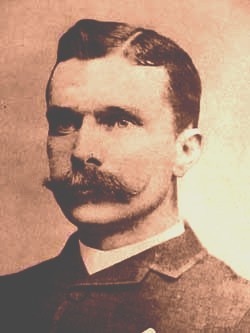 |
| "It is ag'in' my profession to blow on my pals" |
| Sam Bass, was born on a farm near Mitchell, Indiana, on July 21, 1851, to Daniel and Elizabeth Jane Bass. He was orphaned before he was thirteen and spent five years along with his brother and sisters on a nearby farm with their uncle and his nine children. In 1869 Sam had enough of the farm life and left home working most of a year in a sawmill at Rosedale, Mississippi. Bass left Rosedale on horseback for the cattle country in the summer of 1870 along with Scott Mayes and arrived in Denton, Texas, in early fall of that year. With winter coming on he took a job at the ranch of Bob Carruth's, a few miles from Denton. Sam always wanted to become a Cowboy but it didn't take long for him to realize that he was not cut out to be one. Quitting his job at the ranch he found work back in Denton handling horses for The Lacy Hotel. Later he worked for Sheriff William F. Egan, caring for livestock, cutting firewood, building fences, and spending much of his time as a freighter between Denton and the railroad towns of Dallas and Sherman. |
|
|
| 1851 1878 Died on his Birthday |