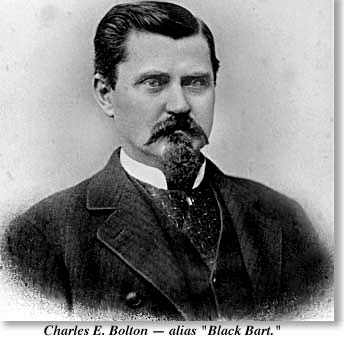
| Charles E. Bolton (Boles), born in Norfolk Co. England in 1829. At the age of two he migrated with his parents to Alexandria township, Jefferson County, in upstate New York. His father John Boles farmed their homestead� which lay 4 miles north of Plessis village, toward Alexandria Bay. �� His first robbery occurred on July 26, 1875, when he stopped the Sonora-Milton coach driven by John Shine. With the stage laboring up an incline, Shine encountered the hooded robber. "If he dares shoot" barked the thief, "give him a solid volley, boys." Protruding from bushes were what appeared to be six rifles, so Shine quickly complied by tossing down the strongbox and warning his five passengers to refrain from doing anything stupid. Bart then suggested that Shine drive off. Later, when Shine returned, he discovered that the six rifles were nothing more than sticks pointing toward the trail. ��� Bart, was an outlaw who delighted newspaper readers with his poetry and outraged Wells Fargo stagecoach lines by holding up 28 stagecoaches between 1875 and 1883, always in the same manner. Bart would wait until the coach neared the top of some hill where it would be going slow, then jump from his hiding spot and tell� them to "Throw down the box!"� then disappear. Because of his poetry, his polite manner to passengers, Black Bart was called "The Gentleman Bandit." ��� The Bandit for some reason never robbed anyone except Wells Fargo and� Chief of Detectives James Hume of San Francisco, set out with a passion to bring this man in. Hume's worked day and night only to come up empty handed. Bart would simply leave no clues, only a poem. |
| One of the most interesting stagecoach robbers and personalities was that of Black Bart, whose real name is said to be C.E. Bolton who was a resident of San Francisco. His usual practice was to leave his home in the bay city and take the evening boat for Stockton, arriving in the river town the following morning. Then he would usually walk forty miles into the mountains by night time. The next day he would rob a stage and the only evidence he would leave would be a �poem� in which there was some humor and occasionally a vulgar line. He was therefore known as the poetic robber. I've labored long and hard for bread, For honor and for riches But on my corns too long you've tread You fine haired sons of bitches. "Black Bart, the P08" |
 |
| Black Bart |
 |
| Robberies continued to plague Wells Fargo coaches. On July 25, 1878, Bart struck for the 5th time when he halted the Quincy Oroville stage, and once more a poem awaited local authorities when they arrived at the scene and looked into the box: "Here I lay me down to sleep, To wait the coming morrow Perhaps success, perhaps defeat, And everlasting sorrow Let come what will I'll try it on, My condition can't be worse And if there's money in that box, 'Tis money in my purse! ��������������������������������������������������������������� Black Bart, the P08 � Five days later, the Laporte Oroville stage fell victim, followed by two more robberies in October. Bart was becoming a major headache for Hume's, who could never land any solid information about his quarry other than the taunting verses. After a robbery in which Bart got little for his effort, he left another humorous poem. So here I've stood while wind and rain, Have set the trees a-sobbin And risked my life for that damned stage, � That wasn't worth the robbin. " |
| Hume's worked feverishly attempting to run down his man, but he lacked even a description of the man. �� The robberies continued to pester Wells Fargo stagecoaches while Hume and others attempted to track down Bart, but the thief made their work hard since he held up stages in no apparent pattern. He might stop two or three in a row, then disappear for six months. � On September 2, 1880, one day after a man robbed the Weaverville Redding stage, a stranger with graying brown hair and blue eyes stopped at a ranch on Eagle Creek for breakfast. When questioned, the rancher indicated merely that the man had been extremely polite. |
| Black Bart's crime spree began to unravel with his robbery on November 3, 1883, of the Sonora-Milton stagecoach. He spent the night before the heist at an inn operated by Madame Rolleri. � Also stopping at the inn was the stagecoach driven by Reason McConnell, On the morning of November 3, Rolleri's young son Jimmy� asked if he could hitch a ride with McConnell. The driver readily agreed and told Jimmy to bring along his rifle to do a little hunting along the way. When the stage reached Funk Mountain, Jimmy jumped off to hunt while McConnell drove up the steep hillside. As the stage neared the top, Bart as usual jumped from his hiding place. �� Bart ordered McConnell to walk down the road while he opened the strongbox. Not far away, McConnell ran into Jimmy, who was hunting.� McConnell took the� rifle and fired two shots at Bart missed. |
| Detectives rushed to� Funk Mountain to try to locate Bart and combed the mountain for clues, finding for the first time some evidence that included a� hat, a belt, a binocular case, a flour sack and a bloodstained handkerchief with a laundry mark in one corner reading, "F.X.O.7."� Detective� Morse started checking out every San Francisco laundry, and there were many but his determination paid off when he walked into the California Laundry. The mark was� identified by� the laundry and the handkerchief as, belonging to a CE Bolton who was staying at the Webb House. |
| The San Francisco police force staked out the Webb House, and a short while later, Bolton came walking up the street toward the hotel. Bolton� was� arrested and arraigned in Calaveras County. �� On November 17, Bolton pled guilty and received a six-year sentence in the state prison, reduced to four and one half� years for good behavior. �� Bolton was sent to San Quentin on November 21, 1883, where he served his sentence and was released on January 21, 1888. Bart disappeared soon after and nothing more was heard from him. Word spread that he lived� in either Mexico City, New Orleans or St. Louis but no one knew for sure. All that is known is that upon his release from San Quentin, Black Bart moved into a rooming house in San Francisco. In February, the room was found empty and abandoned. Reporters and writers had the outlaw living in hundreds of different places and robbing stages, but it was never proved that he did. Bart was never seen again. As was his mysterious way, Black Bart simply vanished like an apparition this time forever. Today the legend looms on, undoubtedly the way the bandit would have wanted it. |
|
|
|
|
|
| A Few Facts |
|
| Black Bart's used the name C.E. Bolton but was listed in a family bible as Boles. He was a Civil War veteran, having been affiliated with Company B, 116th Illinois Infantry. He said that he never used a loaded gun during his robberies. Wells Fargo only prosecuted him for the last robbery he committed. Its been said that he died in 1917, but no one knows for sure. Bart would never take a ladies belongings during a robbery. |
 |
|
 |