NORMANDY
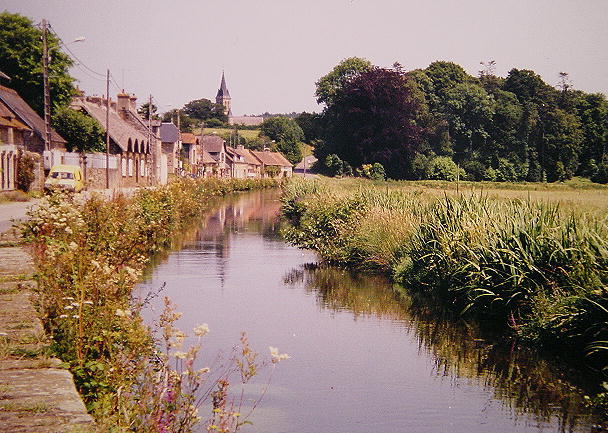
The best way to see any land is by bicycle. Pedaling around Normandy is full of delightful surprises. In this peaceful little village in the Contentin Peninsula for example, you can find brioches the size of a
small birthday cake.
 Normandy is a very old and historic land. It is lush
and green and in some areas surprisingly rural.
The Norman Invasion of England, which was launched from here, changed western
history. But a more recent invasion, in 1944, was
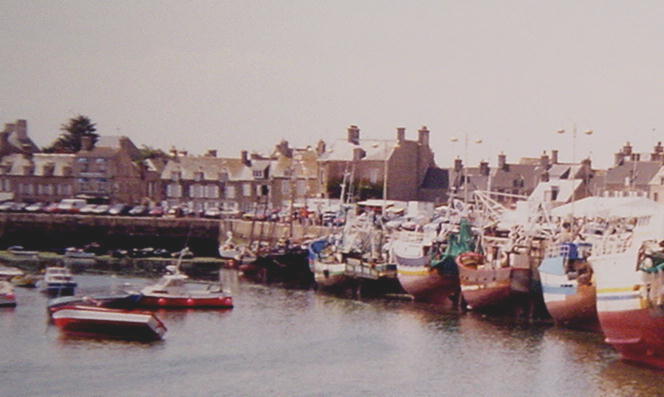
certainly the pivotal point of the last century. A pivotal point of this event was this small harbour town, St. Vaast la Hougue. Normandy is a very old and historic land. It is lush
and green and in some areas surprisingly rural.
The Norman Invasion of England, which was launched from here, changed western
history. But a more recent invasion, in 1944, was
certainly the pivotal point of the last century. A pivotal point of this event was this small harbour town, St. Vaast la Hougue.
The small port of St.
Vaast l'Hougue was the first port
in France to be liberated. Old photographs show small ships in port and huge heaps of
materiels de
guerre piled as high as the rooftops filling
the quays. Now bags of
mussels; moules are the most common cargo
unloaded.
Not to be missed in St.Vaast are
the restaurants lining the quays. The seafood leaps
the twenty yards from the boats to the tables. Naturally they serve
beer too.
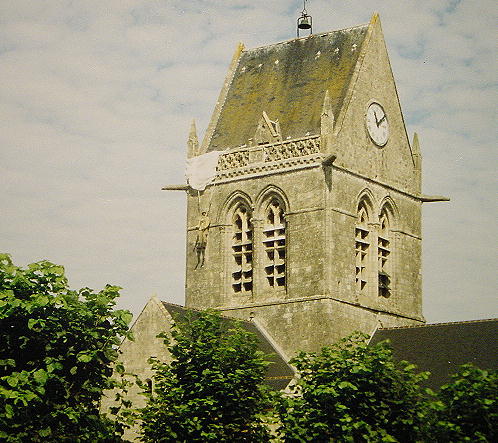 In the early morning of June 6,1944 in the
small town of Ste. M�re Eglise Private
John Steele, a member of a parachute detachment dropping by mistake in
the town square fouled his parachute on the church
spire. He hung there in full view of the Germans for
several hours while members of his unit were killed
and captured. The allies eventually took the town. He
survived to have a bar named after
him. The town commemorates this event by hanging a
parachute and a life-sized figure there. In the early morning of June 6,1944 in the
small town of Ste. M�re Eglise Private
John Steele, a member of a parachute detachment dropping by mistake in
the town square fouled his parachute on the church
spire. He hung there in full view of the Germans for
several hours while members of his unit were killed
and captured. The allies eventually took the town. He
survived to have a bar named after
him. The town commemorates this event by hanging a
parachute and a life-sized figure there.
Very often there is a veteran with
a small van in the square before the church. He
pretends to paint it, continually moving about
rearranging the easle and paints etc. although he
actually painted the picture many years ago. He will
be glad to sell you a copy, which he just happens to have in the van.
Nearby in
the town is a wonderful outdoor museum featuring an
DC-3 aircraft, the "goony bird", as well as a walk-in glider. The gliders were
not solid, just fabric stretched over struts. Even the floor was stretched fabric. You could not walk on it, especially while in the air. It
must have felt like being in a flying tent. 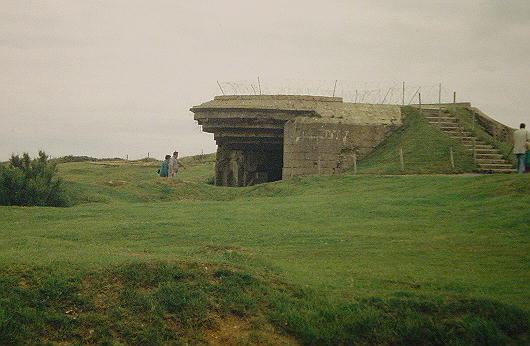 The gliders landed inland but the bulk of the forces landed on the beaches. Waiting for the invaders were
these huge, heavily armed and armoured bunkers high on the cliffs
overlooking the beaches. Ugly but simply too massive to ever
demolish. The gliders landed inland but the bulk of the forces landed on the beaches. Waiting for the invaders were
these huge, heavily armed and armoured bunkers high on the cliffs
overlooking the beaches. Ugly but simply too massive to ever
demolish.
Shortly after John Steele's ordeal began
thousands of men started wading ashore here on Omaha
Beach. Only after several hours of struggle were the troups able to escape this
beach and the deadly fire directed at it from huge casemates like this one. Today it
is overlooked by the American Cemetery, one of the
most beautiful and serene places in the world. 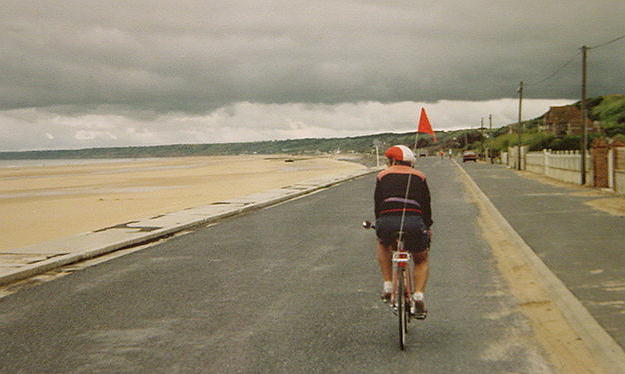
My friend and colleague Gerry
Brooks cycles
along Omaha Beach on a grey day very much like June
6. 1944. Remnants of an artificial harbour can
still be seen in the water. In the distance is the
monument and beside it a restaurant with hot
soup.
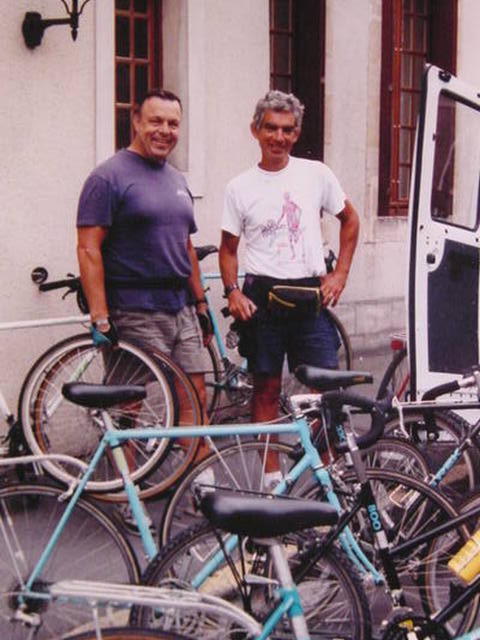
Trip's over
Gerry and Tod
load bikes. HOME |