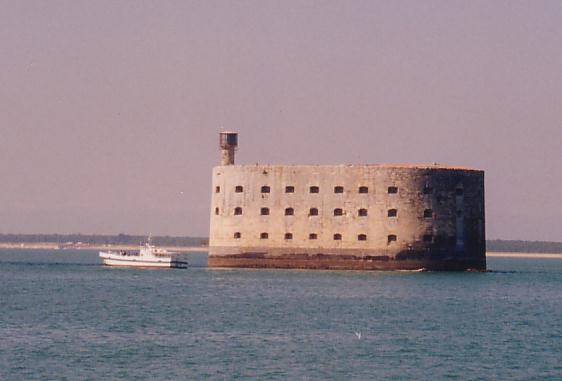
 In 1661 the architect Colbert, at the request of Louis XIV, built the nearby arsenal of Rochefort. This site was well protected, but the low depth of Charente obliged them to finish the construction of the ships in the mouth, in the shelter of the islands of Aix and Ol�ron. It was thus necessary to protect these roads from the English incursions. There were already coastal batteries on these neighboring islands, but the range of the guns was not long enough to provide a complete crossfire and left a corridor of 3000 meters where the enemy ships could enter and bombard the fortress and the ships under construction in complete safety.
It was decided to build a fort between the two islands. But, at this place there was only a high sandbar called the skirts of Boyard, making any solid construction difficult and the project was abandoned. Meanwhile the absence of defense made it possible for the English to approach and sack the island of Aix in 1757, thus showing the vulnerability of Rochefort.
In 1801, Napoleon took up the idea of building a fort on the site of the present Fort Boyard. But the fort had to be build on some sort of solid foundation such as rock. Blocks of stone were extracted the local quarries. The village of Boyardville was the base for this gigantic operation. The construction of the foundation could only be carried out for a few hours around the low tide during the warm season. Moreover, the rocks sank into the sand, under their own weight. In 1809 construction was deferred.
In 1841, work began again, using another technique. Forms were built on the spot into which cement was poured. That made it possible for the work to advance quickly and in 1848 bases were finally finished.
The construction of the Fort began the following year and was finally finished 10 years later. But since the range of the cannon had increased by then, and because England was no longer the enemy, this project was actually finished too late to be of any use.
In 1661 the architect Colbert, at the request of Louis XIV, built the nearby arsenal of Rochefort. This site was well protected, but the low depth of Charente obliged them to finish the construction of the ships in the mouth, in the shelter of the islands of Aix and Ol�ron. It was thus necessary to protect these roads from the English incursions. There were already coastal batteries on these neighboring islands, but the range of the guns was not long enough to provide a complete crossfire and left a corridor of 3000 meters where the enemy ships could enter and bombard the fortress and the ships under construction in complete safety.
It was decided to build a fort between the two islands. But, at this place there was only a high sandbar called the skirts of Boyard, making any solid construction difficult and the project was abandoned. Meanwhile the absence of defense made it possible for the English to approach and sack the island of Aix in 1757, thus showing the vulnerability of Rochefort.
In 1801, Napoleon took up the idea of building a fort on the site of the present Fort Boyard. But the fort had to be build on some sort of solid foundation such as rock. Blocks of stone were extracted the local quarries. The village of Boyardville was the base for this gigantic operation. The construction of the foundation could only be carried out for a few hours around the low tide during the warm season. Moreover, the rocks sank into the sand, under their own weight. In 1809 construction was deferred.
In 1841, work began again, using another technique. Forms were built on the spot into which cement was poured. That made it possible for the work to advance quickly and in 1848 bases were finally finished.
The construction of the Fort began the following year and was finally finished 10 years later. But since the range of the cannon had increased by then, and because England was no longer the enemy, this project was actually finished too late to be of any use.The fort is 68 meters long and 31 wide and 20 meters high. It was designed to withstand a siege. It has water cisterns of 300 000 liters, ammunition stores, stores with powder, 66 casemates, 74 guns. The garrison was to be made up of 260 men including a caterer, a laundry facility and two shoe-makers as the shoes were not expected to wear much. The construction of this fort cost the equivalent of 140 km interstate highway. Once built, the unneeded fort didn't receive the entire planned armament but only 30 cannon. The garrison were subjected to storms which shook the fort and whose waves destroyed the casemates and made the guns fall. A jetty was built in 1866 to break up the waves so that they wouldn't strike the fort with full force. Under the commune the fort was used as a prison, it was abandoned by the army in 1913. The fort became the prey of the local scavengers whenever the sea allowed the access to it. The guns were sold to two scrap merchants who removed them with dynamite ! In 1931, the fort was rented for 300F per annum. During the second world war, the Germans used the fort for target practice. In 1961 it was sold at auction for 7500F. It was then sold to Eric Aerts, a dentist living Avoriaz, for 28 000F who left the fort in its abandoned state. In 1979, E. Aerts sold the fort for 1,5 million francs, pretty good appreciation! Presently, after restoration, it is featured in the famous yearly television adventure program "Raid on Fort Boyard." |