
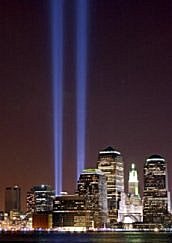
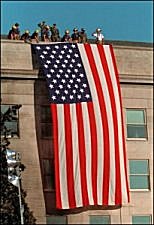
Pentagon--125
Flight 11--92
Flight 77--564
Flight 93--45
Flight 175--56
Total Lost On 911
3,012
At Logan International Airport in Boston, 175 took off on time with just 56 passengers in the big Boeing 767. It left the gate at 7:58. It's wheels were in the air by 8:15. Victor J. Saracini, an experienced 51 year old pilot who had been a Navy flier, was at the controls.
At some point, men armed with knives stabbed flight attendants, a cell phone caller from the plane said in several short calls to his father in Connecticut. Relatives of the caller, Peter Hanson, a 32 year old software execturive from Broton, told reporters that the hijackers seemed to be trying to force the crew to open the cockpit doors.
Sweeney and Ong were in the coach section of the plane. Using crew telephones, they made the calls to their colleagues on the ground, Sweeney to Woodward, a flight services manager at Logan Airport, and Ong to the airline's reservation line. Woodward said Sweeney spoke "very, very calmly, in a way which was quick but calm. She gave him the seat numbers, addresses and even credit card numbers on the reservations computer. One of the names that came up was Mohamed Atta, the man the FBI would later identify as the leader of all 19 of the September 11 hijackers.
Sweeney told Woodward the hijackers seemed to be of Middle Eastern descent and said they had gone into the cockpit with a bomb with yellow wires attached. She said they had stabbed the two first class flight attendants, Barbara Arestegui and Karen Martin, whose station at the front of the plane likely made them the first crew members to confront the hijackers. She said they had also slashed the throat of a business class passenger, who was bleeding severely.
The flight attendants gave the injured people oxygen, and made an announcement over the PA system asking if there was a doctor or nurse on board. Sweeney told Woodward the passengers in the coach section were calm and that they believed there was some type of medical emergency at the front of the plane. About 15 minutes after the women first called, the plane suddenly lurched, tilting all the way to one side, then becoming horizontal again. Ong said the plane was flying erratically, and Sweeney said it had begun a rapid descent, "For a flight attendant to say rapid descent, it's rapid and it's quick. We don't use those terms very loosely, said Woodward.
They were now nearing New York and the WTC, but on board the plane it was quiet. You didn't hear hysteria in the background. You didn't hear people screaming. Woodward asked Sweeney to look out of the window and see if she could tell what was going on. "I see the water. I see the buildings. I see buildings," she told him. On the line to Raleigh, Ong said over and over again, "Pray for us, pray for us," Gonzales and Minter assured her they were praying. Sweeney told Woodward the plane was flying very low. Then, he said, "She took a very slow, deep breath and the just said, "Oh, my God!" Very slowly, very calmly, very quietly. It wasn't in panic."
Those were the last words Woodward heard. Seconds later, he said there was a very, very loud static on the other end.
While Woodward was still holding the telephone, hoping Sweeney would come through, his operational manager came into the room and said that a plane had just crashed into the WTC.
Woodward did not make the connection immediately. "I almost at that point said, Not now, we have a serious situation here," he said. But moments later, he realized that Sweeney's flight was the one that hit the WTC.