Greg's 1966 Fender
Coronado-12 String
and some Coronado History
|
Details:
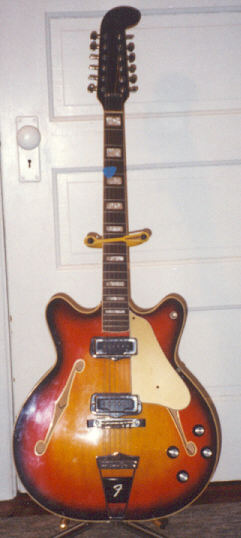
I bought this guitar in 1996 for $475. A pretty good price for a 1966
instrument, the first year of issue. The finish and parts (including that
wacky gold pickguard) are all original except for the tuners, which were
replaced with Schallers. This change was actually a blessing for this guitar,
because the modern tuners really help to keep it in tune.
I used this guitar a lot for recording and occasionally for live performances.
I used it quite a lot when I was in a Monkees cover band for all of those
Mike Nesmith songs. For a short time, I had a six string Coronado II that
matched this instrument exactly. I eventually sold it because it didn't
sound great and it would feed back like crazy.
The Coronado 12 string is very bright and jangly which tends to turn some
people off. I eventually sold this guitar for that reason. While it's a fantasic
conversation piece, it just can't compare to the sound of a Rickenbacker. This guitar is
also very top heavy and its over-sized headstock tends to tip the instrument
toward the floor if you let go! The neck felt very much the same as a Rick 360,
as it was bound. This was also a motivation for me to sell it, as the unbound
neck of the Rick 330 makes it just a tad easier to play. However, I'll really
miss this guitar, as it had a great look and a lot of character. If I ever have
the extra cash someday, I'm sure I'll get another one. Some of the custom color
models are quite beautiful and of course the Wildwoods are amazing. |
Fender Coronado History:
The Coronado family of guitars was Fender's attempt to capture part
of the market enjoyed by the Gibson ES series and the Guild Starfire series
of thinline semihollow electric guitars. It was designed by Roger Rossmeisl
(1927 - 1979), a German luthier that worked for Rickenbacker before moving
to Fender in 1962. Rossmeisl's guitar designs, such as the Rickenbacker
Combo series and Fender LTD, usually called for his trademark German carve
top. However, he chose to use a traditional arched top on the Coronado
series. The DeArmond pickups are the first non-Fender designed pickups
ever used on a Fender guitar.
The Coronados were also notable for their Wildwood finishes. Fender
injected dyes into trees before cutting them down to produce some interesting
striped color patterns. This finish was also available on the Kingsmen
acoustic guitar series. The Wildwoods were numbered from I to IV, each
number denoting a different finish style. This number appeared on the pickguard,
which was usually white with script that read, "Wildwood" followed by its
respective Roman numeral. The Wildwoods featured a more heavily laquered
neck and fancier pearloid tuning pegs. They seem to be of slightly better
contruction than the standard models.
Other finishes included sunburst, red, blue, green, white and antigua.
Some of the colored instruments had matching headstocks. Some early models
also came with checkered binding. Coronado six strings were offered with
one or two pickups and an optional tremolo unit, which was essentially
the same as the Mustang unit. The twelve string featured two pickups and
the famous "hockey stick" headstock that was also found on the Electric
XII model. Fender also made a Coronado bass, with the same body style and
two pickups. It was generally available in the same colors mentioned above.
The Coronado series ran from late 1966 to 1972 and was short lived for
two reasons: the pickups were not very
powerful, and the completely hollow design was prone to feedback. They
were also introduced at a time that most historians describe as the lowest
point of Fender quality, making them less desirable to collectors. However,
Coronados had the same comfortable neck profile as found on the late 1960s
Jazzmaster and its sound is well suited for a variety of musical styles.
There are also several collectors who seek out the Wildwood models for
their unique finishes. These instruments generally fetch more from buyers
than the standard models.
Coronado Specs:
Body: Hollow; 1-piece laminated maple top and back, laminated
maple sides; single bound top, back, and f-holes
Neck: 1-piece maple, bolt-on
Fingerboard: Indian rosewood, single bound; pearloid block markers
Number of Frets: 21
Pickguard: Gold/white/black/white plastic laminate
Bridge: Fender steel with vibrato tailpiece, chrome
Nut: Brass (non-original)
Tuners: Fender, enclosed, chrome
Pickups: Two, Fender/DeArmond single coil with adjustable pole
pieces, chrome
Controls: Tone and volume controls for each pickup, 3-way pickup
selector
Scale Length: 25 1/2 inches
Neck Width at Nut: 1 5/8 inches
Body Width at Lower Bout: 16 1/8 inches
Body Depth: 1 3/4 inches
Weight: 6.7 lb.
Return
to Greg Potter's Power Pop Page