Greg Potter's Power Pop Page!
Power
Pop Links / Greg's
Pop Bands / Guitars
/ CDR &
Tape List / Radio
/ Greg's
Favorite Albums and Reviews
Commodore
64 Links / Wacky
Packages / Weird
and Funny Links
Blank
Pages- Original Power Pop Band / Revolver-
Beatles Cover Band
1964 Fender Mustang,
Olympic White with Pearl Pickguard
and some Mustang History
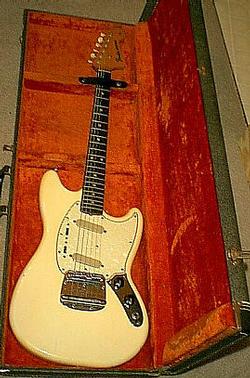
Pre-CBS Mustang, first
year of issue with original parts and original case.
|
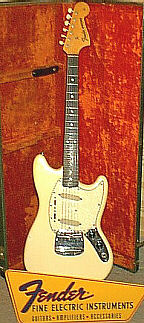 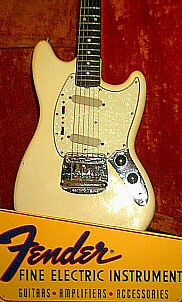
The dealer who sold this
guitar on Ebay took some nifty photos with the original case and a Fender
sign.
|
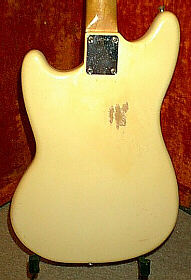 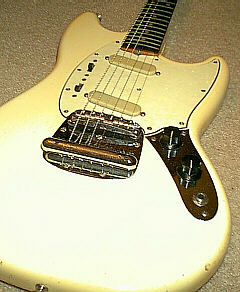
This Mustang has typical
wear for a 60s guitar, belt buckle wear on the back and some small dings
in the finish.
|
|
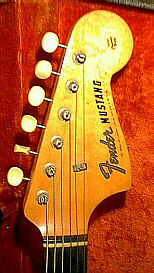 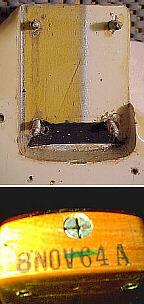
Shown here is the large
headstock introduced to the student models in 1964, with transition Fender
logo and Kluson tuners.
|
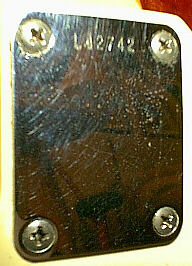 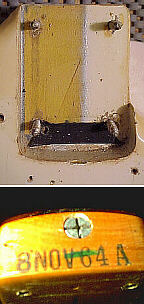
Neck date of November
1964 and L-Series serial #, L42742. The "8" describes the neck length,
which is full scale. The "A" describes the neck size, which has a very
thin profile.
|
|
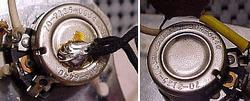
The pots on this instrument
date from the 40th week of 1964.
The pickups are dated
November 1964.
|
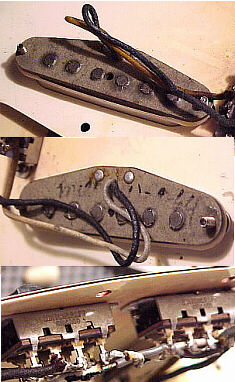
|
Details:
The guitar has its original Olympic White finish and a pearloid pickguard.
White Mustangs were generally equipped with tortoise shell pickguards,
so this is not a common color combination. It is possible that this pickguard
is not original to the instrument since they were very easy to switch and
Mustangs often seem to be victims of part swapping. However, one Fender
reference book notes that while it was quite rare, some white guitars indeed
DID leave the factory with pearl pickguards.
The pickups are originals from 1964 and the pickup covers feature a
different plastic than the later versions. They are an off-white, almost
translucent color that was used primarily in 1964. The pots are originals
from 1964 as well. The switches have since been replaced, but the originals
are still in the case.
This guitar has a tiny neck which I found
annoying to play over time, so I sold it. However, it's not common to find these instruments with an "A" neck. It feels
quite like the 1963 Musicmaster I used to own. I eventually sold my pre-CBS Musicmaster because it's
3/4 scale neck kept the guitar from resonating effectively. This guitar suffered
from the same problem. 3/4 sized guitars just don't sound as good, plain and
simple. However, collectors
make a big deal about pre-CBS Fenders and I have to admit there is something
to it. This Mustang's neck and pickups are certainly better crafted than
those on my 1966 Coronado and the 1968 Jaguar I once owned.
The sound of the instrument in not unlike that '63 Musicmaster, however
is has a bit more ring and sustain due to its slightly longer string length.
The pickups are not especially loud, but they do have that early Fender
sound. The neck pickup in phase is smooth and surprisingly thick. Mustang
owners know that one switch allows you to put the pickups out of phase,
which I don't find particularly useful. It creates a very thin sound that
isn't appropriate for many applications.
I eventually sold this instrument on Ebay for a great price and purchased a new
Gretsch Duo Jet which I use in my Beatles band
Revolver and my original band
Blank Pages.
The dealer's description from the Ebay
auction:
NOV. 1964 Fender Mustang Guitar with original hardshell case. The potentiometers
date 40th week of 1964. Neck date is
November 8 (see photos). Pickups date Nov. '64. VERY RARE early issue
of this model. Made and shipped before the CBS takeover! Also a very clean
and original example! Finished in a rare Olympic White with a VERY RARELY
SEEN pearloid pickguard combination. Usually you see the tortoise guards
on white finishes. We installed newer Switchcraft selector switches, but
the originals are included and they do work but not as good as the newer
replacements. Also, the original wire was used and the other wire on the
other compnents was not touched The pearloid guard is a really cool way
to go and I wonder why they didn't use THAT as the standard. The photos
do well in describing the condition. There are some nicks and dings and
an area on the back of the body that has some finish worn through to the
wood. Not too bad though. Has an enormous amount of character to it for
sure. Plays GREAT!!! The neck on this Mustang has a much more narrow feel
especially towards the lower frets. Has alomost a Jazzmaster feeling neck
profile. The neck is Stamped "A", which may be an indication that it has
the slimmer profile. Nice tapered feel that is very unique from most Mustangs.
The frets have some wear but still have life left in them for sure. The
hardshell case is all intact and is a darker blue than that of later Mustang
cases. The outer tolex is also more like the earlier blonde tolex in texture.
A very rough textured tolex that has the color of the Mustang cases that
were to come, but the tolex is different and darker and was possibly a
"test pattern" used here and there until the most "cost effective" flat
fabric covering was used all the time with the speckled teal color you
usually see. All in all a very unique Mustang that is a VERY early issue
and VERY playable and has a super cool "look".
Fender Mustang History:
The Fender Mustang was introduced in August 1964 before the sale of
Fender Electric instruments to CBS. The idea was to create a mid-line model
between the student grade DuoSonic, and the professional Telecaster. The
Mustang was a very popular model, and was made until 1981. Originally designed
with a 22.5" inch scale, the Mustang is almost always found with
a 24 inch scale. Early models had a slab alder body, but it was given the
patented Fender contour body in early 1969.
The earliest models include a large style headstock shape, 1 DES number,
3 patent numbers and Pat. Pending headstock decal, and Pat. Pending tailpiece.
August 1965 was the last month for these features.
The Mustang had two pickups and (usually) a 24" short scale length.
Though the scale length is longer than the original Duosonics/Musicmasters
(which had 22.5" scales), the Mustang is still considered a "student model".
Hence their value is low compared to other models. Most Mustangs have thin,
oval necks, but on early models, it is not uncommon to find Mustangs, Duo-Sonic
II's, and Musicmaster II's with larger than "normal" necks. The larger
neck with the 24" scale increases the playability/comfort factors of the guitar.
Originally the Mustang was introduced to replace the entire DuoSonic/MusicMaster
line, becoming the new Fender student model. However, the introduction
of the Mustang moved the DuoSonic/MusicMaster lines to a second generation,
24" scale length. Due to extreme backorders, all student-line Fenders stayed
intact until 1969 when demand dropped and the DuoSonic was discontinued.
Stamped dates on the bottom of the neck indicate the month and year
that neck was produced. This date does not always indicate when the guitar
was actually assembled, as the company used up parts until they were gone.
Therefore, a 1964 neck could have been added to a body sometime in 1965.
The first number of early Mustang stamps gives the scale length, 8 indicating
a full scale neck and 9 indicating 3/4 scale. The last letter gives the
neck profile. "A" necks usually have a thin profile and "B"s are generally
larger and fatter necks.
Originally Mustangs were available in red, white and blue finishes.
The red finish was called Dakota, the blue was called Sonic and the white
was Olympic. Red and blue guitars received white pearloid pickguards and
white guitars were generally equipped with toroise shell pickguards. There
were some custom color Mustangs produced and some sunburst instuments were
also produced in the 1960s.
In 1969 the Competition Mustangs were introduced, available in blue,
red, green and orange with racing stripes painted across the front on the
instrument. These guitars often had painted headstocks that matched the
body color. In the 1970s as more natural finishes gained popularity, Mustangs
were available in blonde, walnut, black and sunburst finishes.
The instrument has always featured two slanted, single coil pickups
with solid pickup covers. Very early models feature an off-white almost
translucent pickup cover. The more common later versions are solid black,
featured on red and blue models and solid white, which was common with
white finishes. Due to low output from their pickups, many Mustangs have
been modified with humbucking pickups or higher output single coils.
Fender introduced a new tremolo system with the Mustang that was based
on a typical Bigsby. The Mustang featured a floating tune-o-matic bridge
and a rocker bar to which the strings were attached and then wrapped underneath
of. The functionality of this system is marginal and like any Bigsby, it
doesn't help to keep the instrument in tune if it is used excessively.
Early models featured the standard Kluson tuners, which were changed
to "F" tuners after the CBS takeover.
August 1964 Mustang specs:
Slab body, red or white or blue finish.
Gold "transitional" peghead logo.
2 slant mounted pickups with plastic covers and
no visible poles.
2 on/off switches.
Master volume and tone.
Tremolo.
Body: Solid, 2-piece alder
Neck: 1-piece maple, bolt-on
Fingerboard: Brazilian rosewood; pearloid dot markers
Number of Frets: 22
Pickguard: White pearloid/black/white plastic laminate
Bridge: Fender steel; Dynamic Vibrato® tailpiece, chrome
Nut: Plastic
Tuners: Kluson Deluxe, enclosed, Nickel
Pickups: Two, Fender single coil
Controls: Master tone, master volume, two 3-way pick-up selectors
Scale Length: 24 inches
Neck Width at Nut: 1 5/8 inches
Body Width at Lower Bout: 12 inches
Body Depth: 1 1/2 inches
1968 Mustang specs:
Black Fender decal.
"F" style tuning gears replaces Kluson gears.
Polyester thick finish replaces nitrocellulose lacquer.
1969 "Competition" Mustang specs:
Red, blue, burgundy or orange finish with a white racing stripe.
Contour body.
The Mustang was discontinued 1982. The model has since been re-issued
both with original specs and in the 1969 Competition specs.
Return
to Greg's Guitar Page