NAPOLEON BONAPARTE
"Everything on Earth is soon forgotten, except the imprint we leave on history."
Perusing the literature on Napoleon, we observe a man who did in his life and does unto this very day inspire great passion. You love and hate Napoleon. You admire his meteoric rise to power, his brilliant military campaigns, and his breathtaking scope and energy in administering the affairs of the Empire. You loathe his opportunistic megalomania, his pursuit of his own "Star" though it meant twenty years of unceasing war that devastated Europe and left France at the mercy of the Allies. You feel betrayed by his transition from Liberator to Emperor, preferring the laurel for himself to the Rights of his fellow men. You struggle with his legacy: fragile Empire or eternal Code? Napoleon would have delighted in our unceasing debate of the meaning of his story. This was a man who lived to make history. In his words, "…it were better not to have lived at all than to leave no trace of one's existence behind."
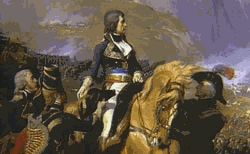
It is difficult not to be impressed with the way in which Napoleon came to power. The Revolution provided Napoleon with the opportunities he needed. For defending Toulon from the British in 1793, he went from captain to brigadier general in eight weeks. For defending the Directory during an uprising in 1795, he was promoted to the highest rank in the Republican Army and eventually given a command in Italy. There, he took a rag tag band of poorly provisioned troops and turned them into a force that could defeat Austria. His victories at Arcola, Lodi, and Rivoli enabled him to negotiate the Peace of Campo Formio directly with the Austrians in 1797. He set up new republics in the north of Italy and ruled them personally from Milan. In 1798, he proposed and led an invasion of Egypt, winning a battle beneath the pyramids in which his force lost but 29 dead, while inflicting thousand of casualties on the Marmelukes. But his army was stranded in Egypt by the Nelson's Navy victory at Aboukir, so he returned to France with only his top aides. Still, he received accolades for his exploits. . He came to exceed the French government in popularity and prestige. By 1799, he had risen via a coup to be First Consul. He was the prototypical Man on Horseback, come to save the nation from itself. "The Revolution is over," he proclaimed. "I am the Revolution." In seven years he had gone from obscure Corsican captain of the artillery, to sole ruler of France.
Once in charge we see both Napoleon's extraordinary capability and his fatal flaw. The vision of what France could be was in his head and only he could give it to her. He sat in on every session creating the Civil Code. He required a specific curriculum in all of his newly founded schools. He reorganized the French government into departments that remain today. He concluded a Concordat with the Pope that He approved or censured every theatrical production. He commented on every major building project. "I wanted to make Paris not only the most beautiful city in the world, the most beautiful city that ever existed, but also the most beautiful city that could ever exist." He made Marshals of his most effective officers, establishing a nobility of merit. He created the Legion of Honor to inspire his troops and one day removed his own medal and placed it upon the breast of shocked soldier. And he personally led Le Grande Armee into war after war that served only to build up in his enemies a burning lust to turn the "Little Corporal's" grandiose dreams to dust.
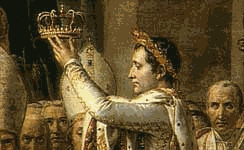
In 1804 Napoleon had the Pope present him the crown as Emperor of France, which he placed on his own head. When Beethoven heard of this, he crossed out the name of the man to whom he had dedicated his Third Symphony. Later, in 1810, he would replace his beloved but barren Empress Josephine with Marie-Louise, daughter of the defeated Emperor of Austria, preferring dynastic to domestic success. "I need a womb" was his explanation. He did affairs with many other women, most especially with the fiery Polish Countess Marie Walewska. In the end, in exile at St. Helena, he was alone. "I don't like women very much," he mused, "or games of any kind, or anything else. I am I suppose a political creature."
 Napoleon's campaign strategy and tactics in the field have remained objects of close study to this day. They were required reading for Lee and Grant at West Point. True, Napoleon benefited greatly from his Revolutionary inheritance. The levee en masse meant a large standing army. The ideal, if not the reality, of "liberty, equality, and fraternity" provided for many years the advantage of superior morale. But to this mixture Napoleon added his own magic. Foremost of these was his conceptualization of the campaign itself. He moved his armies in such a way as to swiftly draw out his opponents, positioning them on ground of his choosing wherein he would deliver the decisive blow. " His other innovations served facilitated execution of this strategic imperative. His corps system created within the army units capable of independent action, while maintaining overall coordination. He moved his army in a manner that both prevented his enemy from knowing where the attack would come and allowing for rapid concentration. But one can make too much of Napoleon as military scientist. "The art of war, " he said, " is a simple art and is all in execution. You engage and then you wait and see." He worked with the materials at hand and, at his height, seemed able to turn all events to his advantage. At his height, he went beyond anticipating an opponent's maneuver, seeming to plan their moves for them. The night before Austerlitz, in December of 1805, Napoleon released to each of his beloved soldiers a plan for the battle to come that included the movements of his enemies, the Austrians and Russians. Suffice it to say that the morrow passed exactly as the Emperor devised.
But as much as Napoleon was a master of military strategy, he was taught a lesson in the supremacy of diplomacy. His unwillingness to show lenience to the vanquished assured their desire for revenge. His mania for isolating Britain, his "Perfid Albion," resulted first in the grinding guerilla war in Spain from 1808 to 1813, then in the disastrous retreat from Moscow in 1812, and finally the enmity of all Europe by 1814. His desire to displace the Ancien Regime in Europe with is own set in motion forces beyond his control. Among other things leading to the rise of a German state that terrorized France in wars to come.
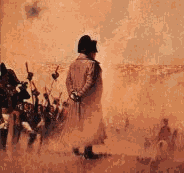 A legend is not complete without a dramatic finale and Napoleon had two. Deserted by his own marshals in 1814, he was exiled to Elba. From there he escaped within one year's time. The restored Bourbon monarchy collapsed and Napoleon led France again for one hundred days, ending finally in the defeat by the Wellington and Blucher at Waterloo. He considered for a while a flight to America, but surrendered for reasons still unclear to the British. They marooned him on a rock in the South Atlantic called St. Helena. Was Napoleon at last cowed, humbled? No.
"My fame lacked only one thing, " he remarked when he heard of his final destination. "I have worn the imperial crown of France, Italy's crown of iron; and now England has given me one that is greater and more glorious still - the one worn by the Savior of the world - a crown of thorns."
What then of Napoleon's legacy? He lost the world, yes, but he got what he wanted in the end. Its history cannot be written without him.
In the words of J.M. Roberts in his History of the World, "he unlocked huge reserves of energy in other countries just as the Revolution had unlocked them in France, and afterwards they could never be quite shut up again."
BACK
HOME