ROBERT E. LEE
|
|
"With all my devotion to the Union and the feeling of loyalty and duty of an American citizen, I have not been able to make up my mind to raise my hand against my relatives, my children, my home. I have therefore resigned my commission in the Army, and save in defense of my native State, with the sincere hope that my poor services may never be needed, I hope I may never be called on to draw my sword..."
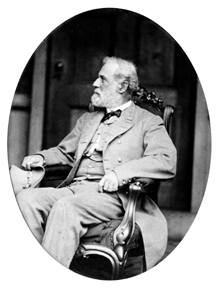
Lee's name somehow does not belong with the other three. We see him unambiguously as the tragic hero. He was a noble man, led astray by his love for Virginia. Offered the helm of the Union army by Lincoln, he declined, choosing instead to take up the sword in defense of the South. Lee is the reluctant hero, capable, perhaps, of leading either side to victory, he chooses loyalty to land and family over duty to country. In his hands, the Army of Northern Virginia became the Confederacy's best chance to win the war. At the heart of Lee is a contradiction. He is a born fighter who hates war. At the Battle of Fredicksburg, as his soldiers routed the mindless assault on their entrenched positions, Lee observed, " It is well that war is so terrible, we should grow too find of it."
Capitalizing on the great gifts of his commanders, Lee remained practically invincible while on the defensive. Son of Revolutionary War hero "Light Horse Harry" Lee, had Robert chosen the path blazed by Washington, biding his time, letting the enemy take it to him, he might have held out just long enough for the north to lose their will to win. But a war of attrition, perpetuating the killing on both sides, prolonging the devastation of Virginia's farms and homes, was the furthest thing from Lee's mind. He sought instead early success via a decisive victory on northern soil, one that would force the enemy to sue for peace and bring the bloody conflict to an end. Twice he followed great victories with invasions of the north. The first ended at Antietam , a bloody stalemate resulting from Lee's marching orders having fallen into Union hands, wrapped about three cigars and left near a campfire. Lee retired to Virginia to try again a year later. The second invasion led to Gettysburg.
At Gettysburg, Pennsylvania, on July 3, 1863, Lee made the now infamous decision to send thousands of his men to their deaths in a massed charge on the Union center.
Why? Looking back, it is clear that Lee was gambling to end the war. One last decisive blow would do it. Though his second in command, Longstreet, questioned repeatedly the wisdom of the attack to come, Lee believed that there was nothing he could ask of his men that they could not do. But moving the determined defenders from their well-chosen ground was beyond even their power. He had gambled with their lives and lost. As the wounded and stragglers returned from Pickett's Charge, Lee rode back and forth amongst them, exclaiming, "The blame is mine. You must help me." And they did. In defeat as in victory, Lee's men continued to revere "Marse Robert."
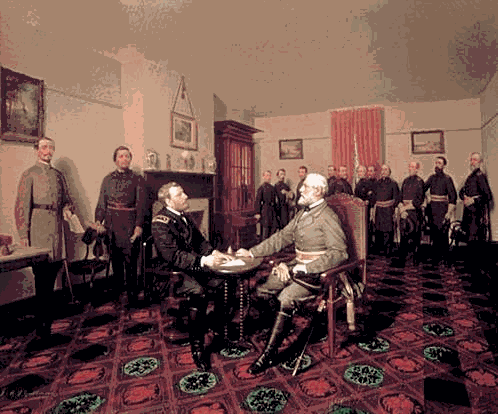
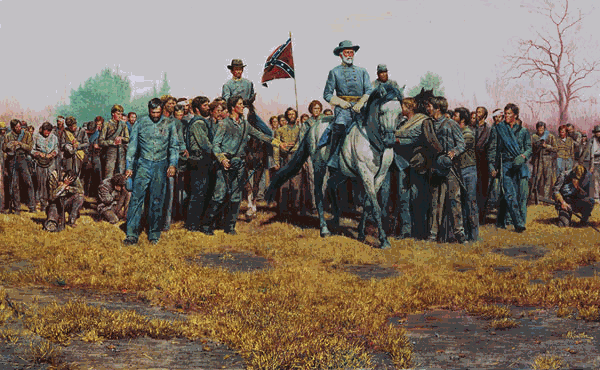
So the war went on. For two more bloody years, Lee's men followed him, playing a deadly game of cat and mouse with the pursuing Union army. Finally, in April of 1865, Lee saw that there was nothing to be gained from further fighting. Checkmated in the end by Grant's willingness to accept murderous casualties in the name of victory, Lee surrendered. Here, at war's end, we see Lee at his noblest, setting a tone that helped to heal the nation. "Abandon your animosities," he said, "and make your sons Americans."
BACK