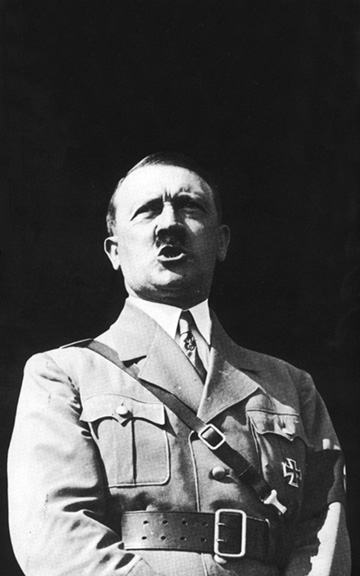
ADOLF HITLER
"War is eternal, war is universal. There is no beginning and there is no peace. War is life. War is the origin of all things."
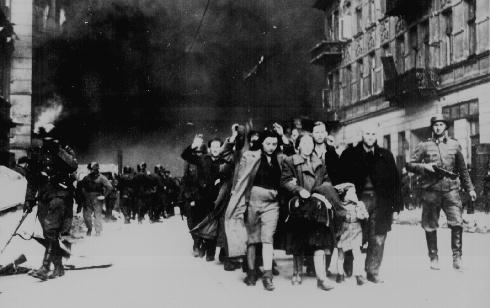
It is more than fifty years since Adolf Hitler shot himself dead in the F
ührer Bunker beneath Berlin. He died with the Germany he had created. His commitment to founding a Greater Germany, a Thousand-Year Reich, brought the world six years of war, death and destruction on a scale that still defies our comprehension. His passion for purifying the Aryan race paved the way for the systematic genocide of Jews, Slavs, Roma, homosexuals, Jehovah's Witnesses, Communists and others in the Holocaust. His name has become synonymous with Evil.Why was Hitler who he was? What does it mean that "a Hitler" could come to power over a "civilized society" in the Twentieth Century? These are questions that permeate the literature on his life. There are as many answers are there are authors. Even the facts of his life are subjects of intense controversy. There are as many interpretations of Hitler as there are historians. He is portrayed as charlatan, statesman, fanatic, genius, madman, charismatic leader, pornographic self-loather, frustrated artist, abused child, and racist killer. There are even those who feel to attempt to understand Hitler is to commit blasphemy. To explain evil is to exonerate it. And there are those who say, "What is evil after all? Even such a man as Hitler believed he was right." Hitler has become a cipher for us. We encode who we are in our particular remembrance of him.
However, in general our historical rear view mirrors have difficulty in resolving the hit and run experience that was Hitler's intersection with our modern world. We make of him an aberration, a freak fostered by a most unfortunate time. We make of him a criminal genius, blamed for all the evil done in his name. We need Hitler to be other than he was because of what that says about who we can be.
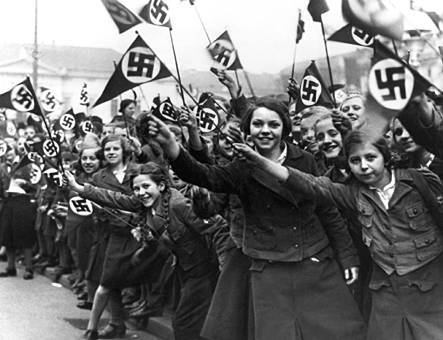
We assume that Hitler terrorized the German people into accepting his totalitarian rule. We forget that at his zenith, Germans revered him, as they had no other. He was simply, their F
ührer. In the words of one seventeen-year-old German girl in 1939, Hitler was "a great man, a genius, a person sent to us from heaven." A Nazi newspaper said of him, "…the best imaginable expert in all fields." General Wilhelm Keitel referred to Hitler as "Grösster Feldherr aller Zeiten," the Greatest Warlord of All time." The philosopher Martin Heidegger saw Hitler in this light: "The Führer himself and alone is the German reality, present, future, and its law." Imagine these words spoken in all seriousness about one of our leaders today. They came sincerely from the hearts of those whose demoralized spirits Hitler had uplifted, whose dissipated energies he had engaged, whose fears of chaos he had put at ease, whose appetite for a Germany reborn as a power second to none he had sated. Hitler's adoration came from giving the people what they wanted.
We assume that the Germans were duped, that Hitler and his Nazi cohorts concealed their plans until it was too late. We forget that the man they made Chancellor was the man who said: "My first and foremost task will be the annihilation of the Jews…until all Germany is cleansed," and "The next war will be bloody and grim…the most inhuman war…which makes no distinction between military and civilian." Alfred Rosenberg, editor of the Nazi paper Völkischer Beobachter included in his summing up of the party platform in 1930, the following:
Imagine a campaign centered on these sentiments today. This program, appalling to us now, was appealing to those who voted the Nazis into power. It spoke to their desire for putting things aright. The German nation would assume its rightful place in the world. Good Aryan folk would travel via double-decker trains to holiday on the Black Sea, served by Slavs who were born to be their slaves. Hitler's words did not drive his people's values, they were derived from them.
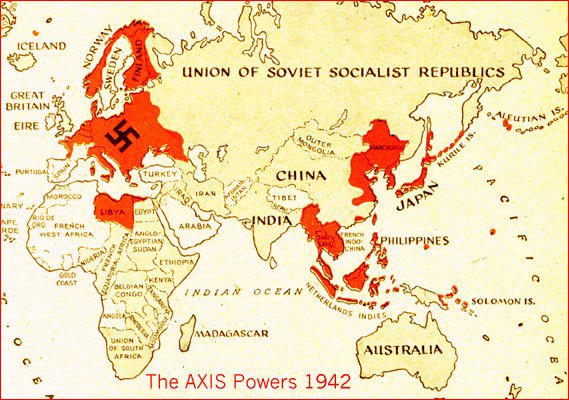
And we assume that it was inevitable that this man Hitler was doomed to be defeated, crushed beneath the combined arms of a world united against him. But it was not always so. From the vantagepoint of spring 1942, things appeared very differently. It was the Nazis who seemed nearly unstoppable; their latest Blitzkrieg racing towards the Volga in search of oil to fuel the Greater Reich. Most of Western Europe was theirs. The same France that had resisted so valiantly for four years in World War I had fallen the year before in little more than a month. Hitler's Japanese allies had inflicted upon the Americans a devastating blow at Pearl Harbor and were on the march throughout Southeast Asia. True, by the end of that year, all this was a nightmare from which the world was waking, stirred by names of places now well known: Midway, El-Alamein, Stalingrad. But those were battles yet to be fought. On April 28th, Australian Prime Minister John Curtin assessed the situation for his countrymen this way:
"Dangerous days lie ahead for us. The people of Australia have no illusions about the struggle. They know that this is not a fight for Australia, nor for the Empire, nor for any section of the world, but a fight for the world itself."
What we have, perhaps, forgotten is that our world was nearly lost to and finally wrested from a man named Hitler, a process that cost the lives of more than fifty million men, women, and children. Time has dimmed our understanding that this was not the result of the inner demons of one man, but of the willingness of so many to deal out death in his name.
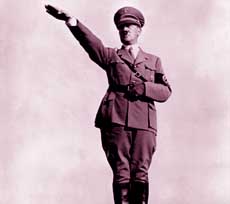
Our continued fascination with Hitler, in some ways, continues to reward his thirst for a place in our history.
He said, "I shall become the greatest man in history. I have to gain immortality even if the whole German nation perishes in the process."
Maybe we should study him less and spend more time learning about us.
The best answers to the "why" questions that surround Hitler's life lie within Germans of his time. He came to power from them. He waged war with them. He murdered through them. An examination of our loves, our fears, what we value, what we desire, what we loathe is the best predictor of what can kind of government we will bear.
BACK