|
Bridging the Red-Blue Divide
NOVEMBER 7, 2004
by
GREGORY J. RUMMO
What if the armies of the Lord picked
up and dusted off their swords? Vowed to set the captive
free and not let Satan have one more? What if the church,
for heaven sake, finally stepped up to the plate? Took a
stand upon God’s promise and stormed hell’s rusty
gate?
What if His People Prayed—Casting Crowns
WHEN MY WIFE was pregnant with our first
child, a young mother told me that having children was a
wonderful experience. “Your only regret will be that you
didn’t have them sooner,” she said.
At the time, I wasn’t all
that certain what she meant but I suspended comments until
November 20, 1988 when our first son was born.
I quickly realized that
young mother was right. Having children is indeed a
wonderful experience with the emphasis on the word
experience.
One cannot
enjoy theoretical children. Reading about them or studying
them is not enough. Like many things in life, they must be
experienced to be appreciated and understood.
The same can be said about
the “moral issues” that media pundits claim propelled George
W. Bush to a second term in the White House and defeated
same-sex marriage in all eleven states where it appeared on
the ballot.
Traditional American
morality has as its source the Bible and most notably
Christianity. But neither can be grasped in theory only.
They must be embraced—experienced, if you will—in
order to be appreciated and understood. And the only way
that is possible is for individuals to embrace
Christianity’s author, Jesus Christ in a very personal way.
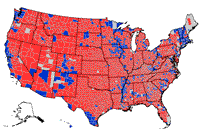
The frustration experienced
by perplexed Democrats swooning in the wake of that sea of
red states making up America’s geopolitical map is the
latest evidence for America’s great cultural divide.
Liberals are scratching their heads, trying to understand
the reasons for the morality chasm that exists between them
and mainstream America and why values continue to be so
important. But they’ll never find the answers until they
search their hearts.
Not every American who
embraces traditional family values does so with an acute
awareness of the Bible’s teaching about every theological
nuance. For some it may be nothing more than having been
raised in a home where a vestige of Christian values, handed
down from the previous generation, has proved sufficient to
influence behavior. Indeed, ask some people why they believe
the way they do and many cannot give an answer deeper than
“I just know it’s the right thing to do.”
Such a priori
reasoning is further evidence of the power of Christianity
in American society to influence behavior—and not just at
the polls. No wonder the history revisionists—that’s a
polite phrase for atheists—want the Ten Commandments,
Nativity displays and other symbols of Christianity removed
from the public eye. They serve as nagging
reminders—conscience pricks—for them and the other
blue-state elitists who can only ridicule what they do not
understand.
Last December, US News &
World Report featured a cover story about evangelical
Christians in America. The article pointed out that
according to a Gallup survey, “roughly four out of 10
Americans identify themselves as evangelical or born-again
Christians.” It is this group’s involvement in politics that
was largely responsible for the Election Day stunner that
has liberals wringing their hands.
But an even
greater responsibility for evangelicals transcends politics:
It is their God-given calling to lovingly make the case for
traditional morality by sharing the Gospel among those who denigrate its
importance .
Mort Kondracke joked with
Jim Angle on FOX NEWS several days after the election that
liberals should go to Bible school to help them understand
why 59 million Americans voted the way they did.
Kondracke was exactly right.
 |
|
If you liked this column, there's more in
Rummo's new book, published in August 2004, "The View from
the Grass Roots - Another Look." It's 536 pages
of sometimes humorous, sometimes poignant and
almost always provocative commentary on American
Culture. $19.95 shipping and handling included.
Click here for more information.
|
It is the
responsibility of those “four out of 10 Americans”—the
evangelicals who claim to embrace the Bible as their
guidebook for life—to be salt and light in a culture that is
steeped in spiritual darkness and rotting from within. And
if judgment would first “begin at the house of God,” as the
apostle Peter wrote, this would open the door for America’s
only hope: A true revival in the 21st century.
The Rebirth of America, a book produced by the Arthur S.
DeMoss Foundation describes in a chapter entitled “The
Awakening of America,” the great revivals that spread
through this country during different periods in its
history. In the revival of 1740, 25,000-50,000 people were
added to churches in New England at a time when the
population was only 300,000.
During the
Second Great Awakening which began around 1800, thousands
were swept into churches, “more than 10,000 in Kentucky
alone between 1800 and 1803.”
But in 1905, a revival occurred that shook the nation. So
profound was its influence that “ministers of Atlantic City
reported that of a population of 50,000 in that city, they
knew of only 50 adults who were unconverted. In Portland
Oregon, 240 department stores closed each day from 11 to 2
for prayer and signed an agreement among them that no one
would cheat and stay open.”
A revival,
which always produces conversions, would undoubtedly include
members of the perplexed liberal crowd. And those
conversions—genuine salvation experiences—would
finally be the event to lead them to understand what the
red–blue divide is all about.
n
Gregory J. Rummo is an author and
syndicated columnist. His latest book, “The View from the
Grass Roots—Another Look,” was just published. Visit
GregRummo.com
for more information.
|