|
Rain Forest Villagers
Happy to Host Missionaries
THE HERALD NEWS,
Sunday, April 4, 2004
Story and photos by Greg
Rummo
"WE
WAIT FOR LIGHT,
but behold
obscurity; for brightness, but we walk in darkness. We grope
for the wall
like the blind, and we grope as if we had no
eyes: We stumble at noonday as in the night; we are in
desolate places as dead
men. We roar all like bears, and mourn
sore like doves: We look for judgment, but there is none; for
salvation, but it is far off from us." Isaiah 59: 9-11
 The
late morning sun is just starting to burn through the
remnants of last night's thunderstorms, which lit up the
night sky over the dense jungle. Tendrils of water vapor
reach down from the low clouds, intertwining with countless
spires of humidity rising up from the jungle canopy. One
imagines a thousand translucent church steeples. The
late morning sun is just starting to burn through the
remnants of last night's thunderstorms, which lit up the
night sky over the dense jungle. Tendrils of water vapor
reach down from the low clouds, intertwining with countless
spires of humidity rising up from the jungle canopy. One
imagines a thousand translucent church steeples.
The thickness of the air - that's the
only way to describe it - muffles the occasional call of a
Chichara, a large locust-like bug. A bead of sweat trickles
out from under my hat, runs down my cheek and drips onto my
soaked shirt. Another day in the rain forest has dawned.
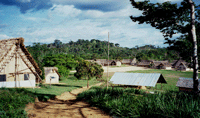
I am sitting on a wooden bench in the
home of Clint and Rita Vernoy. The Vernoys, along with their
four children, are Baptist missionaries. Seven years ago
they were invited by a tribe of Yekwana Indians to come and
live in the tiny village of Chajurana, located on the
Chajura River, a tributary of the mighty Orinoco River deep
in the Venezuelan rain forest.
The Vernoys make their home in a
mud-clay brick building with a thatched roof and a cement
floor. They have managed significant improvements over the
years, including a gravity-fed shower, a generator for
electricity during the evening and when clouds obscure their
solar panels, and a four-burner propane stove.
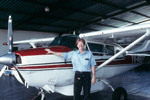 Their
home is a remarkable achievement, especially in light of the
fact that everything they bring into the jungle must fit in
a space no larger than the cargo area of a Cessna 206.
Considering their surroundings, they have a very comfortable
home. Their
home is a remarkable achievement, especially in light of the
fact that everything they bring into the jungle must fit in
a space no larger than the cargo area of a Cessna 206.
Considering their surroundings, they have a very comfortable
home.
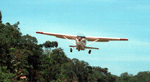
They are able to minister to the
Indians in a variety of ways by providing medicine, food and
other sundries, which they sometimes use to trade. Their
presence also provides a reason for Mission Aviation
Fellowship to land one of their two single-engine Cessna's
on the 500 meter landing strip on a regular basis, bringing
supplies to the Vernoys and providing a window to the
outside world for the inhabitants of Chajurana.
Since there are no roads in this part
of the world, the only other way to get to their village is
by canoe - a 2-week trip filled with dangerous portages
through waters infested with anacondas, piranhas and
crocodiles.
 But
of all the work the Vernoys are engaged in, they regard the
opportunity to share the Gospel of Jesus Christ with the 450
or so Yekwana living in their village, plus the 60 Sanema
Indians living on the other side of the Chajura River, their
most important work. But
of all the work the Vernoys are engaged in, they regard the
opportunity to share the Gospel of Jesus Christ with the 450
or so Yekwana living in their village, plus the 60 Sanema
Indians living on the other side of the Chajura River, their
most important work.
"People think it's all perfect harmony
here," Clint shares with me. "The secular anthropologists
want the Indians to stay the way they are. They gloss over
the nudity and the use of alcohol as if it is an essential
part of their culture. They try and explain that the
Indian's yaraque - an alcoholic homebrew - gives the Yekwana
a non-violent 'mellow' drunken stupor. They're not here to
help the Indian women after they have been beaten silly by
their drunken husbands or to sew up the cuts from machete
fights."
"The Indians themselves have often told
me that they do not want others telling them to stay the way
they are," he continues. "They want to experience progress,
they want to be able to determine their own destiny."
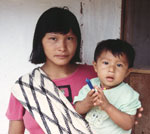 Our
conversation is interrupted by Zoraida, a young Yekwana
mother who enters the Vernoys' home and sits on my left. The
Indians are constantly coming into the Vernoys' home, or
lined up outside, peering through the screens - there is
literally no privacy. The Vernoys accept this as a way of
life in this culture. Our
conversation is interrupted by Zoraida, a young Yekwana
mother who enters the Vernoys' home and sits on my left. The
Indians are constantly coming into the Vernoys' home, or
lined up outside, peering through the screens - there is
literally no privacy. The Vernoys accept this as a way of
life in this culture.
Zoraida is carrying her baby, Chaves,
in her arms. Chaves has been suffering from a bad case of
diarrhea.
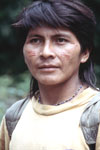
Moments later, Jorge appears at the
door and walks in. He takes a seat on the wooden bench next
to me on my right. Jorge has recently contracted malaria.
 The
rainy season has started here in the Bolivar section of the
rain forest and disease is spreading through the small
village. The rain showers wash over the jungle and into the
rivers carrying with them the detritus and germs which have
accumulated on the jungle floor during the month's long dry
season. This increases the likelihood of stream-borne
illness as the Chajura River is the lifeline of the village.
The Indians drink and bathe in it and use its water for
cooking. The rains also pool in low places in the forest,
creating fertile incubators for mosquitoes, which carry
malaria, yellow fever and dengue fever. The
rainy season has started here in the Bolivar section of the
rain forest and disease is spreading through the small
village. The rain showers wash over the jungle and into the
rivers carrying with them the detritus and germs which have
accumulated on the jungle floor during the month's long dry
season. This increases the likelihood of stream-borne
illness as the Chajura River is the lifeline of the village.
The Indians drink and bathe in it and use its water for
cooking. The rains also pool in low places in the forest,
creating fertile incubators for mosquitoes, which carry
malaria, yellow fever and dengue fever.
As Rita administers a small dose of
pink Pepto-Bismol to the crying infant, Jorge explains that
he has not been feeling well. Finally, after a half-hour, he
gets up and waves weakly, saying goodbye to us in Mike -
short for Maquiritare - the language of the Yekwana. It's
about time for his afternoon febrile seizure and he wants to
go home and lie down.
He thanks the Vernoys for another
Mefloquine tablet and walks away, the screen door slamming
behind him. Rita explains that there are now four cases of
malaria in the village, all in close proximity to the
Vernoy's home.
I am not worried. I am taking
Mefloquine myself as a prophylactic against the disease, but
the Vernoys cannot take it on a constant basis, and there is
the risk that they could easily contract malaria. Their
oldest son, Joshua, had malaria the previous rainy season.
 Tribal
missionary work is exciting but can also be very dangerous
for reasons other than diseases. Only four weeks before I
arrived, five people - three missionaries, a passenger and
the pilot - were all killed as a New Tribes Mission Cessna
206 crashed on a mountainside at 7,000 feet, only a few
miles from where we had flown just one day ago. Tribal
missionary work is exciting but can also be very dangerous
for reasons other than diseases. Only four weeks before I
arrived, five people - three missionaries, a passenger and
the pilot - were all killed as a New Tribes Mission Cessna
206 crashed on a mountainside at 7,000 feet, only a few
miles from where we had flown just one day ago.
Missionary work among the Maquiritare
Indians dates back to the 1970s and the work of the Orinoco
River Mission. But these missionaries moved on, leaving a
spiritual vacuum in the village of Chajurana. The Vernoys,
who have been in Chajurana since 1999, have been accepted by
their hosts.
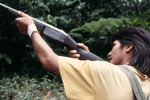
"Indian culture has been abused," Clint
says. "Miners have come in and raped the jungle for its gold
deposits and the Indian women for pleasure. Anthropologists
come here and try and tell the Indians how to live. Then
they get on a plane and go home to the comforts of Western
Civilization. We gained the right to be heard because we
lived among them."
 In
1998, there was some concern that the Vernoys would be
forced to leave Chajurana. At the urging of a group of
anthropologists with an obvious anti-religious and
anti-North American bias, the Venezuelan National Guard was
ready to order all non-Indians out of the jungle. The tribal
leaders called for a meeting to discuss the situation.
Hundreds of Indians converged in the tiny village for the
three-day pow-wow. In
1998, there was some concern that the Vernoys would be
forced to leave Chajurana. At the urging of a group of
anthropologists with an obvious anti-religious and
anti-North American bias, the Venezuelan National Guard was
ready to order all non-Indians out of the jungle. The tribal
leaders called for a meeting to discuss the situation.
Hundreds of Indians converged in the tiny village for the
three-day pow-wow.
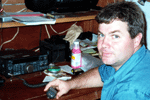
When Clint was given the chance to
speak, it became obvious to all the Indians that the only
ones willing to live with them were the missionaries. In the
end, the chief stood up and said, "These people eat our
food, they live here with us. They have brought their
children into the jungle with them. They treat our sick with
medicine. They comfort our dying. They have even paid the
plane fare out of their own pockets to fly our critically
sick people to the city for medical attention. They can
stay."
 Clint
looks at his watch and announces that a supply plane for the
guesthouse he is building is arriving in about 30 minutes.
That's our cue to make our way to the airstrip and help
unload the MAF Cessna when it arrives from Ciudad Bolivar
with about 450 kilograms of supplies. This turns out to be
no easy job and takes us almost two hours in the sweltering
heat and humidity. The airstrip is several miles from the
village and the plane must be unloaded and each piece of
cargo carried from the airstrip down a steep embankment to a
45-foot dugout canoe. From there, it is roughly a mile down
the Chajura River to the shores of the village. There, piece
by piece, the process is repeated as the cargo is unloaded
and carried up a steep embankment to the missionary's home. Clint
looks at his watch and announces that a supply plane for the
guesthouse he is building is arriving in about 30 minutes.
That's our cue to make our way to the airstrip and help
unload the MAF Cessna when it arrives from Ciudad Bolivar
with about 450 kilograms of supplies. This turns out to be
no easy job and takes us almost two hours in the sweltering
heat and humidity. The airstrip is several miles from the
village and the plane must be unloaded and each piece of
cargo carried from the airstrip down a steep embankment to a
45-foot dugout canoe. From there, it is roughly a mile down
the Chajura River to the shores of the village. There, piece
by piece, the process is repeated as the cargo is unloaded
and carried up a steep embankment to the missionary's home.
On Wednesday of the week I was in
Chajurana, the Yekwana held a banquet in my honor. Almost
the entire tribe packed into a large, round, thatched-roof
structure called a churuwatta, the equivalent of a stateside
civic center. They served chicken rice soup (only the men
got pieces of meat), and a sour tasting bread called casava,
made from the root of a plant grown by the Indians.
The night before I left the rain
forest, the Vernoys announced they would show a Christian
video entitled Perdona Nuestras Deudas to the
village. Word quickly got out and, by the time we had
carried the generator, the video player and the small,
9-inch color television to the appointed place outside under
the stars, more than 200 people were seated, eagerly
awaiting our arrival.
Friday morning comes quickly, and it's
time to leave the jungle. Although the rain showers prevent
the MAF Cessna from picking me up early in the morning as
scheduled, the overcast breaks around noon and I am finally
able to fly out later in the afternoon, landing at the
airport in Puerto Ayacucho on the Colombia-Venezuela border.
 What
makes a man move his entire family to a remote
"God-forsaken" jungle? I muse over and over in my mind as
the Cessna rolls towards the MAF hangar. Then I remember
Clint's words to me: "They are brilliant people here in the
jungle. Their questions about God are just as good as ours
and I love them very dearly." What
makes a man move his entire family to a remote
"God-forsaken" jungle? I muse over and over in my mind as
the Cessna rolls towards the MAF hangar. Then I remember
Clint's words to me: "They are brilliant people here in the
jungle. Their questions about God are just as good as ours
and I love them very dearly."
As the prop spins down, and I realize I
am back to civilization, the words of the apostle Paul to
the Corinthian church play over in my head: "For the love of
Christ compels us." The sacrifices the Vernoys have made to
be salt and light to the Indians of the Orinoco rain forest
are truly moving. The Yekwana and Sanema are hardly
God-forsaken. n
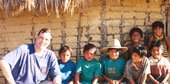 Greg Rummo is a syndicated columnist. Since 1998, he has visited several
third-world countries in Central and
South America to assist missionaries in the work of evangelism. This year he’ll be
trekking through the Peruvian
Andes in July as well as traveling to the
Yucatan in
Mexico with his
older son, John. Visit his website,
www.GregRummo.com Greg Rummo is a syndicated columnist. Since 1998, he has visited several
third-world countries in Central and
South America to assist missionaries in the work of evangelism. This year he’ll be
trekking through the Peruvian
Andes in July as well as traveling to the
Yucatan in
Mexico with his
older son, John. Visit his website,
www.GregRummo.com
|