|
Bringing Hope, Joy to
the "End of the Earth"
JULY 26, 2004
By
GREGORY J. RUMMO
QUISHUAR, PERU
AN
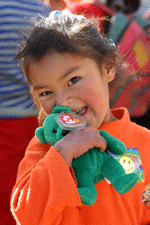
ADORABLE LITTLE 3-year old Quechua girl stares at me, her
large brown eyes peering inquisitively into mine. “Which
country do you come from?” She asks me in Spanish. It’s
obvious to her I am a Gringo, even though I may very well be
the first one she’s ever laid eyes on, here, literally at
the end of the Earth, deep in the southern Cordillera Negra
in Peru’s Andes mountains.
“Los
Estados Unidos,” I reply. Her eyes grow wide and she
smiles, revealing the decay in her upper teeth.
 “I have a daughter back
home,” I continue in my broken Spanish. “She
is beautiful like you. Her name is Rebecca. What is your
name?” “I have a daughter back
home,” I continue in my broken Spanish. “She
is beautiful like you. Her name is Rebecca. What is your
name?”
“Isabella,” she tells me
while clutching a green Beanie Baby that was just given to
her by one of the other 30 Gringos from our group. Her eyes are
definitely Asian; evidencing the ancestry anthropologists
believe is inherent among the Quechua when centuries
earlier, the Inca migrated into South America across the
land bridge that connected North America to Asia.
She reminds me of my own
Chinese daughter back home. And right now, back home
is a very, very long way away.
It was only three days ago
on a summer afternoon when my son and I boarded a flight to
Lima at Newark’s Liberty International Airport. After a
7-hour flight, followed by an overnight 8-hour bus ride, we
arrived in Huaraz in the Callejon de Huaylas, the valley
that cuts the Andes mountains into two ranges; the
Cordillera Negra and the Cordillera Blanca.
After a day to
acclimatize, we boarded a van for another long ride, this
time on a dry, sinuous dirt road that took us over several
14,000 foot mountain passes. Eight hours later at twilight,
we arrived in the tiny village of Huanchay where we pitched
our tents on a dirt soccer field.
The next
morning, after eating a hasty breakfast and packing our gear
in a duffel bag that would be tied to a burro, we set out on
foot for what we were told by the locals was “about a
four-hour walk.”
We walked all
day, crossing two mountain ranges and covering 12 miles
until finally arriving in Quishuar. The trek had taken us
twice as long as we had been told.
Catching our
breath, we stood above the clouds at over 11,000 feet,
watching as the sun slowly set in the western sky, wondering
where our gear was.
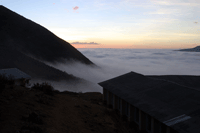 It was almost an hour later
when the first burros staggered up the last leg of the steep
mountain. By now, the clouds that only thirty minutes ago
had been so beautifully tinged with rose were white and
ghost-like as they crept into the village. The dampness sent
chills through us as we stood around, contemplating setting
up our tents in the encroaching darkness. It was almost an hour later
when the first burros staggered up the last leg of the steep
mountain. By now, the clouds that only thirty minutes ago
had been so beautifully tinged with rose were white and
ghost-like as they crept into the village. The dampness sent
chills through us as we stood around, contemplating setting
up our tents in the encroaching darkness.
But the
village officials had a surprise: They let us use the
colegio—the school building—where we would be able to
sleep inside on the dry floor, thus avoiding the cold, damp
air.
Imagine a
group of 30 foreigners showing up in the center of your town
at sunset. Do you think it would be possible to convene a
meeting with the mayor and enough council people on such
short notice to discuss granting permission to the group to
spend the night in the local public school?
We have so
much in America we are choking on our blessings, yet often
unwilling to share them and suspicious of everyone that is
different from us. The people of Quishuar willingly gave to
us out of their poverty and in so doing, reminded us of the
words of Jesus, “It is more blessed to give than to
receive.”
The day-long
walk at high altitude had robbed many of us of our
appetites. I was only able to eat two Fig Newtons and a few
handfuls of dried fruit and nuts while my son stared at half
a can of Chef-Boyardee ravioli that he couldn’t finish.
We had
traveled far to bring a little hope and happiness to this
Pueblo which was short on both. But getting here was
only part of the goal. Our job for the evening was in fact
just beginning.
It was around
7:30 p.m. when the villagers started to filter into the
school yard. Family by family, they came in anticipation of
seeing something most of them had never seen before in this
place where electricity had not yet been invented.
 |
|
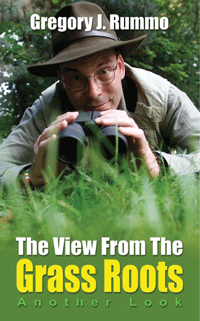
If you enjoyed this column, imagine how much
you'll love Rummo's latest book! It's 536 pages
of sometimes humorous, sometimes poignant and
almost always provocative commentary on American
Culture.
Click here for more information.
|
They sat in
silence for two hours on the cold, damp ground, transfixed
by the images and the sounds of The Jesus Film, a popular
evangelistic tool that portrays the life and death of Jesus
Christ from Luke’s Gospel.
When the movie
was over, they sat for another hour, listening to Pushpi, an
itinerant Quechua evangelist who always travels with us, as
he explained the meaning of the death, burial and
resurrection of Jesus Christ to them.
The next
morning the entire village came back to the colegio
to bid us farewell. Before leaving, we passed through the
crowds handing out toys to the children along with New
Testaments in both Spanish and Quechua to family members.
We had been
obedient to The Great Commission; the command of Jesus to
his disciples to go to “…the end of the earth,”
to share His story and to bring a little hope to the
hopeless; and to put a smile on the face of a little 3-year
old girl named Isabella.
n
Gregory J. Rummo is a
syndicated columnist. Read all of his columns on his homepage,
www.GregRummo.com.
|