|
Orphans No More
THE SUNDAY HERALD NEWS, OCTOBER
3, 2004
Story and photos by
GREGORY J. RUMMO
|
"The little girl
we are hoping for—our future daughter, Rebecca
Lee—is still at least another year away, and for
all we know, she may not have even been born
yet." |
IN MARCH 2001,
my wife and I began
the process to adopt a baby girl from the People’s Republic
of China through America World Adoption Association in
McLean, Virginia. Having worked for a China-based
import-export company as its CEO since 1987 and having
traveled to China several times, I had developed a special
place in my heart for its people. In March 2003, during an
orange terror alert and around the time the Chinese began
admitting to the world that SARS truly was of epidemic
proportions, we traveled to China with our two biological
sons, John and James.
What
follows is a diary of sorts, portions of which were
published as shorter newspaper columns, detailing our
journey from beginning to end. It truly was such a wonderful
experience that this year, we began the process all over
again. Our second dossier went to China in late August. We
expect to travel next spring to bring home our second
daughter.
November 13,
2001
Today marks the culmination of a “paperwork
pregnancy.” Coincidentally, it’s been almost nine months
since my wife and I began this long and arduous process
called adoption. But the little girl we are hoping
for—our future daughter, Rebecca Lee—is still at least
another year away, and for all we know, she may not have
even been born yet.
The
cover story of the March 12, 2001 issue of
U.S. News &
World Report
described
the
ordeal many couples face when they adopt a child. “The
Adoption Maze,” characterized the process as “difficult,
expensive and potentially heartbreaking.” To that
description I can add lengthy, unnecessarily convoluted and
frustrating.
Something as simple as obtaining a birth certificate can
become a weeks-long wild goose chase. Because my wife and I
were born in New York City, we had to obtain a “long-form”
birth certificate—a document containing all of the detailed
information about our parents as well as the birthing
doctor’s signature and the official seal of the Department
of Health of the City of New York. A second document, a
“letter of exemplification” signed by the deputy city
registrar, certifying that the birth certificate was indeed
a true copy had to be attached. Then, these two documents
had to be sent to the New York county clerk who certified
the registrar’s signature and official position. From his
office, the document, now three pages in length, was mailed
to the Secretary of State’s office in New York where it was
certified.
This
process of notarization and certification ascending the
political hierarchy was repeated for the rest of the
documents making up our dossier.
 |
|
The Great Wall on the outskirts of Beijing,
China's capital city. It was one of our stops on
the way to adopting our daughter in March 2003. |
Adoptive couples
are also required to have a home study; a comprehensive and
invasive process meant to assure the adoption agency and the
foreign orphanage of the financial, physical, psychological
and mental fitness of the adoptive couple. We had to write
first person narratives about our upbringing from earliest
memories. Interviews of all family members including our two
biological sons were conducted. We were fingerprinted
several times. We supplied photographs of our home—inside
and out—and of the family in all sorts of situations
including recent vacations, various hobbies and family life
in general.
This
dragged on through the summer until we had everything we
needed with one exception—our 171H from the Immigration and
Naturalization Service—the official document we needed from
the US government approving our adoption.
Finally, this arrived in our home almost eight months from
the day we initiated the process.
Our
dossier arrived in China on Nov. 30. Now, all that’s left to
do is to wait, possibly for as long as another year. While
my wife and I are hoping our daughter will be home for
Christmas, a more realistic goal is that we will have our
referral by then and we will travel to China in mid-January
2003.
By
then, our adoption will have taken 23 months from beginning
to end. That’s longer than two pregnancies. Quite frankly,
that’s too long.
Although the documentation portion of an adoption is still a
lengthy process, the waiting time for obtaining the referral
(the name, several photographs and brief history of the
child) from the China Center for Adoption has decreased. In
2001, it was almost 14 months from the date a dossier went
to China to the time an adoptive couple received their
referral. Currently the waiting time is now approximately 6
months.
January 23,
2003
The
chatter on the message boards on Yahoo! for America-World
Adoption Group 108 mostly centered around a pool to see who
would come closest to guessing the date we would receive our
referrals. There were 29 different posts that morning before
the message boards grew eerily quiet for several hours.
Then,
suddenly, the message boards were flooded with the joyous
news of orphans who were orphans no more.
Suddenly, the phone rang at my desk in the office shortly
before 2 p.m.
 |
|
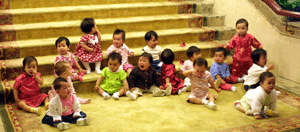
Sixteen of the 17 girls managed to stay in one
place long enough on the steps of the China
Hotel in Guangzhou for me to take their photo
Our daughter, Wu Minjian, is the sixth from the
left, seated behind the girl wearing the bright
green dress. |
“You have a healthy
baby girl,” Jessica Miller, our family adoption coordinator
announced proudly over the telephone. My pulse quickened and
I could feel my face flush as the blood rose in my head.
“Wh…wha…what’s her
name?” I stammered incoherently.
“Her
name is Wu Minjian.”
The
sound of her name was lyrical. As I softly repeated it over
and over again, the realization came over me: After 22
months, the waiting was finally over. We are scheduled to
leave for China in late March to bring our little daughter
home.
March 28,
2003
It’s
the middle of the night half a world away in Beijing,
capital of the People’s Republic of China. I am lying wide
awake in our hotel room when suddenly there’s a gentle knock
on the door. “Who’s that?” my wife, who is equally as wide
awake as I, asks. Jumping out of bed and walking to the door
I look through the peephole to see our older son, John,
standing in the hallway, showered and dressed in his street
clothes. Our two boys are sharing the adjacent room on the
fourth floor at the Beijing Radisson and it’s obvious their
biological clocks are as confused as ours.
Opening
the door I ask, “What are you doing up so early?”
“What
time is it?” he shoots back smiling. “James said something
about a buffet.” He’s looking better than he did six hours
ago when we were all so tired we could barely stand up
straight.
“It’s
2:30 in the morning. Go back to sleep. We’ll call you when
it’s time to get up and get ready for breakfast.”
Marco
Polo dealt with war and other adverse circumstances when he
traveled to Kublai Kahn’s court in medieval China during the
thirteenth century. But he never dealt with jet lag.
Our
trip to China began at 4:15 on a Thursday morning when the
clock radio cheerfully went off, rousing us all from a deep
sleep. We showered and I walked Chewy one last time before
saying goodbye to him for two weeks. Then we ate a hasty
breakfast and helped the driver load our luggage into the
back of his van. We arrived at Newark airport at 6:45 a.m.
Check-in and security was a snap as the airport was
virtually empty due to fears over the war in Iraq and an
orange terror alert in the homeland. The first leg of our
journey was a short, 2-1/2 hour flight to Chicago. The plane
was practically empty and we had plenty of room to spread
out.
In
contrast, the flight to Beijing was oversold. When it was
time to board, there was Pandemonium in the boarding area.
We made like a herd of steer, lining up in a long queue that
stretched as far as the eye could see.
Forty-five minutes later the door to the aircraft was shut
and we taxied to the end of the runway where we held for
about ten minutes until a long enough window between
arriving aircraft afforded us a slot to roll for takeoff.
The flight seemed to go on for days. We ate. We ate again.
We had a snack. Then we ate again. I watched a couple of
movies. Our sons played Super Mario Brothers on their Game
Boy Advance. We dozed on and off and talked with each other
and with our fellow travelers. I read half of Steve
Martini’s
The Jury.
Mercifully, fourteen hours later we touched down on the
runway in Beijing. By the time we went through quarantine,
immigration, and customs; picked up our bags from the
luggage carousel and rode twenty minutes on the bus to our
hotel, we had been traveling for almost an entire day and
night.
I tried
to imagine the feeling of awe that came over Marco Polo upon
his arrival in the Far East; as he went about immersing
himself in China’s culture, meeting the
people, learning
their language and sampling the cuisine.
But we
were too exhausted to follow in his footsteps. We took hot
showers followed by a short nap and then walked across the
street to KFC for a light supper before finally passing out.
Good
thing Marco Polo never had to deal with jet lag. There
weren’t any KFCs back then to help with the adjustment.
April 3, 2003
On a
hot, sticky day my family and I visited a farm on the
outskirts of the city of Nanning in southern China’s Guangxi
province. The roar from the diesel trucks straining to haul
their cargoes along the highway leading into the mountains
disappeared in the distance behind us as we picked our way
along the path that led deeper into the fields resembling a
patchwork quilt in varying shades of green and umber.
The
odor of the freshly dug earth mingling with the sweetness of
the new-mown hay strewn along the hardpacked clay path
permeated the damp air. Every now and then the acrid odor of
manure removed any lingering doubts that this was indeed a
farm.
The
workers were almost all women, but they weren’t the type I
would have expected to find working out in the fields in the
sweltering heat. They weren’t big or outwardly muscular.
Most were petite. But despite their slim frames, they rolled
up their sleeves and worked hard. They went about their
business quietly. Some planted, some watered, some
harvested.
I
watched one woman fill a pair of wooden buckets with water.
She then effortlessly shouldered them, placing the wooden
yoke behind her head. She walked down a row watering what
looked like a patch of onions. The water alone must have
weighed more than 50 pounds.
I stood
in the middle of all this activity holding Wu Minjian
tightly in my arms. This little girl would celebrate her
first birthday in 10 days. She was the newest addition to
our family and in less than 24 hours would officially become
our daughter.
An
ancient Chinese proverb states: “An invisible red thread
connects those who are destined to meet, regardless of time,
place, or circumstance. The thread may stretch or tangle,
but will never break. As time goes on, the thread will
become shorter until finally bringing the people it connects
together.”
Our
adoption journey was a journey of faith. As the writer in
the Old Testament book of Psalms declared: “The Lord God is
a sun and shield,” we also embraced this promise, believing
God had illuminated our path as bright as the noonday sun.
We were also confident that his shield would protect us as
we followed him.
We had
resolved to let nothing—not the war in Iraq, an elevated
terror alert, or the threat of SARS—keep us from this
rendezvous with destiny.
 |
|
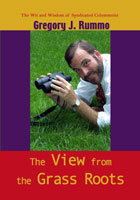
You can read all of the details of the Rummo's
adoption journey in his new book, "The View from
the Grass Roots - Another Look." It's 536 pages
of sometimes humorous, sometimes poignant and
almost always provocative commentary on American
Culture. $19.95 shipping and handling included.
Click here for more information.
|
Minjian’s big,
bright eyes seemed to take it all in. She hugged me
tighter, and I was suddenly overcome with emotion as the
words of our guide, Lin Don Quing, played over and over
in my head: “I have taken you to a farm in rural Nanning
so you can see for yourselves a place very similar to
the one where your daughter was most likely born. A
woman will have her baby on a farm like this one, and
then abandon it in a big city, hoping it will be found
and taken care of,” he said.
Lin had explained
the sad story of abandonment in China to us during the bumpy
bus ride out to the countryside. Most orphans are never
adopted. Raised in orphanages, they attend school only until
the eighth grade and then find some menial labor. They carry
a stigma, which some overcome by moving to another province.
Every year, millions of babies are abandoned in China.
Official estimates are up to 2 million babies, but
unofficial estimates put the number as high as 4 million.
The healthy ones
are almost all girls. Healthy boys are rarely abandoned
because they carry the family name to the next generation.
That is deemed important in a society where almost all
families are limited to one child.
It was
almost a year earlier when the little girl I was now holding
in my arms was discovered abandoned by the roadside near the
Fujiang Post Office in Wuzhou City, several hundred miles
east of Nanning. Her umbilical cord was still attached when
a police officer found her. He turned her over to the Wuzhou
Social Welfare Institute, where the nannies estimated she
was about 2 days old. At the time this was going on, we were
aware of none of it. We had spent the year prior to her
birth running around getting our paperwork together. When
she was born, our dossier had already been in the hands of
the China Center for Adoption in Beijing for five months. It
would be another nine months before we would have her
photograph, know her name, and be made aware of the
circumstances surrounding her abandonment.
Our
bittersweet half-hour visit to the farm came to an end. It
was symbolic of our own journey of faith that was finally
ending. As we made our way back to the bus along the earthen
path, I pondered God’s sovereignty and the red thread that
had stretched more than 9,000 miles, across two continents
and an ocean. It had finally brought us together.
n
For additional detailed information on foreign adoptions,
visit America World Adoption Association’s website,
awaa.org.
Gregory J. Rummo is an author and
syndicated columnist. His latest book, “The View from the
Grass Roots—Another Look,” was just published. Visit
GregRummo.com
for more information.
|