|
Is God Trying to 'Get Our
Attention?'
SEPTEMBER 17, 2004
By
GREGORY J. RUMMO
AS RESIDENTS OF Florida
turn a weary eye eastward towards Jeanne, the next hurricane
in the Atlantic that has the potential to threaten their
state, a Jacksonville, Fla. pastor recently reminded his
congregation that “God may be trying to get our attention.”
Speaking from the
pulpit of the 3000-plus member Trinity Baptist Church last
Sunday morning, Rev. Tom Messer said, “Any discerning child
of God has to realize that things today are different as it
relates to our country having an appetite for the things of
God. And the stark reality is this: We as a nation and a
people are not moving closer to God and the historic truths
about God but further away from God. …If you believe that to
be true it at least has to raise in your mind the
possibility that God is trying to get our attention.”
The statistics bear
out Rev. Messer’s observations.
According to The
Barna Group, an organization that tracks cultural trends in
Christianity, only half of protestant pastors have a
biblical world view. Perhaps this explains why the number of
unchurched adults has nearly doubled since 1991. Why bother
attending church if the pastor’s faith is not real?
The results of this
flaccidity are predictable: More and more, the Christian
faith is having a limited impact on people’s behavior.
George Barna, the Directing Leader of The Barna Group notes
that many Christians [have become] hard-pressed to convert
their beliefs into action. “The ultimate aim of belief in
Jesus is not simply to possess divergent theological ideas
but to become a transformed person. These statistics
highlight the fact that millions of people who rely on Jesus
Christ for their eternal destiny have problems translating
their religious beliefs into action beyond Sunday mornings.”
If Christianity’s
influence to change individual behavior has been weakened by
liberal pastors in the pulpit, this necessarily translates
into a weaker influence in neighborhoods, communities and on
a national level.
The shock waves are
spreading throughout American culture like a storm surge.
In just this past
year, the movement to secularize society by attempts to
remove “under God,” from the Pledge of Allegiance and the
Ten Commandments from public view seems to have taken on a
life of its own.
Three federal judges
recently ruled that the law President Bush signed banning
partial birth abortion—a wordy construct for a practice that
amounts to infanticide—is unconstitutional.
The homosexual
community has managed to elevate the debate over the
millennia’s-old definition of marriage to a feverish
pitch.
 |
|
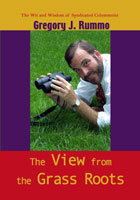
If you enjoyed this column, imagine how much
you'll love Rummo's latest book! It's 536 pages
of sometimes humorous, sometimes poignant and
almost always provocative commentary on American
Culture. $19.95 shipping and handling included.
Click here for more information.
|
Two centuries ago,
Americans had a keener awareness of God’s displeasure over
national sin. This sensitivity so permeated the culture, it
actually steeped the political process in a Christian-based
morality that extended from State Houses to the White House.
Congress reminded Americans to give thanks and praise to God
“through the merits of Jesus Christ, to forgive our sins.”
In 1795, then
governor of Massachusetts, Samuel Adams issued a
proclamation in which he stated: “With true repentance and
contrition of Heart, we may unitedly implore the forgiveness
of our Sins, through the merits of Jesus Christ, and humbly
supplicate our Heavenly Father, to grant us the aids of his
Grace…”
And in 1807, then
governor of Connecticut, Jonathan Trumbell reminded the
citizenry in a proclamation of a day of prayer and fasting:
“It will become us humbly to reflect upon and seriously to
consider the Judgments of the Lord, which in various ways,
at this time, seem peculiarly abroad in the Earth; and
endeavor to search out the procuring causes of God's
singular Displeasure.”
The Old
Testament prophet Nahum wrote: “The Lord has his way in the
whirlwind and in the storm.” As Americans looks
sympathetically towards Florida and the disaster that has
befallen a large part of that state, we would do well to ask
ourselves the question: Will we as a nation “reflect upon
and seriously consider the Judgments of the Lord?”
n
Gregory J. Rummo is an author and
syndicated columnist. His latest book, “The View from the
Grass Roots—Another Look,” was just published. Visit
GregRummo.com
for more information.
|