|
Peruvian glacier is
not all it's cracked up to be
AUGUST 2, 2004
By
GREGORY J. RUMMO
HUARAZ,
PERU
HUARAZ IS THE shining
star of the Callejon de Huaylas (Canyon of the
Mountains) in the Ancash region of Peru. From almost any
vantage point in the city, there are spectacular views of
the Andes mountains including Huascaran, Peru’s highest peak
at 22,205 feet.
The village is a bustling center of commerce where you can
buy anything, from flowers and food to handmade chullos
and blankets. But it is also a confluence of the old and the
new with first-class European restaurants like Bistro de
los Andes and Internet cafés on virtually every street
corner. The blend provides a happy medium for the thousands
of tourists who come here to spend time acclimatizing in the
thin air—it’s over 10,000 feet—before departing on a trek or
an alpine summit through the mountains.
This
tourism in combination with the local culture creates an
atmosphere described as “full of energy, diversity, and
enjoyment unlike any other region in Perú.”
But
in April, 2003, something ominous was discovered in one of
the glaciers above this village of over 100,000 that, if
proven to be what some scientists claim, could put a damper
on the festive spirit and possibly result in a huge loss of
life.
NASA
announced its Spaceborne Thermal Emission and Reflection
Radiometer was monitoring what appeared to be an “ominous
crack” in a glacier feeding into Lake Palcacocha. “Should
the large glacier chunk break off and fall into the lake,
the ensuing flood could hurtle down the Cojup Valley into
the Rio Santa Valley below, reaching Huaraz…in less than 15
minutes.
When we arrived in Huaraz a year
ago, I was warned that Americans suddenly weren’t the
Peruvian's favorite tourists. We are viewed by much of the
Third World as wealthy capitalists (and by their standards,
we are.) This, coupled with our reputation as the world's
largest consumers of fossil fuels,
automatically brands us as the culprits behind global warming
which was undoubtedly the direct cause of the crack in the
glacier or so the logic went.
This year we were again reminded of
the impending disaster during an acclimatization hike up to
a high point overlooking the city where a breathtaking vista
of the Cordillera Blanca, including the Cojup Valley
spread out before us to the east.
But
to blame Americans or even global warming turns out to be
not only historically inaccurate but premature.
In the Peruvian Andes, since 1702,
there have been more than 22 catastrophic events resulting
from ice avalanches that have caused outburst floods from
glacier lakes, according to the United States Geological
Survey. The USGS explains these floods, known in Perú as
aluviónes, “come with little or no warning and are
composed of liquid mud that generally transports large rock
boulders and blocks of ice. The floods have destroyed a
number of towns, and many lives have been lost.”
|
|
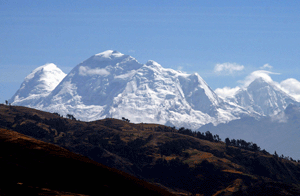
Gregory J. Rummo
Huascaran, Peru’s highest mountain at 22,205
feet was the site of a devastating aluvione
in 1970 that buried the village of Yungay,
killing 18,000 people. |
The
most serious aluviónes destroyed part of the city of
Huaraz in 1725 and 1941. There were also two destructive
“high-speed avalanches from the summit area of Huascarán
Norte (6,655 m asl) in 1962 and 1970 that destroyed several
villages and caused the deaths of more than 25,000
inhabitants.”
The
Greening Earth Society in its July 28, 2004 newsletter asks
the question: “Are glaciers, ice caps, and sea ice melting
worldwide because human industrial activity is causing
global warming? Geologic history says otherwise.”
“Ice ages have come and gone
for millennia in the absence of greenhouse gases being
produced by human industrial activity. In the Northern
Hemisphere, for example, a Medieval Warm Period (800–1300
A.D.) gave way to a Little Ice Age (1300–1900 A.D.), from
which we began to emerge only a century ago. The temperature
and ecosystem changes the warming and cooling periods
triggered are vastly greater than anything observed in
recent decades.”
The
cover story of the July 2004 National Geographic sheds light
on who, or more accurately what, is to blame: The Sun.
 |
|
If you enjoyed this column, imagine how much
you'll love Rummo's latest book! It's 536 pages
of sometimes humorous, sometimes poignant and
almost always provocative commentary on American
Culture.
Click here for more information.
|
“Sunspot activity has indeed been high over the past century
as Earth’s temperatures have climbed…” The writer was quick
to site a recent NASA report that states the “greater
luminosity [of the sun] seems to account for only half of
the global temperature increase…” But NASA’s hedging use of the phrase “seems
to account” is telling, especially in this context where
they seem to have an agenda predicated more on opinion than
the cold, hard facts of science.
If
greater sunspot activity is responsible for the observed
warming of the earth’s surface, there’s little we can do
about it.
But
waiting for the next Little Ice Age doesn’t help the people
of Huaraz where one good shake of the earth’s mantle may be
all it takes to wipe out half of their city in the time it
takes you to digest this column.
Or maybe not. Another group of scientists with the Tropical
Glaciology Group at Innsbruck University has undertaken its
own analysis of the satellite images. After careful
re-examination, they believe the “ominous crack” is nothing
more than a rock step in the glacier that has appeared due
to the thinning of the ice.
The
group has concluded that NASA’s warning was “a regrettable
miss-interpretation of the images which has not only caused
worry and panic among the approximately 100,000 inhabitants
of Huaraz, but has also caused a major economic damage to
the local tourism industry...”
n
Gregory J.
Rummo is an author and syndicated columnist. In July, 2004
he trekked through the Cordillera Negra in Peru's Andes
Mountains.
Contact him through his website,
www.GregRummo.com.
|