|
Deaths in our forests
Hemlock stands falling victim to
voracious insects
SUNDAY HERALD NEWS, AUGUST 29, 2004
Story and photos by
GREGORY J. RUMMO
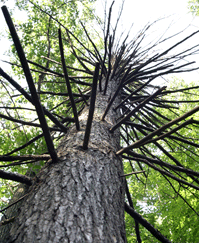 IF
STEPHEN KING had written the opening to this article, it
might go something like this: She had been a matriarch,
standing tall and strong for the last 80 years. Despite
living through the Great Depression, two world wars and
numerous frigid winters in the northeast, she had somehow
managed to weather these storms. But one day, she caught a
bug from Asia and slowly, her youthful vigor ebbed as the
life was literally sucked out of her. During those last
years, her limbs grew weak and became brittle. Her skin
began falling off in chunks, exposing the raw red flesh
underneath. It was as though she was suffering from Leprosy.
When we finally called in the surgeon he said there was
little he could do. In a last act of mercy, we cut her body
up in sections, and ran her limbs and trunk through a wood
chipper. IF
STEPHEN KING had written the opening to this article, it
might go something like this: She had been a matriarch,
standing tall and strong for the last 80 years. Despite
living through the Great Depression, two world wars and
numerous frigid winters in the northeast, she had somehow
managed to weather these storms. But one day, she caught a
bug from Asia and slowly, her youthful vigor ebbed as the
life was literally sucked out of her. During those last
years, her limbs grew weak and became brittle. Her skin
began falling off in chunks, exposing the raw red flesh
underneath. It was as though she was suffering from Leprosy.
When we finally called in the surgeon he said there was
little he could do. In a last act of mercy, we cut her body
up in sections, and ran her limbs and trunk through a wood
chipper.
It's a
sad day when a big tree dies—especially when it's in your
own backyard. But the 100-foot hemlock we had cut down
several years ago one bright spring day was no anomaly. It
was one among many in our neighborhood that suffered a
similar fate over the past 20 years. All had fallen prey to
an infestation of bugs which biologists have been seemingly
powerless to thwart.
This
fall, as the leaves of the deciduous forests undergo their
autumnal color transformation as a prelude to them dropping
off the trees, a plague of insects called the hemlock woolly
adelgids (HWA) continues its slow and silent defoliation of
the hemlock forests in the eastern United States. Here in
New Jersey, that means predominately Sussex, Morris,
Passaic, Bergen, Warren, Hunterdon and Somerset counties.
Most of
the hemlocks at risk—14,225 acres out of a total of
26,000—are located in Sussex County, New Jersey's
northernmost county bordering New York State. But you don’t
have to drive that far to see the devastation.
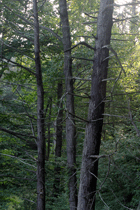 You
can take a short walk through my neighborhood in northern
Morris County on the Passaic County border. Here around Lake
Edenwold—the tiny 4-acre lake that laps at my backyard—there
is ample evidence of the defoliation. Scattered among the
maple, oak and other hardwoods in the woods, in people's
backyards and along the lake's shoreline are the pale gray
spikes that once were healthy eastern hemlocks (Tsuga
canadensis). In their prime, these trees had graceful
sweeping limbs covered with soft, green needles. They
created dense shade and provided nesting sites for a number
of song birds such as the blackburnian warbler,
black-throated green warbler and the blue-headed vireo, all
of which prefer the seclusion of hemlock forests to raise
their young. The dense shade underneath the trees also
shielded Kikeout Brook and its now virtually extinct
population of native brook trout from the hot summer sun,
preventing the small stream from becoming a simmering
consommé during the months of July and August. You
can take a short walk through my neighborhood in northern
Morris County on the Passaic County border. Here around Lake
Edenwold—the tiny 4-acre lake that laps at my backyard—there
is ample evidence of the defoliation. Scattered among the
maple, oak and other hardwoods in the woods, in people's
backyards and along the lake's shoreline are the pale gray
spikes that once were healthy eastern hemlocks (Tsuga
canadensis). In their prime, these trees had graceful
sweeping limbs covered with soft, green needles. They
created dense shade and provided nesting sites for a number
of song birds such as the blackburnian warbler,
black-throated green warbler and the blue-headed vireo, all
of which prefer the seclusion of hemlock forests to raise
their young. The dense shade underneath the trees also
shielded Kikeout Brook and its now virtually extinct
population of native brook trout from the hot summer sun,
preventing the small stream from becoming a simmering
consommé during the months of July and August.
But now
these once majestic trees—former centurions of a forest
primeval—are little more than dry, rotting corpses; home for
another year or two perhaps to a pileated woodpecker or a
wood duck until the next gale barrels through and snaps the
trunks in half, leaving the stumps to endure a more
humiliating fate; to a colony of carpenter ants or termites.
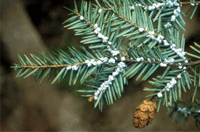 The
hemlock woolly adelgid is native to the Far East; Japan and
most likely China, where it is common but innocuous. They
are kept in check by natural predators. But here, there are
no natural predators hence; they are insidious, feasting
freely on hemlocks without any challenge to their voracious
appetite. HWA attack a hemlock in its petiole, the small
stem that joins the needle to the twig. Existing in three
stages; eggs, crawlers and adult females (all HWA are
females), they lay their eggs in the winter months from
December to February. They hatch beginning sometime in April
into first generation crawlers. It is the crawlers, or
nymphs, which do most of the damage during the growing
season. The
hemlock woolly adelgid is native to the Far East; Japan and
most likely China, where it is common but innocuous. They
are kept in check by natural predators. But here, there are
no natural predators hence; they are insidious, feasting
freely on hemlocks without any challenge to their voracious
appetite. HWA attack a hemlock in its petiole, the small
stem that joins the needle to the twig. Existing in three
stages; eggs, crawlers and adult females (all HWA are
females), they lay their eggs in the winter months from
December to February. They hatch beginning sometime in April
into first generation crawlers. It is the crawlers, or
nymphs, which do most of the damage during the growing
season.
They are
Lilliputian demons, microscopic vampires, attacking and
sucking the life out of the hemlocks. They accomplish their
dirty work by injecting a long, flexible hypodermic-like
tube called a stylet bundle into the base of the hemlock's
needles. The stylet bundle works its way into the tree's
xylem, and once there, it zeroes in on these cells where a
hemlock stores its food. Then, the little bugs go to work,
turning on the suction and siphoning out the tree's stored
food supplies. If the infestation is left unchecked, the
hemlock slowly starves to death over a period of several
years.
The HWA
problem, which started in southeastern Pennsylvania in the
1950's, first came to light in New Jersey almost 20 years
ago. In the mid-1990s, Mrs. Denise Royle, a graduate student
at Rutgers University did extensive work on a project
identifying areas of New Jersey's hemlock forests and their
relative health by utilizing infrared satellite images
dating back to 1984 and comparing them to images made in
1994. Working together with George Koeck, a Regional
Forester with the N.J. Forest Service, she used the
Geographic Information System (GIS) to calculate the total
acreage of remaining hemlock in the state and identify the
degrees of HWA caused defoliation. Entire tracts of hemlock
forest, more than 50 acres in Sparta Glen for example, were
almost completely defoliated as biologists stood by
helplessly and watched.
When I
first wrote about the HWA infestation in New Jersey in 1995,
I spoke to Koeck at length. At that time his prognosis for
the future of the hemlock forests was ominous. “For all
practical purposes, the hemlock forests in New Jersey are
doomed,” he told me in a telephone interview.
The
problem, he explained was finding a cost-efficient way to
kill the adelgids. While HWA infestations on ornamental size
hemlocks can be easily checked using either dormant oil
spray, a commercially available insecticide called Merit or
insecticidal soap, it is the forests of 100-300 year old
trees that would be next to impossible to treat by any means
due to the sheer physical size of each tree, the acreage
involved and the inaccessibility of hemlock stands. You
can't run a 10-mile length of garden hose into Waywayanda
Gorge and effectively spray a 300-year old hemlock. And
aerial spraying with an insecticide such as Merit, while
often effective, kills other beneficial insects including
aquatic species which then impacts fish and birds higher up
on the food chain.
But
there appeared to be a ray of hope in the late 1990s.
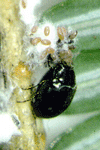 In
Japan, hemlocks are not at risk to adelgid infestations
because of a natural predator, a beetle known as
Pseudoscymnus tsugae. It has the peculiar culinary
penchant of dining almost exclusively on the hemlock woolly
adelgid. Studies were underway to introduce this predaceous
species to attack and kill the HWA or interrupt its life
cycle. Dick Reardon, an entomologist with the USDA Forest
Service explained that in 1990, a population of these
beetles was imported from Japan by Mark McClure, a scientist
with the Connecticut Agricultural Experimental Station.
Experiments began in the laboratory shortly thereafter and
the results were encouraging. By 1997, large numbers of the
beetles had been reared for release into infested hemlock
stands in the eastern U. S. In
Japan, hemlocks are not at risk to adelgid infestations
because of a natural predator, a beetle known as
Pseudoscymnus tsugae. It has the peculiar culinary
penchant of dining almost exclusively on the hemlock woolly
adelgid. Studies were underway to introduce this predaceous
species to attack and kill the HWA or interrupt its life
cycle. Dick Reardon, an entomologist with the USDA Forest
Service explained that in 1990, a population of these
beetles was imported from Japan by Mark McClure, a scientist
with the Connecticut Agricultural Experimental Station.
Experiments began in the laboratory shortly thereafter and
the results were encouraging. By 1997, large numbers of the
beetles had been reared for release into infested hemlock
stands in the eastern U. S.
“They
are a real good mortality agent on HWA and we are seeing
positive results in places like Connecticut, where we
released the beetles on individual trees in field plots of
hemlock,” Reardon told me when I spoke to him in 1998. It
was his hope that the beetles would be reared en masse
and subsequently released in the dozen or so states where
HWA infestations were the worst, New Jersey being among
them.
 |
|
If you enjoyed this column, imagine how much
you'll love Rummo's latest book! It's 536 pages
of sometimes humorous, sometimes poignant and
almost always provocative commentary on American
Culture. $19.95 shipping and handling included.
Click here for more information.
|
A year later,
such a program was well underway in New Jersey. Mark
Mayer, an entomologist with the New Jersey Department of
Agriculture, was overseeing the mass rearing and
releases of Pseudoscymnus tsugae at the
Department of Agriculture Philip Alampi Beneficial
Insect Laboratory in Ewing Township. In 1999, a total of
140,000 beetles were produced. 65,000 were released in
13 sites and an additional 67,500 shipped to other
states. The remaining beetles were held as rearing
stock. By early 2000, the state Department of
Agriculture had produced 230,000 beetles with more than
140,000 released in 1998 and 1999 in places like the
Newark Watershed around Clinton Reservoir and in the
Hemlock Ravine in Waywayanda State Park's northwest
corner. More releases were planned for later that year.
It was
quite literally aliens pitted against predators in a
miniature War of the Worlds that was playing out in
the state’s hemlock forests. But the prognosis still wasn’t
good. In 2000, Mayer told me, “We are in a race, but the
adelgid is way ahead.”
But four years later in 2004,
there may now be cause for some rejoicing. Brad Onken, a
Forest Entomologist and HWA Program Coordinator with the
USDA Forest Service out of Morgantown West Virginia is
hoping that New Jersey’s hemlocks may not all be doomed to
extinction.
One of the reasons has been
the weather; two successive colder than normal winters. Who
could forget the way we were forced to hunker down in our
homes last January for three weeks straight, bemoaning the
arctic blast that sent the mercury plummeting into the
single digits? Those frigid temperatures were freezing the
hibernating adelgids to death. “This [was] quite a blessing
for us as it offer[ed] an opportunity for established
predators like P. tsugae… to be better positioned to
build in numbers naturally,” Onken explained.
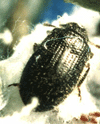 But
it wasn’t just meteorological serendipity that worked in the
hemlock’s favor. Two new predators of the HWA were
introduced into the environment. Laricobius nigrinus,
a native to British Columbia, was released in 5 other states
and there are plans to conduct releases elsewhere this fall
including New Jersey. But
it wasn’t just meteorological serendipity that worked in the
hemlock’s favor. Two new predators of the HWA were
introduced into the environment. Laricobius nigrinus,
a native to British Columbia, was released in 5 other states
and there are plans to conduct releases elsewhere this fall
including New Jersey.
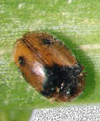 The
New Jersey Department of Agriculture Beneficial Insect Lab
has also begun rearing a second lady beetle predator,
Scymnus sinuanodulus, a native of China. The plan is to
begin releasing them in New Jersey and other states where
there are HWA infestations next spring. The
New Jersey Department of Agriculture Beneficial Insect Lab
has also begun rearing a second lady beetle predator,
Scymnus sinuanodulus, a native of China. The plan is to
begin releasing them in New Jersey and other states where
there are HWA infestations next spring.
“The
search for additional HWA natural enemies in China and
elsewhere where HWA originates will continue until we have
exhausted all opportunities,” Onken explains. “Our goal is
to establish a complex of HWA natural enemies throughout the
infested region to provide long term control of HWA. This
is not a quick fix but offers a self perpetuating means of
limiting outbreaks of HWA. We are focused on very host
specific (meaning the predators only feed on adelgids)
natural enemies so the risk of collateral damage to native
species is minimal.”
Onken
concedes the battle to save the hemlocks is a race against
time. “In the southern region such as the Great Smokies, the
clock is ticking faster. They have not had the winter
mortality of HWA as occurred in the Northeast and HWA has
been spreading like wild fire over the last couple of years
throughout the southern Appalachians. This area contains
some of the oldest and largest hemlocks in the East and the
timeframe to get this under control before we lose this
resource is down right scary.”
In the
battle of alien versus predators, I’m rooting for the
predators. But even if the predators are capable of keeping
the adelgid population in check, the adelgids have a huge
head start. Onken sounds an ominous note: “We do stand to
lose [the hemlocks] as an ecological component of eastern
forests.”
Not even
Stephen King could conjure up a more frightening scenario.n
Photos
of HWA infested hemlock and three predator beetles courtesy
of US Forest Service. For additional information, visit the
US Forest Service’s Hemlock Woolly Adelgid website.
Gregory J. Rummo is an author and a
syndicated columnist. His second book, “The View from the
Grass Roots—Another Look,” was published in August. Copies
may be purchased on the Internet from
the publisher.
A limited number of
autographed copies are available directly from the author at
GregRummo.com.
|