The year was 1932. Under the
auspices of the China Inland Mission, or CIM,
John and Betty Stam were sent out from the
Madison Avenue Baptist Church in Paterson as
missionaries to China. Two years later, on Dec.
6, 1934, Tsingtao, the city where they were
ministering, was captured by the Communists.
The Stams were arrested and all
their possessions confiscated. Incredibly,
amidst all the rioting and looting, John Stam
was able to scribble a letter that fell into the
hands of the CIM headquarters. The letter
explained that their captors were demanding
$20,000 for their release. But their release
never occurred.
Two days later, they were led from
their prison and taken to a clump of pine trees
on a hill a short distance from the town. As
Communist agitators addressed the gathered
crowd, John and Betty Stam were beheaded -
martyred for their missionary work.
The Stams were a gentle couple. They
went to China, hearts filled with love for the
Chinese and in obedience to the Great
Commission: "Go into all the world and preach
the Gospel to every creature," (Mark 16:15).
It can be difficult for many people
to understand what good could result from the
deaths of dedicated Christian missionaries who
minister in a foreign country, to a people who
are not their own, who speak a different
language and embrace a different culture.
But another such case, made into a film, will
open later this month in theaters nationwide. It
recounts the story of five missionaries who were
speared to death in the Amazon rain forest in
1956 by a Stone-Age tribe of Indians known as
the Aucas.
Jim Elliot, Pete Fleming, Nate
Saint, Ed McCully and Roger Youdarian were
American missionaries working in Ecuador. They
had learned of a savage Indian tribe that had
killed several Shell Oil company employees. The
Aucas were so violent that six of every 10
deaths were homicides committed against each
other by spearing.
Fearless, the missionaries initiated
contact through an ingenious method of lowering
a bucket of gifts from a small airplane. As Nate
Saint flew the bright yellow single-engine Piper
PA-14 overhead, banking it in a tight circle, a
bucket was lowered on a long rope. It remained
nearly motionless, just long enough for several
curious Aucas to help themselves to the
contents.
This continued for several months.
Thinking they had gained the tribe's trust, the
missionaries landed their plane on a sand bar in
the Curaray River. Over the ensuing days, they
made several friendly, face-to-face encounters
and even gave one of the Aucas, Naenkiwi, a ride
in the plane. But on January 8, 1956, all five
missionaries were attacked and brutally
murdered.
The world recoiled in horror.
The images of the mutilated bodies,
recovered from the Curaray River, appeared in
newspapers across the county. LIFE Magazine ran
a 10-page story on the incident. It seemed to be
nothing more than a tragic loss.
But what happened next could be
viewed as one of the greatest acts of
forgiveness in the 20th century: Two years
later, Elisabeth Elliot, Jim Elliot's wife, and
Rachel Saint, Nate Saint's sister, went to live
with the tribe, now known as the Waodani. The
women studied the tribe’s language and learned
their culture. Their demonstration of
forgiveness to the men who murdered their loved
ones so moved the Waodani, they were given the
opportunity to share the greatest story of
forgiveness—Christ’s death on the cross. Many of
the Indians were converted to Christianity. The
murder rate dropped 90 percent.
Years later, Steve Saint, Nate
Saint's son, moved his family from Florida to
live with the Waodani. His children now call
Mincaye, one of the tribal elders,
"grandfather," even though he killed their real
grandfather.
Sunday, January 8, marks the 50th
anniversary of the deaths of these five
missionaries.
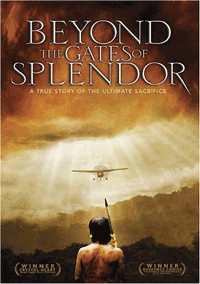
In 2005, a 2-hour documentary, "Beyond
the Gates of Splendor," was released on DVD.
It recounts this story of forgiveness that
sprang from martyrdom with interviews of
Elisabeth Elliot, Rachel Saint and the wives and
colleagues of the other missionaries. Many of
the Waodani also appear in the documentary,
which contains original footage shot in the
jungles of Ecuador.
On January 20, "End
of the Spear," will open in 1,200 theaters
across the country. The movie stars Louie
Leonardo ("Law & Order," "ER" and "Charlie's
Angels") as Mincaye and Chad Allen ("St.
Elsewhere," "My Two Dads," "Our House" and "Dr.
Quinn, Medicine Woman") who plays both Nate
Saint and his son, Steve.
"End of the Spear" tells the story from the
Waodani's point of view, showing how this
extraordinary act of forgiveness led to an end
of tribal violence and deep, caring friendships
for the children of the men that were murdered.
On October 28, 1949, Jim Elliot
wrote in
his diary, "He is no fool who gives
what he cannot keep to gain that which he cannot
lose."
In a little more than six years and
two months, Elliot's words were played out in
his death.
n