We
have had over 100 years to learn from our mistakes when
the hallowed streams fished by Gordon were almost
destroyed by men bent on plundering the Earth’s natural
resources...Unfortunately, you don’t have to look far to
find the evidence for a similar disaster in the making
on one of our own hallowed trout streams.
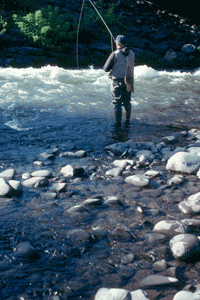 |
| The
rivers of the Catskills were the birthplace
of fly fishing in America. |
If you
drove by any of New Jersey’s streams yesterday you may
have noticed gaggles of anglers congregating along the
riverbanks. Trout season opened on Saturday and, as
always here in our state where the fishing is mostly
“put-and-take,” everyone and his grandmother was decked
out in neoprene, standing elbow to elbow in the water,
trying to catch a trout by any of several methods
including salmon eggs, worms, spinners, baitfish and
artificial flies.
In most
years, Opening Day is more of a ritual than an
opportunity to actually enjoy fishing. It’s usually
still pretty chilly, falling shortly after spring’s
arrival. But nonetheless, it offers an opportunity to
get out of the house, where we’ve been held captive by
the elements for the last four months and subjected to
shorter hours of daylight.
By May, the crush has
subsided. The weather has also warmed and the trees are
starting to leaf out and are filled with warblers,
Baltimore Orioles and other songbirds. It is during this
period that the purists emerge: Those anglers, who
believe the best and the only method of catching the
trout is with the artificial fly.
Fly fishing has its
roots in England where two men; Frederick M. Halford and
G.E.M Skues developed angling techniques using the
artificial fly. Trout flies can be separated into two
general groups; those that float on the surface of the
water are called dry flies; imitations that are designed
to sink are called wet flies. Halford was a dry fly
snob. Skues concentrated on imitations fished below the
surface.
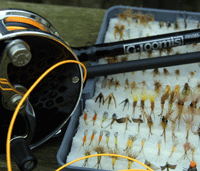 |
| An
assortment of dry flies imitating the adult
stages of various stream-borne insects.
|
Fly fishing made the jump
over the big puddle to America during the late 19th
century to the rivers of the Catskill Mountains. It was
there that the man credited with its American genesis
lived in a small farmhouse for the last ten years of his
life.
Theodore Gordon is the
acknowledged father of American fly-fishing. Born into
wealth in 1854, he spent the better part of his life
following two pursuits; a failed business career selling
securities for which no one remembers him and refining
the techniques for fishing for trout with the artificial
fly. It is the latter that has become practically
synonymous with his name. The Quill Gordon is a very
effective trout fly he developed to imitate the adult
stage of the mayfly Epeorus pleuralis, found
throughout the trout streams of the Northeast.
Gordon was something of
a recluse. He moved from the big city to escape the
cacophony of modern life to a small cabin on the
Neversink River where he lived until succumbing to
tuberculosis. Despite his appearance on the scene of
American angling during what are considered the halcyon
days of fly fishing, the rivers of the Catskills were
just recovering from the brink of destruction.
Prior to the Civil War,
the Catskills were covered with old growth forests
consisting predominately of hemlocks. These evergreens
kept the mountains cool during the summer and their
roots held the soil in place.
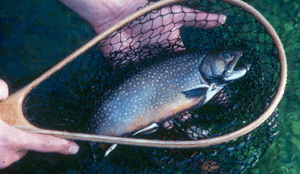 |
| A brook
trout, one of several native species in
American trout streams. |
But suddenly, America
was at war with itself. The demand for leather goods,
boots in particular, for the armies of the North and
South rose dramatically. Hemlock bark is a rich source
of tannin, used in the production of leather. Vast
stands of these majestic trees were clear cut and
stripped of their bark. With the shade gone and nothing
to hold back the soil, the rivers of the Catskills
warmed and became silted. The native brook trout, a
species sensitive to changes in the environment, was
driven to extinction in all but the tiniest brooks and
creeks at the highest elevations. Populations have never
fully recovered to this day.
As the rivers of the
Catskills slowly recovered, the brown trout, a less
sensitive species, was imported from Europe and
introduced in America. At first this met with some
resistance. But the brown trout could survive in warmer
water and proved to be just as challenging a game fish
as the native brook trout.
Throughout the 20th
century, fly fishing techniques were further refined
giving rise to a new breed of angler-environmentalists.
A full creel of dead trout no longer was the measure of
a successful day spent on the stream. The focus shifted
to learning about the trout’s habitat, the aquatic
insects upon which they fed and developing an acute
sensitivity to any environmental threat that could
affect adversely the water quality of the rivers and
streams in which the trout lived. “Catch and release”
was practiced on many streams, insuring that there would
be enough trout for others to enjoy.
I’d like to believe
that such a holistic approach to angling would be
sufficient to kindle an environmental awareness of the
importance of our water resources. We have had over 100
years to learn from our mistakes when the hallowed
streams fished by Gordon were almost destroyed by men
bent on plundering the Earth’s natural resources.
The assumption is
admittedly naïve. You don’t have to look far to find the
evidence for a similar disaster in the making on one of
our own hallowed trout streams.
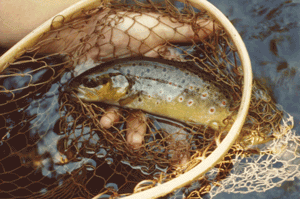 |
| A
Pequannock River wild brown trout.
|
The Pequannock River
is a lovely trout stream flowing along the border of
Passaic and Morris Counties. In addition to receiving
regular stockings of rainbow and brook trout, the river
nurtures a population of wild brown trout. The lower
portion is a miracle of sorts, tumbling over
algae-slicked rocks as it flows past dumpsters and strip
malls through the suburban hamlets of Bloomingdale,
Butler and Riverdale.
But the bigger problem
for the Pequannock and its population of wild brown
trout is not cosmetic. There’s a battle raging over the
quality of the water itself.
Ross Kushner is the
Executive Director of the Pequannock River Coalition.
Over the past 10 years, his organization has become
concerned about elevated water
temperatures in the river which caused a substantial
fish kill in 1994 and a less-severe kill in 2002. The
organization initiated a temperature monitoring program
in 1994 to determine the sources and extent of these
problems. Based on the data, several portions of the
Pequannock River and several Pequannock River
tributaries were listed as “impaired” for temperature in
2002 and 2004 by the New Jersey Department of
Environmental Protection. Additional study by the NJDEP
confirmed that lack of sufficient river flow resulting
from insufficient water releases from Newark-owned
reservoirs is the cause of almost 80 percent of the
river’s temperature problems.
In
August, 2004 the NJDEP issued new permit requirements
for the City of Newark in its diversion permit for the
Pequannock River, including requirements for minimum
river flows, both between the City’s reservoirs and
below their reservoir system which feeds the lower
river.
“These
permit conditions were immediately challenged by the
City of Newark,” Kushner says. “Negotiations between the
NJDEP and the City have dragged on ever since. It has
now been more than 18 months since this modified permit
was released, with no improvement in river flows and no
enforcement of the new permit conditions.”
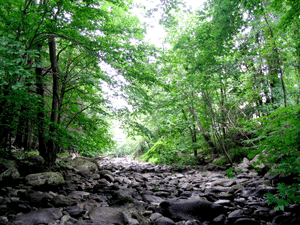 |
|
The Pequannock
River during the summer of 2005 below
Charlottesburg Reservoir on the border of
Kinnelon and West Milford. (Photo courtesy
of Ross Kushner.) |
During the summer
of 2005, the Pequannock River virtually disappeared in
some places due to a complete lack of water releases
from Newark-owned reservoirs. “Zero flow rate[s] w[ere]
seen on the lower Pequannock without a declared
drought,” Kushner said. “Also, temperatures recorded in
the lower Pequannock last summer were higher than any we
have measured in the past, topping out at nearly 80
degrees.” Kushner recently heard that the City of Newark
is requesting DEP authorization of a multi-year study in
the Charlottesburg Reservoir before any decision is
reached on the permit conditions. “We see this study
only as an excuse for a long delay,” he said.
In
January, the PRC contacted Lisa Jackson, the new DEP
Commissioner, for an opportunity to discuss this issue.
“We haven’t heard back from her yet,” Kushner said. “It
will be interesting to see where she stands.”
The
native brook trout of the Catskills were almost driven
to extinction during the 1800s by the tan lords. Will
the wild brown trout of the Pequannock suffer a similar
fate at the hands of the water lords in the City of
Newark?
It’s
spring now. The weather is cool and there’s plenty of
water. But summer is coming. Kushner sounds a defiant
note: “We insist that the time for action has come. I’m
certain we will win in the end. The question is, will
the DEP come through on their own, or do we need to haul
them into court for failing to meet their obligations?” n
Gregory
J. Rummo is a syndicated columnist.