I'll
never forget that morning in May. I was sitting in my
backyard sipping a cup of coffee before most of the
world had awakened. It was cool and a thin veil of fog
shrouded the neighborhood, making it seem as though our
tiny yard was an isolated oasis in the middle of
Paterson.
Then I saw him. I almost bolted out of my chair but,
fortunately, caught myself or I would have most
certainly spooked a stunning male rose-breasted grosbeak
that had perched on my birdfeeder only a few yards from
where I sat.
I was transfixed for the moment, the cup of coffee
frozen en route to my mouth for fear that any movement
would frighten the bird away. Unaware of my presence, he
leaned forward taking a few seeds into his beak. Deftly
separating the husks from the kernels, he paused, went
back for seconds, and then was gone.
Moments like these are not everyday occurrences. The
rose-breasted grosbeak is a migratory species that makes
its appearance in our area in early May. Some settle
down to nest and raise a family in the wooded areas
fringing the big city but most move on to quieter
surroundings.
 |
|
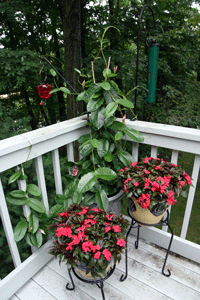
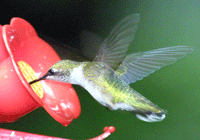
Red flowers on
the author's deck lure hummingbirds to the
nectar feeder. |
Stepping
stones
Most suburban backyard birdfeeders serve as temporary
rest areas, called "stepping stones," for a host of
migratory species. Unfortunately, if all you have to
offer these travelers is food, they will continue on
until finding a place that is more hospitable. The idea,
then, is to create a habitat that will not only attract
a larger variety of birds but that will also make them
want to stay and settle down for a while. Think of it
like this: Birds want more than a fast-food restaurant.
They are more comfortable in a bed and breakfast.
If you
build it, they will come
Birds are a lot like humans in this regard. Give them
food, water, shelter and a place to raise a family and
most are content to put down roots for a while. So, with
a little careful planning and some work, you can create
a tiny wildlife sanctuary in your yard or even on a
small deck or a patio that will attract a larger and
more colorful variety of birds.
Ira Grindlinger, the owner of Wild Birds Unlimited in
Paramus, explains that the average suburban backyard is
visited by 15 to 25 bird species over the course of a
year. "By providing these four elements - food, water,
shelter and a nesting site - the number of species can
double and in some cases triple," he says.
Birds require a steady and reliable source of food and
water offered in a secure environment. They also need a
place to build their nests where they can raise their
young. Once such a haven has been discovered, they will
remember its location and will return. If they nest in
the area, their young will imprint on their surroundings
and they will return, beginning a trend that can span
generations.
|
 |
 |
|
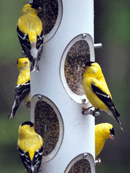
A feeder full of
male Goldfinches |
A female
Red-throated Hummingbird |
 |
 |
 |
|
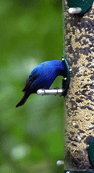
An Indigo Bunting
buries its head in the feeder |
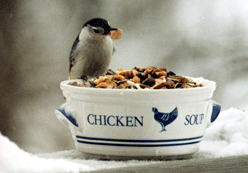
A White-breasted
Nuthatch chows down on a piece of a peanut on a
cold, wintry morning |
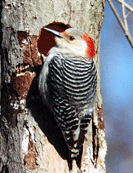
A Red-bellied
Woodpecker hollows out a home in a maple tree
in our front yard |
Feeding
the birds - a commitment
The first thing you must decide is, are you willing to
make feeding the birds a commitment? It's almost like
keeping a dog or a cat. You wouldn't think of letting
Fido or Tinkerbelle go a week without food or water. If
you want to keep the birds coming year round, you must
keep your feeders and your water dishes full or your
feathered friends will check out and eat at someone
else's breakfast nook.
 |
|
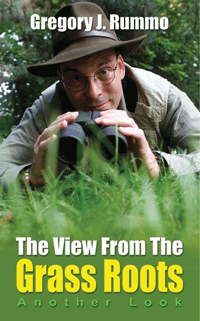
The complete story of the adoption of his first
daughter, Wu Min Jian appears in Rummo's
second book, “The View from the Grass
Roots—Another Look.” It's 536 pages
of sometimes humorous, sometimes poignant and
almost always provocative commentary on American
Culture. $14.95 shipping and handling included.
Click here for more information.
|
You may be able to slide somewhat on your caretaking
responsibilities during the summer months, when insects
abound and the birds are off devouring mosquitoes and
other tasty airborne morsels. But during the winter and
the spring, you can take advantage of the dearth of
natural food and attract a greater number and variety of
birds that will remain faithful to your backyard
throughout the year.
Food and
water are not enough
Birds also require security. They don't like eating or
drinking in exposed areas. Several years ago we moved to
northern Morris County. There is a four-acre lake
literally lapping at my backyard. You'd think that would
provide ample water for the birds that come into our
yard, but they prefer to drink from my birdbath.
Why? It's in a sheltered location, not out in the open
like the lake's shoreline, where they would be exposed
to predators. Backyard feeders and sources of water
should be placed in areas near small trees or bushes in
order to provide a place of refuge to which birds can
flee or where they can simply perch and feel secure in
between morsels.
Offer
them a home
Ornamental evergreens like hemlocks and andromedas
afford nesting sites among their dense branches for
cardinals, robins, blue jays and other platform
builders. These birds weave sticks into the branches to
build their nests. Other species such as woodpeckers,
chickadees and nuthatches build their nests inside tree
cavities. You can lure cavity nesters into your yard by
hanging nest boxes of the appropriate sizes in secluded
spots.
The National Wildlife Federation is featuring a program
to certify backyards as wildlife habitats. Among the
criteria required are a source of water, which can be as
simple as a bird bath; plants with berries or fruit, a
bird feeder or flowers with a source of nectar; a
nesting box or a brush pile, dead tree or thick shrub;
and a chemical-free environment.
Don't think you have what it takes to make your backyard
or your patio a wildlife sanctuary? You'd be surprised.
Grindlinger offers some encouragement: "There are
actually some fire escapes that meet the criteria for a
certifiable wildlife habitat. They may just have a bird
feeder, a birdbath and a potted ficus tree, but they
still meet the criteria despite being in the middle of
New York City."
Visit www.nwf.org for
more information.
n