Canchirao is a
place you’ve probably never heard of. You’ll not find it
on any map of Peru. It’s a tiny Quechua village located
11,500 feet above sea level in the Cordillera Negra in
the Andes Mountains. In early August I spent a day and a
night there with a group of 25 Christians from the
States; 10 members of the Madison Avenue Baptist Church
in Paterson, NJ, three high school students from
Hawthorne Christian Academy also in NJ and 12 members of
Trinity Baptist Church located in Jacksonville, Florida.
Accompanying us on the trek were our Quechua guides who
also serve as itinerant evangelists.
Our mission was to assist these evangelists in
their work of spreading the Gospel, largely accomplished
in this area of the world by distributing portions of
the New Testament translated into Quechua and Spanish
along with a nightly showing of “The
Jesus Film,” a popular movie about the life of
Christ available in over 900 languages and dialects.
Since 1979, over 6 billion people have either watched
this movie or listened to the audio version of it.
 |
|
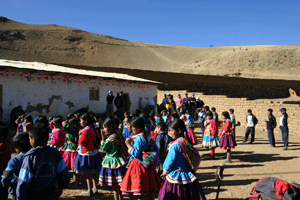
In Canchirao the hillsides are barren
because of a drought |
This was
my fifth such trek through the Andes. But on this day we
were about to walk into a situation like none other I
had ever experienced before on any of my previous treks.
Our day
started around 8:30 a.m. when we left a small
village where we had spent the night. We knew we had a
long, arduous journey ahead of us. Our guide, Adelid
explained we had to hike up and over a mountain pass
close to 13,000 feet in order to get into the next
valley. The hot, middy sun burned through the thin air
reminding us that this area of Peru is a desert. Each of
us carried 3 liters of water. For most, that would only
be a half-day’s supply.
We walked
for several hours, climbing slowly until stopping for
lunch at a small, community building that offered some
shade. One of the locals offered us some water and we
pumped several gallons through our portable water
filters, filling our empty Nalgene bottles. We then set
off for the steeper ascent up to the pass. This took
almost another two hours. Finally arriving at 12,750
feet, we rested, knowing the walk was now downhill for
the rest of the day.
 |
|
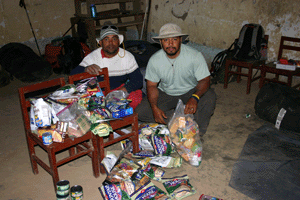
Robert De Aza Arache and Luis Guzman,
members of Paterson's Madison Avenue Baptist
Church, with some of the food collected from
the trekkers. |
The trail
down was steep and very dusty. Several of us lost our
footing, slipping and sliding on the loose gravel and
the fine, red-brown powdery soil. We quickly became
covered in dust. It filled our noses and stung our eyes.
You could taste it.
An hour
later—hot, filthy and sweaty—we arrived at the small
school in the village of Canchirao. We had walked for
days to get to this village, passing and stopping in
other villages where fields of wheat and corn were
cultivated on the steep hillsides. Although the ground
was generally dry in these parts of the Andes at this
time of year, there was still some water in the rivers
and streams that was used for irrigation.
But not
here.
 |
|
The complete story of the adoption of his first
daughter, Wu Min Jian appears in Rummo's
second book, “The View from the Grass
Roots—Another Look.” It's 536 pages
of sometimes humorous, sometimes poignant and
almost always provocative commentary on American
Culture. $14.95 shipping and handling included.
Click here for more information.
|
Some of
the teens in our group immediately set out to find a
small stream in which they could get cleaned up. All
they were able to find was one, three-inch pipe that
delivered a trickle of water. We would soon learn that
this was all the water this village had for a population
of almost 200 people.
Our Quechua leaders spoke to some of the older people in
the village who had assembled at the school to watch us.
What they learned was shocking. Canchirao was in the
middle of a horrible drought. The stream had all but
dried up. The crops had failed. The people were sick and
starving.
It quickly became apparent to all of us that we were
faced with a different mission.
With only one day remaining in the trek, everyone went
through his remaining food which consisted largely of
snacks like granola bars, packages of lunch meats and
dehydrated meals. We quickly assembled a huge pile of
food in the middle of the schoolhouse room. It would be
enough to sustain these people for several days until we
could arrange for more supplies to arrive.
That night during the showing of “The Jesus Film,” our
Quechua leaders announced to the assembled villagers
that in the morning we would distribute the remaining
food we had in our duffel bags to the 120 students in
the school.
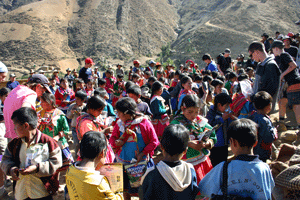 |
|
Distributing food to the schoolchildren in
Canchirao |
The next
morning the entire village assembled in front of the
school. One of the professors, Julio Avelina Garcia,
addressed the large crowd. “Our people are sick and
starving. We brought our case to the local government
but no one offered to help. Then, all of a sudden, the
visitors appeared.” We were given a round of applause as
we passed through the crowds, distributing the food to
the grateful schoolchildren.
We walked out of Canchirao later that morning, hiking 13
miles down the steep trail to the larger village of
Yuatan where we left money and made arrangements with
the sister of one of our guides who lives there to
purchase flour, wheat, sugar, rice and other food
supplies that would be picked up by some of the men from
the village later that same week and brought back on burros.
But just
before leaving Canchirao, something else happened. It
was something I will never forget. One of the older
children from the village brought us an offering—a bag
of small, gnarled potatoes—to show the people’s
appreciation for our sacrifice. It was they who had made
the real sacrifice, giving us a gift from out of their
poverty. It served as a reminder to us of the words of
Jesus, “It is more blessed to give than to receive.” n
Additional
photos from this year's Andes Trek may be viewed on
the author's Blog site.
Gregory J. Rummo is a businessman and writer.
Contact him through his website,
GregRummo.com