 |
|
Gregory J. Rummo
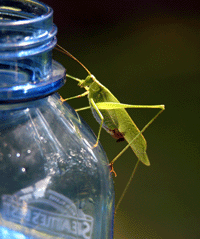
A katydid
inspects its world from high atop a water
bottle. |
Of
the many sounds of nature I enjoy, one of my favorites
is the cacophony of a backyard filled with katydids,
those big fat green bugs that start singing around dusk
sometime in late summer. Later this month or during the
first week of August, depending on the weather, the
first ones will begin their annual symphony from the
treetops of the more wooded suburbs.
When we first moved to New Jersey back in 1986, we lived
in Paterson, where there are few trees and fewer
katydids - at least in my old neighborhood. But when we
moved to the foothills of the Highlands my desire to be
serenaded by this creature's nightly symphony was
finally satisfied. There is simply nothing like falling
asleep to their sweet lullaby on a cool summer evening
with all the windows open.
The katydids that are indigenous to our area are "leaf
katydids." They are large, bright green winged insects
that blend in with the green canopy of the maples and
oaks and the other hardwoods of the deciduous forest.
Good thing, too, because they make a succulent meal for
a bat or any other winged critter lucky enough to
discover one.
Katydids are members of the Orthoptera family and are
relatives of crickets and grasshoppers. They hatch from
eggs deposited the previous year on tree bark or
branches sometime in July, then undergo several molts
until reaching a healthy three inches in length.
God has a sense of humor and I believe he demonstrates
it among the members of the animal kingdom in the
unexpected twists exhibited by the sexes. With the
birds, the males are the more attractive, the females
being drab in coloration. A similar surprise has been
engineered into the katydids - the males do all the
talking. Their familiar song - "katydid, katy-didn't" —
is made when the insect stridulates, or rubs its left
wing on a ridge on the right one.
Interest in the katydid is apparently widespread and
even passionate. I am not the only one in journalistic
circles to write about them. The katydid has been the
subject of editorials in some large newspapers. "A
Bumper Year for Bugs" ran on The New York Times' Aug. 8,
1994, editorial page. The newspaper reported their songs
were "(l)ouder, definitely louder. That is the emphatic
if impressionistic judgment about the nightly katydid
chorus this August, ventured by a dozen householders and
nature-watchers from Georgia to Connecticut."
The katydids will soon be serenading those of us lucky
enough to share our backyards with them for the rest of
the summer and on into autumn, until the cold weather
finally sounds the death knell and shuts down their
little boomboxes for another year. But not to worry -
these harbingers of summer will return to the trees on
schedule next year, as they have done, like clockwork,
for millennia.
If you are feeling left out at this point because you
live in the heart of the city and don't get up to Garret
Mountain that often to listen to the nightly serenade,
don't worry. Nature has something else planned for you,
but it's a daytime concert. The first cicadas crawl out
of the ground early this month to begin their incessant
buzzing.
|
 |
 |
 |
|
Roy Troutman photos
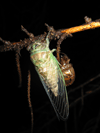
An annual cicada
crawls out onto a branch, splits its skin and
emerges as the adult. |
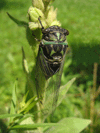
An adult annual cicada on a weed. The bugs
darken several hours after emerging. |
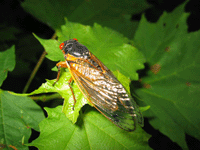
Periodical cicadas (Magicicada) emerge
every 13 or 17 years en masse in what are
termed broods. |
Cicadas are the other loud bug of the summer. Unlike the
nocturnal katydid, cicadas produce their song during the
day using a pair of tymbals, or ridged membranes,
located underneath on their abdomen, a portion of which
is hollow and acts as a resonating chamber.
There are two general types of cicadas: the annual and
the periodical species, called Magicicada. Annual
cicadas are fat green bugs that emerge during the first
week of July. They spend anywhere from two to five years
underground and their emergence is staggered, ensuring
there is always a representative population of them in a
given year. In contrast, the Magicicada are black with
distinguishing red eyes. They emerge every 13 or 17
years, en masse.
The University of Michigan Museum of Zoology's
Periodical Cicada page explains the reason behind
this mass exodus of Magicicada:
 |
|
The complete story of the adoption of his first
daughter, Wu Min Jian appears in Rummo's
second book, “The View from the Grass
Roots—Another Look.” It's 536 pages
of sometimes humorous, sometimes poignant and
almost always provocative commentary on American
Culture. $14.95 shipping and handling included.
Click here for more information.
|
"Although nearly all of the periodical cicadas in a
given location emerge in the same year, the cicadas in
different regions are not synchronized and may emerge in
different years. All periodical cicadas of the same
life-cycle type that emerge in a given year are known
collectively as a single 'brood' (or 'year-class'). The
resulting broods are designated by Roman numerals -
there are 12 broods of 17-year cicadas (with the
remaining five year-classes apparently containing no
cicadas), and 3 broods of 13-year cicadas (with ten
empty year-classes). As a result, it is possible to find
adult periodical cicadas in almost any year by traveling
to the appropriate location."
The last noteworthy emergence of Magicicada in New
Jersey occurred in 1996 when the so-called Brood II
blanketed the state in some regions. In Bedminster, the
woods were literally alive with swarms that produced an
eerie and deafening sound that propagated through the
deciduous canopy like waves. It was reminiscent of the
sound made by the mutant ants in the 1954
science-fiction thriller "Them." Large emergences can
produce more than a million Magicicada per acre.
The emergence of Brood II was in stark contrast to the
relatively disappointing no-show of Brood X last year.
The 2004 emergence had been hyped by the media as "rival(ing)
locust plagues promised in the Bible," says Dan Mozgai,
who runs a Web site dedicated to cicadas called
CicadaMania.com.
"People in New Jersey assumed that the entire state
would be inundated, but this was not the case. In any
given state in which Magicicadas emerge only a select
number of counties and towns will experience them," he
explains. "It is also common for cicadas to emerge in
vast numbers on one side of a town, while on the other
side of town, only a handful will emerge. A new housing
development will probably have zero cicadas, while the
woods across the road might be chock full of them."
We'll probably have to wait until 2013 for the next
spectacular appearance of Brood II, although Brood XIV
is scheduled to make an appearance in our area in 2008.
Mozgai cautions it probably will not amount to much: "A
few scattered emergences here and there, if at all, he
says. "Brood II is the most impressive of the three
broods that inhabit New Jersey."
Till then, aficionados will have to be content to listen
to the daytime songs of the annual cicadas. Meanwhile
another small consolation: Those of us who appreciate
the nocturnal symphony of katydids can sleep with the
windows open.
n