EARLIER THIS SUMMER, on a very
steamy first day of August, I sat with several friends
in Panera Bread on Route 23 south in Wayne, sipping a
strong morning cup of coffee and contemplating the trip
that lay before us. The weatherman had warned it would
hit 100 degrees. But we were bound for Peru, to the
Andes Mountains, south of the Equator, where it was
winter.
The Andes
are enchanting. They are home to ancient civilizations;
the Huari and the Inca lived there centuries ago. It is
a place of vast punas—high plains grasslands—that
stretch to the horizon, and then suddenly rise steeply
to become glacier-encrusted mountains towering over the
valley floor miles below.
It is a
place from which I cannot escape—when I am there and
when I am here—for my thoughts constantly go back to the
sights and sounds—the sun rising on the massive eastern
faces of Huandoy, Huascaran and Chopicalci; to the haze
of blue smoke and the aroma of eucalyptus wood fires
from a hundred adobe houses scattered in pueblos
throughout the region; to the people, the half-million
indigenous Quechua inhabiting the Callejon de Huaylas,
the sprawling valley that lies between the twin ridges
of the Andes: the Cordillera Blanca and the Cordillera
Negra.
It is the place of
Inca Huancanca—“where the Inca cried”—and I too cry
when I daydream of this place that has grown so close to
my heart.
Later that afternoon
the ten of us departed from Newark’s Liberty
International airport for an adventure, a “vacation with
a purpose” in the words of Pompton Lakes’ resident
Gabriel Bustos, one of the members of the group this
year. This was his second trek in two years. His eyes
well up whenever he thinks of Peru. “He hasn’t stopped
talking about the trip since he got home,” his wife Mary
Beth explains.
“Adventure” is a description which only partly
characterizes what has become an annual event simply
known as “Andes Trek” to its devotees. It is in fact a
10-day missions trip, something that has become popular
in evangelical circles over the past 25 years.
Roy Seals,
the director of Global Faith Missions, in Chattanooga,
Tennessee, who has himself been on two Andes treks
explains:
“While adventure is
part of the Andes Blanket program, the primary focus is
on people. When Jesus saw the multitudes, the Bible
says, ‘He was moved with compassion.’ The Biblical
definition of compassion demands action and that is what
the Andes Blanket is all about: People meeting the needs
of people. Those who go must be willing to get out of
their comfort zone, use their own financial resources,
travel to a different country with a challenging
environment to meet the needs of people.
As much as I remember
the magnificent Andes Mountains, the memory of Quechua
Indians is what stirs me the most. People eagerly
running down the side of a mountain to receive the
Bibles we distribute; listening attentively as we shared
the Gospel in their town square or as they viewed ‘The
Jesus Film.’ Young Quechua Indians who studied our
faces, elderly Quechua Indians who looked to us for
assistance with their needs, young Quechua adults who
wondered why we would travel all the way to their
distant land to visit their remote mountain villages. It
is the memories of these people that stirs the greatest
emotion from me.”
After landing in Lima
around 10:00 p.m., we boarded a bus for the 8-hour
overnight trip to Huaraz, the shining star of the
Callejon de Huaylas and home to more than one-hundred
thousand Quechua. The ride took us north along Peru’s
Pacific coastal desert on the Pan American Highway for
100 kilometers. Much of the landscape here is gray and
foreboding, barren of all life. It is a no-man’s land,
reminiscent of the fictional planet Tatooine, the
birthplace of Star War’s hero and Jedi Knight Luke
Skywalker.
Eventually
this main artery becomes less of a highway and more of a
road, passing through several small, noisy towns where,
during daylight hours, outdoor fruit and vegetable
markets toe up to its edges.
On the
outskirts of Pativilca stands an innocuous, green sign
with an arrow pointing to the right. “Huaraz 200 KM,” it
announces. You could miss it if you weren’t paying
attention. Fortunately our driver doesn’t. From here at
sea level, it’s uphill for the next three hours through
the southern Cordillera Negra on a sinuous road that
winds back and forth through hairpin curve after hairpin
curve. There are no guardrails. One misjudged turn would
spell almost certain death. Fortunately I took a
Dramamine at the airport several hours ago so I sleep
through most of the excitement.
They say
ignorance is bliss. What I did not know at the time (and
only later learned when we stopped in Catac, a small
village just outside of Huaraz) was that since leaving
the airport the inside rear left tire had gone flat. We
all assumed the rhythmic thumping was engine noise or a
sloppy differential with lots of accumulated mileage.
Every once in a while you read of a tourist bus plunging
over the side of one of these mountain roads. We had
only just begun our journey and already had experienced
the promise of God’s protection.
The bus
climbs ever higher through the villages of Chasquitambo,
Raquia and Cajacay until arriving at the Conococha pass
at 13,260 feet. Here, the treeless grasslands stretch
out into the east before rising into a spectacular group
of snow-capped mountains. These are the southern nevados of the Cordillera Blanca. It’s shortly after
sunrise and a ghost-like bank of clouds has crept over
much of the puna. We stop for a bathroom break. The air
is very chilly and noticeably thinner. I wonder to
myself if it’s the lack of oxygen or the view that is
breath-taking. A few become dizzy and retreat back into
the warmth of the bus but not before taking in the
awesome spectacle of the Andes, a sight no less
spectacular after six trips than when I first laid eyes
on them in 1999.
“There’s
Huascaran,” I announce like a tour guide, pointing out
the unmistakable twin peaks of Peru’s highest mountain,
visible in the distance almost 100 KM to the north.
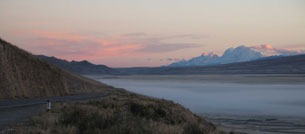 |
At the Conococha Pass
over 13,000 feet. The sun rises in the eastern sky.
Huascaran, Peru's highest mountain, is visible
in the distance. |
Finally,
almost 24 hours since leaving Panera Bread, the bus
pulls up at the Wycliffe Language Institute in Huaraz, a
small campus belonging to Wycliffe Bible Translators
headquartered in Orlando, Florida. Here, we’ll spend the
next two days acclimatizing for the 5-day trek that will
cover more than 30 miles and take us as high as 15,000
feet.
Phil
Winfield is the brainchild of these annual treks through
the Andes. He now pastors Grace Church in Des Moines,
Iowa. But as a missionary in Peru’s capital city, for 13
years, he was—and still is—very much involved in a
variety of different ministries aimed at all levels of
society; from the wealthiest decision makers running the
country to the poorest outcasts in Manchay, a squatter’s
settlement on the outskirts of Lima where it is
estimated almost a quarter of a million people live in
the most horrible squalor imaginable.
In 1998,
just before his son Phillip was to leave for college in
the States, the two of them embarked on a father and son
trek along the Santa Cruz trail, a well-traversed
50-mile circuit through the Cordillera Blanca that
includes two passes approaching 16,000 feet. They went
for the adventure but God had another idea. What they
encountered along the way were Quechua villages;
Cashapampa, Colcabamba, Vaqueria and Yanama. There were
no churches and many of the people had no concept of
Christianity. Winfield’s missionary heart was stirred.
He vowed to return with a larger group of men who would
be willing to bring Bibles to these people in their own
language.
|
Wycliffe Bible
Translators, USA is part of an international
association of Wycliffe organizations dedicated to
seeing God's Word become accessible to all people
in the language that speaks to their heart. In its
70-year history, Wycliffe has been involved in
more than 600 translations, representing greater
than 77 million people. Today Wycliffe consists of
more than 6,000 personnel working in partnership
with expatriates and nationals worldwide.
Information courtesy of
Wycliffe.org |
A year
later, Winfield’s vision was realized. 25 men walked the
Santa Cruz trail accompanied by several guides and over
a dozen burros. They took with them various portions of
the Bible translated into both Spanish and Quechua by
the Wycliffe Translators. I was privileged to be among
that first group of trekkers. It was a physically
challenging hike and when it was over I remember saying
to myself, “That was nice but I won’t be doing that
again any time soon.” But I couldn’t escape from the
images: The faces of children, filthy in some cases,
with runny noses, deep, wheezing chest coughs and
clothing so tattered you wouldn’t let your dog use for a
bed. Over the next five years I returned four times.
Each year
interest in the treks increased. Groups have become larger
and in some years several treks were held to accommodate
everyone. In 2001 we began nightly showings of “The
Jesus Film.” Hundreds of Quechua often showed up, some
walking miles in the darkness to see a movie—a foreign
concept in itself in many villages in the Andes where
there is no electricity.
It’s
August 4 now. After two days to acclimatize, we leave
the Wycliffe Center in a small bus for the trail head. A
truck leads the way carrying the heavier gear. For what
seems like an interminable amount of time, the two
vehicles struggle up a narrow dirt road that takes us up
to a scenic overlook high above the city. The bus driver
seems to be playing chicken at every switchback, seeing
how close he can come to the edge without driving off
into oblivion and killing us all. He’s not of course and those who are on their first trek grip the
backs of the seats in front of them tightly. Admittedly, even
for a seasoned rider like me, it is somewhat of a
white-knuckle ride and everyone’s adrenal gland gets a
good workout.
Mercifully, after an hour, we stop. We have arrived at
the end of the road. From here it’s all on foot for the
rest of the week.
Fifteen
minutes passes and suddenly a horse whinnies in the
distance. And then, from around the bend, we are met by
our arrieros—the burro managers—who will transport our
gear for the duration of the trek on their burros and
horses, leaving us only to carry our small day packs.
They smoothly transfer everything from the truck and
we’re ready to walk to the first village, Purucuta,
about 3-1/2 hours away.
About an
hour into the walk, Adelid Yanac, our Quechua guide who
also serves as a missionary with Wycliffe points to a
stand of trees on a distant hillside. “That is my
father’s farm,” he explains. “A decade ago when the
Shining Path ruled these mountains, my father told me
they would ride up to his farm and announce they were
conducting a meeting. If you didn’t show up for the
meeting, you ran the risk of being murdered along with
the rest of your family.”
From
1985-1990 the Shining Path—a terrorist group (known as
Sendero Luminoso in Spanish) was responsible for the
deaths of tens of thousands of indigenous Quechua in the
Andes region of Peru. The group’s leaders are rotting in
jail cells now but the memory is still fresh in the
minds of many Peruvians and some worry about a
resurgence.
In June,
Peruvians elected a new president, Alan Garcia who was
the country’s president during the Shining Path’s reign
of terror. But Mr. Garcia was successful at convincing a
majority of Peruvians that he is no longer the leftist
he was 20 years ago. His opponent whom he defeated,
Ollanta Humala was viewed by some as a Shining Path
sympathizer. Mr. Humala’s father had clamored for the
release from jail of the terrorist organization’s
leaders. In a Wall Street Journal column written
in March, Mary Anastasia O’Grady wondered if Peruvians
would choose another path. She wrote of the disquieting
effect of Papa Humala’s comments on Peru’s currency and
its stock market but then explained: “The son
immediately distanced himself from his father's
rhetoric, but in the light of the candidate's own
extremism, the country's history of left-wing military
rule and the current Shining Path resurgence, Papa
Humala's plea on behalf of a terrorist leader was
disquieting.”
We’re 15
minutes from Purucuta when Yanac turns and asks me if we
can stop here and set up camp in an open field near a
small, adobe building the locals use as a community
center. “We will walk down to the village and invite the
people to the movie tonight,” he explains. “And there’s
water here.” It’s a beautiful spot with the full
panorama of the Cordillera Blanca in the eastern
horizon. We’re exhausted. No one argues.
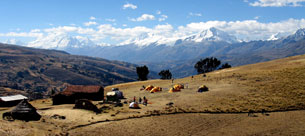 |
|
Camp 1 Outside of
Purucuta. The building to the left with the dark
brown roof serves as a community center. It is
the place where a decade ago the Shining Path (Sendero
Luminoso) preached its message of hatred.
|
While I am
setting up my tent, Yanac walks over and explains in
hushed tones: “This was the very building where the
Shining Path held meetings a decade earlier. There may
be people who come tonight to see ‘The Jesus Film’ who
were at those meetings.” “Will I be able to interview
any of them?” I ask. “I doubt any will be willing to
speak out in public but we will ask,” Yanac replies. I
ponder the contrast: We will be sharing a message of
hope—offering a chance for a new life—in the same
building where messages of fear and death may still echo
in the ears of those who will come later that evening.
|
The Jesus Film
is the most widely-distributed, translated film in
history —Originally distributed in 1979 by Warner
Brothers in theaters nationwide, the two-hour
"JESUS" film is not only the most
widely-distributed, but also the most translated
film in history---with more than 900 separate
language translations and more than 6 billion
exposures globally, topping Oscar greats Gone with
the Wind, The Sound of Music, The Lion King,
Titanic, and The Wizard of Oz. The Jesus Film
Project penetrates the most remote, dangerous
places on earth through a massive logistical
operation involving hundreds of staff and
volunteers who tote generators, makeshift screens,
and portable projectors to film showings, often to
people who have never heard of Jesus and some who
have never seen a film or TV.
Information courtesy of
JesusFilm.org |
By 8:00
o’clock the small community center is packed with almost
100 Quechua. Their response to the movie was
predictable; virtually all made commitments to become
Christians. After the movie, we all introduced ourselves
in Spanish, sang three songs; one in English, another in
Spanish and finally, one in Quechua and then passed
through the crowd, handing out New Testaments and bags
of candy and gifts to the children. Then the members of
the Quechua Evangelical Association who accompany us
every year; Pushpi, Yepo and Timoteo, spoke to the crowd
and prayed with them.
Morning
comes quickly in the Andes. It’s like someone flips a
switch and both the lights and the heat come on at once.
We eat a hurried breakfast of fresh pancakes our cook
prepared for us and then pack up our gear. Just before
filing out, the community leaders return to show their
gratitude and extend an invitation to the missionaries
to conduct bi-weekly services. A woman gives us a gift
of a huge sack of fresh potatoes that will be turned
into French fries later that evening to accompany the lomo
saltado our cook has planned for dinner.
Santa
Catalina is the next village on our itinerary. I already
know it’s going to be a long walk at high altitude but
just how long, I am not sure until Yanac stops to ask a
Quechua woman working in the fields. “Woooooooo!” She
exclaims, which means the same in Quechua as it does in
English. Loosely translated—“You Gringos are in for a
grueling walk.” And she is right. For the next three
hours, we walk, climbing slowly higher until we ascend
above 13,000 feet where we continue to walk for another
three hours. The wind is blustery across the
high-altitude pampas but it competes with a blazing sun
to make it rather pleasant—for some. For those
struggling with altitude sickness, it is a difficult
day.
Shortly
after 5:00 p.m. we arrive, setting up our tents in a
grassy field adjacent to a concrete play area on the
outskirts of Santa Catalina. We’ll repeat the same
program tonight, and in the next two villages on our
route: Santa Cruz de Rurek and Dos de Mayo. In each
place the results are similar—rapt attention to the
movie followed by an almost unanimous response to its
message.
It’s
August 9 and we’re back on the bus for the 8-hour return
trip to Lima. Our flight leaves for the States at 11:00
p.m. meaning we’ll arrive at Newark early in the morning
the next day. As the bus retraces the route we took only
8 days ago paralleling the Cordillera Blanca I gaze
transfixed out the window at the nevados in the
distance, wondering if this will be my last trip to this
enchanted place. “Are you saying goodbye to the
mountains,” Asks Lourdes Parra, who is sitting next to
me. This is Lourdes’ second trek in two years. A
Peruvian, she has a special love for the Quechua. “Why
do you look so sad?” She presses gently.
James,
the half-brother of Jesus Christ wrote in the New
Testament book that bears his name, “Has not God chosen
the poor of this world to be rich in faith?” It is a
rhetorical question and I see the answer played out
again and again in the Andes Mountains in Peru every
year.
Jesus said
the fields were “white unto harvest” but the laborers
were few. What He meant was there would always be people
ready to respond to the Gospel if only there would be
enough disciples willing to go and share the Good News.
That is
why I return year after year to the Andes and why I find
it so hard to leave.
At the
Conococha Pass I catch a glimpse of the Cordillera
Huayhuash in the distance. It is in this mountain range
where the village of Inca Huancanca lies. The
Inca cried centuries earlier here—and I join with them
whenever I think of this place where the message of hope
is so readily embraced by so beautiful a people.
n
Gregory
J. Rummo is a syndicated columnist. Write to him at
GregRummo.com. Additional information about these treks
through the Andes and the Andes Blanket Project can be
found at AndesBlanket.org.