 |
|
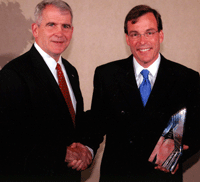
On April 22, Gregory J. Rummo was presented with the New Jersey Family
Policy Council's Media Award. Present at the annual banquet was Colonel
Oliver North, host of FOX NEWS "War Stories." |
On
April 22 I was presented with the 2005 Media Award by
the New Jersey Family Policy Council at their annual
banquet. While honored to receive such recognition, upon
deeper reflection, I can’t help but ask myself the
question: Was there no one else more qualified?
Is there
really such a dearth of professional, family-friendly
journalists in newsrooms across our state that the
Family Policy Council felt compelled to award a
businessman moonlighting as a columnist?
Apparently the
answer is yes.
A University
of Connecticut Department of Public Policy study found
that journalists who were surveyed picked Democrat John
Kerry over George Bush in the 2004 election by a margin
of over 2-to-1. In another survey, only 12 percent of
local reporters, editors, and media executives are
self-described conservatives.
The Christian
Science Monitor reported last year on the findings of
the non-partisan Pew Research Center which found “the
gap between journalists and other Americans particularly
wide on social issues.”
547
journalists and executives in a wide range of print and
broadcast organizations were surveyed. 88 percent
thought “society should accept homosexuality; about half
the general public agrees. And while about 60 percent of
Americans say morality and a belief in God are
inexorably linked, only 6 percent of national
journalists and executives surveyed believe that.”
Liberal media
bias is old news.
What is news is that
lately, this bias has turned ugly and in some cases,
downright hostile.
A newspaper in
which my column appears recently dished up an editorial
written in response to my column, “Liberals apply double
standard when it comes to religion.”
Entitled “The
right is wrong,” the editorial led with a laundry list
of complaints: “The religious right wants to outlaw
abortion, permanently ban embryonic stem-cell research,
require the teaching of creationism in schools and
funnel ever-more federal money to religious groups.”
The
hand-wringing continued several paragraphs later as
Christians were compared to mullahs desiring a theocracy
in America. “But what distinguishes a democracy from a
theocracy except the wall dividing church and state?”
The title of
the editorial reminded me of the prophet Isaiah’s words
“Woe to those who call… good evil.” That the religious
right would like to see the genocide of pre-born humans
halted is not news. And raising a race of slaves for the
sole purpose of harvesting their body parts should be
abhorrent to all but the most barbaric. What is it that
evolutionists fear when the teaching of “creationism”
(Intelligent Design is a better metaphor) is proposed in
public schools? Are evolutionists so insecure in their
own religion, which requires its adherents to practice
faith in spontaneous generation—a “theory” debunked
centuries ago by modern science, that they cannot stand
to have their ideas challenged? And why not fund
faith-based organizations if indeed they are the most
effective in solving the societal problems that continue
to plague us?
If the media
wishes to characterize Judeo-Christian influence in
American culture as a breach in “the wall of
separation,” its members need to go back to school and
brush up on their American history. Their hallowed
“wall” is not mentioned in any of the founding documents
of our country; including the Declaration of
Independence, the Constitution and the Bill of Rights.
The concept of
separation of church and state comes from a phrase used
by Thomas Jefferson in a private letter written to a
group of Baptists in Danbury Connecticut to quell their
fears that the First Amendment’s guarantee of free
religious expression implied it was a freedom that was
only government-given and not God-given.
 |
|
The complete story of the adoption of his first
daughter, Wu Min Jian appears in Rummo's
second book, “The View from the Grass
Roots—Another Look.” It's 536 pages
of sometimes humorous, sometimes poignant and
almost always provocative commentary on American
Culture. $14.95 shipping and handling included.
Click here for more information.
|
Jefferson wrote,
“Believing with you that religion is a matter which lies
solely between man and his God; that he owes account to
none other for his faith or his worship; that the
legislative powers of government reach actions only and
not opinions, I contemplate with sovereign reverence
that act of the whole American people which declared
that their legislature should ‘make no law respecting an
establishment of religion or prohibiting the free
exercise thereof,’ thus building a wall of separation
between Church and State. Adhering to this expression of
the supreme will of the nation in behalf of the rights
of conscience, I shall see with sincere satisfaction the
progress of those sentiments which tend to restore to
man all his natural rights, convinced he has no natural
right in opposition to his social duties.”
Author and historian David
Barton explains, “Jefferson’s reference to ‘natural
rights’ invoked an important legal phrase which was part
of the rhetoric of that day and which reaffirmed his
belief that religious liberties were inalienable rights.
While the phrase ‘natural rights’ communicated much to
people then, to most citizens today those words mean
little. By definition, ‘natural rights’ included ‘that
which the Books of the Law and the Gospel do contain.’
That is, ‘natural rights’ incorporated what God Himself
had guaranteed to man in the Scriptures. Thus, when
Jefferson assured the Baptists that by following their
‘natural rights’ they would violate no social duty, he
was affirming to them that the free exercise of religion
was their inalienable God-given right and therefore was
protected from federal regulation or interference.”
“Jefferson
believed that God, not government, was the Author and
Source of our rights and that the government, therefore,
was to be prevented from interference with those rights.
Very simply, the…‘wall’ of the Danbury letter w[as] not
to limit religious activities in public; rather [it]
w[as] to limit the power of the government to prohibit
or interfere with those expressions.”
“Thomas
Jefferson had no intention of allowing the government to
limit, restrict, regulate, or interfere with public
religious practices. He believed, along with the other
Founders, that the First Amendment had been enacted only
to prevent the federal establishment of a national
denomination.”
Jefferson’s
intentions were very clear.
What is not
clear is why this must be explained by a businessman
moonlighting as a newspaper columnist.
n