|
Celebrating a Different
Kind of Independence
JUNE 21, 2004
By
GREGORY J. RUMMO
ON
JUNE 28, my son and I will board a Continental flight from
Newark’s Liberty Airport, final destination: Lima, Peru.
From there, we’ll take an overnight, 8-hour bus ride to
Huaraz, the largest town in the Callejon de Huaylas, the
huge valley that separates the Cordillera Blanca from the
Cordillera Negra. Like two immense backbones, these mountain
ranges run north to south, comprising what are known simply
as the Andes.
In Huaraz, we’ll spend a
day or two to acclimatize and then we’ll embark on a
week-long trek through the Cordillera Negra with 28 other
Americans, three Quechua evangelists, our guides and their
burros and over ten thousand copies of various portions of
the Bible. We’ll walk, all day in some cases, from village
to village, stopping in the squares and along the dusty
roads to preach the Gospel and then distribute New
Testaments to the indigenous Quechua who farm the steep
slopes in that part of the world. In the evenings under a
star-studded sky that rivals the best show at any
planetarium, we’ll show the DVD version of “The Jesus Film”
in Dolby Surround Sound on a large, portable screen. It’s
all run from a small, gas-powered generator. This always
draws a crowd of several hundred curious Quechua families,
most of whom have never seen a movie in their lives.
This is the
fourth time I have made such a trip. But it is the first
time one of my sons is coming along with me. I’ve explained
to him that it can be a demanding challenge, both physically
and mentally. He tells me he’s ready; we’ve been running and
hiking together now for ten weeks. We’ll see.
On previous
treks through the Cordillera Blanca, our group hiked as much
as 60 miles in five days at altitudes ranging between 10,000
and 16,000 feet. On some nights, we camped in places that
were utterly desolate and inhospitable.
In 2001, we
shivered around the campfire in the tundra at 12,000 feet at
the base of Hualcan, a jagged, icy peak that is among the 99
in the Andes that tower over 6,000 meters. Two years prior
along the Santa Cruz trail we camped at 13,000 feet at a
place called Tallipampa where we were completely encircled
by snow-capped mountains. As though standing inside a great
cathedral, we watched as the sun slowly set in the west,
bathing them in alpenglow and making us feel warm inside.
Such contrasts are
reminders of a deeper, spiritual contrast.
While Latin Americans are
still largely open to the Gospel, here at home, many hearts
have become hardened to the things of God.
We may be the greatest
country on the earth and certainly the most affluent. But I
wonder where we would rate on a scale that measures
spirituality in light of our many blessings.
Stand on a sidewalk
anywhere in America and pass out Gospel tracts or New
Testaments and there will always be a percentage of
passers-by who will refuse to take one. And if you follow
the flow of those people who have taken a copy, there is
inevitably a trail of them littered carelessly on the
ground.
In America it’s clear to me
that we’ve become too busy for God.
But south of the border,
there’s a hunger for the Gospel unlike anything I have ever
seen. I’ve been on mission’s trips to Costa Rica, Venezuela
and twice to Mexico’s Yucatan Peninsula. Rarely has a person
ever refused a copy of the Bible.
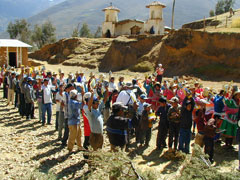 In Peru the hunger for
God’s Word seems even greater. We’ve had groups of young men
playing soccer in a roadside field stop playing to listen to
what we had to say and then all gladly receive a copy of the
New Testament. On another occasion, as we passed a terraced
hillside where a group of men were harvesting wheat, when
they noticed us, they immediately dropped their tools and
came running towards us when they realized we were handing
out Bibles. In Peru the hunger for
God’s Word seems even greater. We’ve had groups of young men
playing soccer in a roadside field stop playing to listen to
what we had to say and then all gladly receive a copy of the
New Testament. On another occasion, as we passed a terraced
hillside where a group of men were harvesting wheat, when
they noticed us, they immediately dropped their tools and
came running towards us when they realized we were handing
out Bibles.
Two years ago, the mayor of
a larger village in the Andes heard that a “group of
Gringos” from the States was coming with Bibles. He ordered
all his people to meet in the center of town the next
morning. After role call, the townspeople lined up to
receive their Bibles. We subsequently learned that those
Bibles are still being used as the school’s official
Spanish-Quechua textbook.
There’s no hindrance to
handing out God’s word in the public schools in the Andes.
We always ask permission and in every instance, with one
exception, have been warmly welcomed. We’ve even been
invited to preach to the student body on several occasions.
In a small school in the
village of Vaqueria that we visited in 1999, a teacher wept
as she thanked us for giving each of her students their
first copy of a New Testament translated into the Quechua
dialect by the Wycliffe Language Institute.
One of the New Testament
books we often hand out is “Santiago” or “James” in English.
The writer makes this statement: “Has God not chosen the
poor of this world to be rich in faith and heirs of the
kingdom which He promised to those who love Him?” Surely
this is the reason behind the hunger for the Word of God I
have witnessed again and again on my travels through the
Third World.
As you celebrate
Independence Day this year, perhaps enjoying a barbecue or
watching the fireworks and thinking about the freedom and
liberty we all enjoy here in America, think of us as we trek
through the mountains on another continent, carrying with us
the only true source of mankind’s spiritual freedom and
liberty.
n
Gregory J. Rummo is a
syndicated columnist. Read all of his columns on his homepage,
www.GregRummo.com.
|