|
Required Reading: The 9/11
Commission Report
SEPTEMBER 7, 2004
By
GREGORY J. RUMMO
TUESDAY SEPTEMBER 11, 2001,
dawned temperate and nearly cloudless in
the eastern United States. Millions of men and women readied
themselves for work. Some made their way to the Twin Towers,
the signature structures of the World Trade Center complex
in New York City…”
So
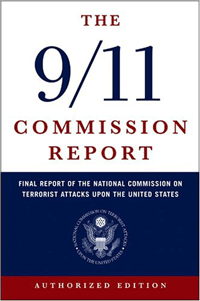
begins “We Have Some Planes,” the opening chapter of “The
9/11 Commission Report.”
Daniel
Henninger in his “Wonderland” column that appears Fridays in
the Wall Street Journal characterized it as a “reality check
for any who take the time to read it.”
Joe Belz, the
publisher of WORLD Magazine wrote in the August 7 issue:
“[F]or Election Day 2004, I have a[n] …idea. Just this once,
let’s ask everyone to show up with his or her own copy of
the paperback version of The 9/11 Commission Report. It
should be slightly dog-eared to prove that it’s actually
been read. Maybe poll watchers should even ask each prospect
to point to one underlined paragraph that the reader thinks
is especially pertinent. Just for 2004: No book, no vote.
Citizenship, after all, should be a little costly. If the
right to cast a free ballot has cost some of our forerunners
their very lives, is it so bad to put a couple of speed
bumps in the road to the voting booth? Is it wrong to ask
would-be voters to offer a little proof that they’ve thought
things through?”
Hmmm,
not a bad idea, especially this year when candidate Kerry’s
position on the war in Iraq continues to “mature.” First he
said he had voted for the war only to vote against it. Then
he didn’t vote to fund it. Then he said he would have voted
for the war even knowing what we know now—we assume the
senator was implying our inability to find caches of WMD.
And now—I can’t say “finally” because who knows when
“finally” will happen?—Kerry has characterized the war in
Iraq as “the wrong war in the wrong place in the wrong
time.” All this from the man who would be in charge of the
war against terrorism if we elect him this November.
It’s
hard to believe that only three years after that terrible
day, one is hard pressed to find a factual, non-partisan
account of America’s war against terrorism.
The 9/11
Commission Report cuts through the spin.
The
first chapter is both a riveting and poignant account of the
events of that day. I found myself reliving the emotions as
I read through it, wiping the tears from my eyes at several
points. And even though the report characterizes the details
of what happened on that morning as “complex,” it concludes
on page 45, “[T]hey play out a simple theme. NORAD and the
FAA were unprepared for the type of attacks launched against
the United States…They struggled under difficult
circumstances to improvise a homeland defense against
unprecedented challenges they had never before encountered
and had never trained to meet.”
 |
|
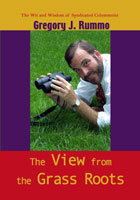
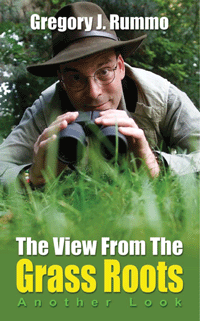
If you enjoyed this column, imagine how much
you'll love Rummo's latest book! It's 536 pages
of sometimes humorous, sometimes poignant and
almost always provocative commentary on American
Culture. $19.95 shipping and handling included.
Click here for more information.
|
Chapter two
describes the beginnings of Bin Laden’s al Qaeda network
and the issuance of a fatwa (an interpretation of
Islamic Law) against the United States in February 1998.
It was claimed that “America had declared war against
God and his messenger.” The signers, Bin Laden, Ayman al
Zawahiri and the other members of the “World Islamic
Front” declared it was the “individual duty for every
Muslim” to murder any American “in any country in which
it is possible to do it.”
Few Americans were
made aware of al Qaeda’s threat to the US. Bin Laden and the
names al Qaeda and Taliban were hardly ever
mentioned in our casual conversations or in the evening
news. The threat to America was not taken seriously, a
tragedy in and of itself for it portrayed an administration
that was largely asleep at the switch while these pathogens
festered on Petri dishes in places like the Sudan, Pakistan
and Afghanistan.
Other factual
surprises await the diligent reader.
Take for example the
Iraq-al-Qaeda connection that no one in the mainstream press
is willing to admit. Although the 9/11 Commission concluded
there was no evidence of any “collaborative operational
relationship” between the two on 9/11, it does report that
Bin Laden had sent out a number of feelers to the Iraqi
regime offering some cooperation. In mid-1998, Iraq took up
the initiative, sending a delegation to Afghanistan to meet
with the Taliban and then Bin Laden. Additional meetings may
have occurred in 1999 between Iraqi officials and Bin Laden
at which time Bin Laden was offered a safe haven in Iraq.
The report describes the two sides as being “friendly…indicat[ing]
some common themes in both sides’ hatred of the United
States.”
May I
remind everyone what George W. Bush said in his State of the
Union in January 2002 for which he received rousing applause
from both sides of the aisle: …[S]ome governments will be
timid in the face of terror. And make no mistake about it:
If they do not act, America will. (Applause.) …The price
of indifference would be catastrophic.”
George
W. Bush’s position on the war against terrorism “matured” on
9/11. And it has not wavered since.
Spend
the next several weeks reading through the 9/11 Commission
Report. You owe it to yourself to be informed, especially in
this election year when so much is at stake and when the
candidates for the White House couldn’t be farther apart in
their fundamental understanding of what America’s response
must be in this continuing war against terrorism.
n
Gregory J. Rummo is an author and
syndicated columnist. His latest book, “The View from the
Grass Roots—Another Look,” was just published. Visit
GregRummo.com
for more information.
|