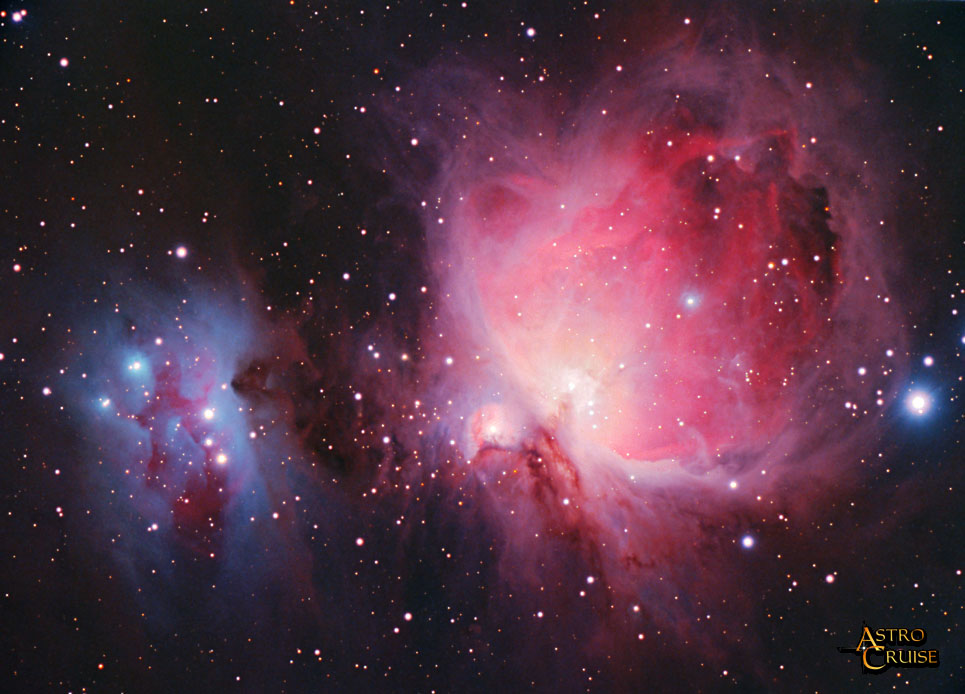
| My Favorite Celestial Object: M42 The Orion Nebula (M42) is a birthplace for stars, a cloud of Hydrogen and other gasses, condensing like rain in a raincloud into stars and little globs that are too small to ignite into stars. The Hubble Space Telescope has spent a reasonable amount of time looking deep into the heart of this nebula and has found some interesting events taking place. |
 |
|
 |
 |
 |
 |
 |
 |
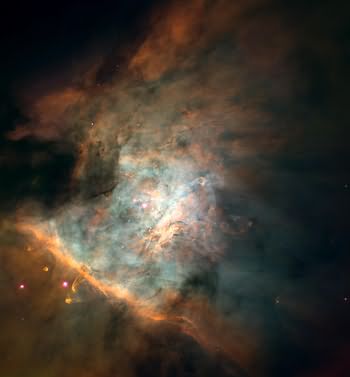
| Amazing to behold at any resolution, the Hubble Space Telescope improves upon perfection. At the left is an image taken with a very powerful ground based telescope. To the right is an image from the Space Telescope, a small section of the large red nebula at the left. The amount of detail that the Hubble can discern is truly amazing, pushing past the limitations of former telescopes (mainly by being above the atmosphere). We can now see deep into these mysterious structures in space. The glowing of this nebula is mostly due to the gas actually glowing itself, whereas there are also sections of the nebula where the 'glowing' is actually reflection on dust particles of light of nearby stars. The complex chemicals in the heart of the nebula are responsible for the vast amount of color. |
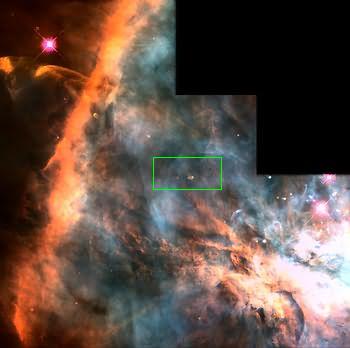
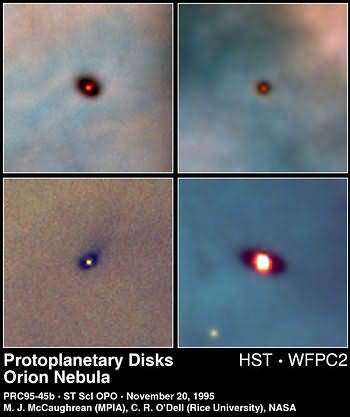
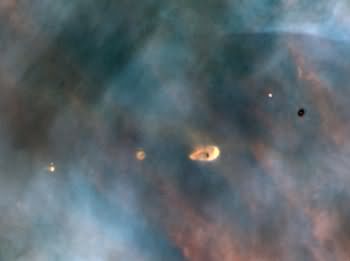
| Were we to zoom into the picture at the top right a bit, and were we to rotate the image clockwise 90 degrees, we would have the image at the left here. enclosed in the green box is the area of the image at the right. These odd-shaped items are protoplanetary disks. The lighter colored ones are not that dense, and are composed of lighter elements. As the blobs condense, they become more spherical and darker. The black spot in the photo at the right is a further progressed protoplanetary disk. You can almost make out the tiny red dot (a very young star) in the center of the disk. The system is rotating, and we are viewing it from above. The other blobs do not seem to have any organized motion yet. |
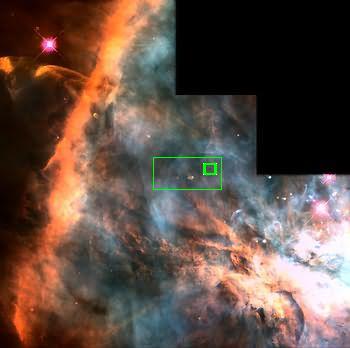
| The image at the left shows the area of the main photo and the progression of areas that we have zoomed into deeper. The smallest green box surrounds the black spot I have described above. Teh Hubble has managed to pull off a pretty impressive close up on that disk. The frame in the photo at the right (top left frame) is the protoplanetary disk of M42, as we have seen in the other photos. The red dot in the center is a brand new star. The star had just been born less than 300,000 years ago (an infant, in stellar life times), eventually the black disk will condense into planets that will end up orbiting the star at the center, which will also grow in size a bit as it evolves. I guess I love M42 so much because in one region of space we see the entire life cycle of stars. Most of the observed events in the Orion Nebula are closest to the birth of stars, but the gasses of the nebula itself, and the large-scale structure of the whole nebula were formed from the violent deaths of stars. That is where the nebula gets its somewhat spherical shape. The outer most edges (as seen in the top left most photo on this web-page) were at one time part of a massive star. Now inside the same area of the star's death, new star births are continuously happening. |