Superchargers
Introduction
|
This material is copy right from www.superchargersonline.com Text printed with permission. Visit the web site to read many good articles |
A supercharger is essentially a large pump that compresses air and
forces it into the engine's air intake. Turbochargers do the same thing, only
they are run by exiting exhaust gasses, while superchargers are powered by the
engine's spinning crankshaft, normally via the accessory belt.
Superchargers have become popular in recent years for several
reasons, including cost efficiency, reliability, and of course, performance.
Supercharging an engine often results in huge power increases in the range of
50% to 100%, making them great for racing, hauling heavy loads, or just having
fun in your daily driver. Although superchargers carry a fairly high ticket
price when compared to other single performance upgrades ($1500 - $4000),
nothing provides more horsepower for your dollar... in fact, nothing
even comes close. And because of the way superchargers work, they provide power
only when the engine is under full throttle or under load... not under normal
cruising conditions. This means that the supercharger will not affect the
engine's reliability, longevity, or fuel economy under normal driving
conditions.
Most of the superchargers sold today are centrifugal-style
superchargers, which are internal-compression superchargers, meaning they
create the boost (compress the air) inside the supercharger head unit (blower)
before discharging it into the engine's air intake. External compression
superchargers (roots or screw-type superchargers - Whipple, Kenne
Bell, Jackson Racing, Eaton) have become less popular
as centrifugal superchargers have evolved. Centrifugal superchargers (Vortech, Paxton, Powerdyne, ATI ProCharger) are more reliable, especially at higher boost
levels, and are capable of creating much more boost than external compression
superchargers, while creating a much cooler intake charge (which results in an
even denser intake charge).
|
|
|
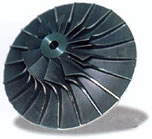
Boost
is created at the point when the supercharger's internal impeller pushes enough
air through the blower to overcome the vaccuum force
naturally created by the engine's air intake, so air is being forced, rather
than pulled, into the air intake. Boost is measured in pounds per square inch,
or psi. More boost equates
to a more dense air charge into the engine's combustion chamber, which allows
the engine to burn more air and fuel and create more horsepower. Most street
superchargers produce somewhere in the range of 6 to 9 psi,
meaning they produce 6 to 9 additional pounds of pressure over the atmospheric
pressure at that elevation (at sea level atmospheric pressure is 14.7 psi).
Many people assume that running a supercharger, and hence added intake boost, puts added strain on an engine's engine parts. This is not necessarily true, because engine damage is almost always caused by RPM. Because a supercharger helps the engine produce more power at lower RPM, supercharged engines will make the same horsepower as their naturally aspirated counterparts at substantially lower engine RPM, where today's street engine's are designed to run (around 6000 RPM). Another concern some people have towards using a supercharger is that they think it will increase the engine's compression to the point that it will cause detonation inside the combusion chamber. Detonation exists when the combustion pressure is raised so high that the inlet charge ignites itself before the spark plug fires. When this happens, combustion takes place while the piston is still travelling up in the cylinder bore, which puts tremendous loads on the piston, rod, and crank. While it is true that a supercharged engine creates boost and increases the engine's compression, proper tuning is the key to success and safty.
Supercharger Pulley
Supercharger
impellers on centrifugal superchargers are spun via an external pulley that is
normally driven from the engine's accessory belt. Because the supercharger
pulley needs to spin at very high RPM, an internal step-up causes the impeller
to run at substantially higher speeds than the input pulley. Because the speed
that the impeller spins determines how much boost is produced by the
supercharger, changing the input pulley size can have a large effect on the
amount of boost put out by the supercharger.
|
|
|
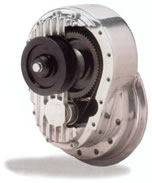
Because
superchargers spin at such high speeds, they often create a substantial amount
of heat, and require lubrication to keep friction to a minimum. Different
supercharger companies have combatted the problems of
heat and friction in different ways. While no single method is the best, each
method has advantages and disadvanages. Powerdyne uses an internal belt to spin the internal gears
(step-up drive), which minimizes heat, is very quiet, and lasts for over 50,000
miles. This internal belt never slips, and does not require you to tap into
your engine's oil supply for lubrication purposes, making it the easiest line
of superchargers to install. Vortech, Paxton, and ATI
(except ATI's self-contained systems) all use the engine's oil to lubricate the
step-up gears and keep heat and friction to a minimum. While this lubrication
is the most common and works well, it does require the engine's oil pan to be
tapped so the supercharger can draw engine oil from the engine. ATI's
self-contained systems also use an oil to provide lubrication and to minimize
heat, but they use a proprietary oil that stays inside
the supercharger head unit and never requires changing. This system is
efficient and does not require the engine's oil pan to be tapped, but is
substantially noisier than Powerdyne's belt drive
system.
Types of Supercharger Systems
The Roots Supercharger (the HPS system)
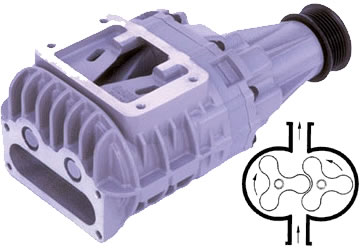
The roots supercharger was originally designed as an air moving device for industrial
buildings. The roots supercharger features two counter-rotating lobes that trap
air from the intake side of the supercharger (normally at the back of the
supercharger), move it around the outside casing of the lobes, and out the
bottom of the supercharger through an outlet / discharge port. Like the twin
screw supercharger, the roots is a "positive
displacement" aka "fixed displacement"
supercharger, meaning that it moves a fixed volume of air per rotation.
Notwithstanding minor amounts of air-leak at low rpms,
the roots supercharger cannot flow backwards like a centrifugal supercharger,
and is thus nearly as efficient in its ability to pump air at low rpms as it is at high rpms. What
this means is that roots superchargers are very capable of making large amounts
of boost even when engine rpms are very low. This
makes for great low-end and midrange power, and also makes them great for
trucks and towing vehicles. The roots is also self
lubricated, and is the simplest of the supercharger designs, meaning it is
reasonably priced and very reliable. This is why roots superchargers have been
the choice of GM, Ford, Mercedes, and Toyota for OE applications.
The only real disadvantage to the roots supercharger is that it creates a lot of heat. There are two
reasons for this. First, the roots supercharger does not compress air - it only
moves from the intake port to the discharge port (i.e. it is the only
supercharger design with no internal compression ratio). All of the compression
is done in the intake manifold. Laws of thermodynamics kick in in favor of supercharger designs with an internal
compression ratio (centrifugal and twin screw) because they do less work on the
incoming air charge. Another reason
roots superchargers create higher amounts of heat is because they tend to carry
some of the compressed air in the intake back into the supercharger because it
gets trapped by the rotating lobes that are exposed to the hotter air in the
intake manifold.
|
|
|
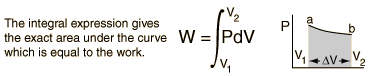
Want to know why a roots supercharger creates more heat than a centrifugal or
twin screw? Calculate the amount of work each does on the incoming air charge
and measure the area underneath the
The Twin Screw Supercharger (the Renntech system)
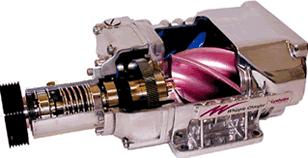
The twin screw supercharger at first glance appears to look similar to a roots
supercharger both inside and out. The two technologies are indeed similar,
however there are significant differences. At the heart of the twin-screw
supercharger are two rotors, or "screws" that rotate towards each
other. The rotors mesh together and draw air from the back of the supercharger.
The twisting rotors move the air to the front of the supercharger, while
compressing the air before discharging through a port at or near the front of
the supercharger.
Because the compression is done inside the supercharger, this
design produces less heat than a roots supercharger - in fact,
it is almost as thermally efficient as a centrifugal design. Like the roots
design, the twin-screw is a fixed displacement supercharger (meaning that it
pumps a fixed volume of air per revolution), and because the tolerances between
the rotating screws are very tight, its ability to create boost at low rpms is unparalleled. Another important advantage of the
twin screw compressor is its reliability. Unlike a roots supercharger, the
rotors in a twin screw supercharger do not actually touch, so there are
virtually no wearing parts.
One disadvantage of the twin screw design is that, because it has an
internal compression ratio, the twin screw is compressing air even when it is
not sending boost to the engine (i.e. under cruising or deceleration). An
internal bypass valve releases the pressurized air, but because it takes work
to pressurize the air in the first place, the twin screw supercharger draws
more power from the engine than while not under boost. Both the roots and screw
need the throttle body placed before the compressor because they are a fixed
displacement supercharger.
|
|
|
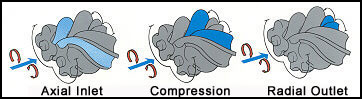
Airflow through a twin screw supercharger.
The Centrifugal
Supercharger (my clk55 AMG system!)
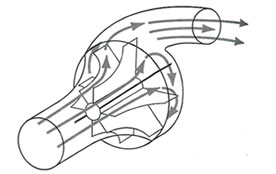
Although the centrifugal supercharger is founded on a technology much newer
than either the roots or the twin screw, it was the first supercharger to be
successfully applied to automotive applications. Unlike the roots, the
centrifugal supercharger is NOT a positive displacement / fixed displacement
supercharger because it does not move a fixed volume of air per revolution. The
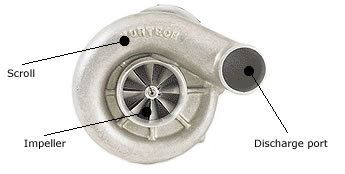
centrifugal supercharger essentially operates like a high speed fan propeller /
impeller, sucking air into the center of the supercharger and pushing it to the
outside of the rapidly spinning (40,000 + rpm) impeller blades. The air
naturally travels to the outside of the blades because of its centrifugal force
created by its rotating inertia. At the outside of the blades, a
"scroll" is waiting to catch the air molecules. Just before entering
the scroll, the air molecules are forced to travel through a venturi, which creates the internal compression. As the air
travels around the scroll, the diameter of the scroll increases, which slows the velocity of the air, but further increases its
pressure.
The centrifugal supercharger enjoys several advantageous
characteristics that make it the most popular supercharger design in the
aftermarket world. First, it is simple and reliable because it has very few
moving parts - just a few gears and the impeller. Second, the centrifugal
supercharger produces very little heat because of its internal compression
ratio. It is also small in size and very versatile because it can "free-wheel" and allow the engine to suck air
through it or even flow air backwards. For this reason it can be placed
anywhere in the intake tract - it can even "blow through" the
throttle body, meaning it can be mounted nearly anywhere. It is also the most
thermally efficient supercharger, meaning that it produces the lowest discharge
temperature.
The only significant disadvantage of the centrifugal supercharger
is that it must be spinning at a relatively high speed before it begins to make
a significant amount of boost. For this reason, it is not as efficient in
creating boost (and power) at low engine rpms. Normally
the supercharger begins to create good boost at around 2800 rpm, and the boost
curve increasingly rises with engine RPM.
Some centrifugal superchargers do not have a self-lubricating oil
system, and draw oil from the engine's oil supply. The disadvantage to this is
that you must tap the oil pan for the oil return line. However, in doing so,
the supercharger becomes virtually maintenance free. Some manufacturers make a
"self-contained" centrifugal supercharger that is self-lubricated
like roots and twin screw superchargers.
|
|
|
|
|
|
The Turbocharger
You may be wondering where the turbocharger fits in to this equation.
Technically, a turbocharger is a type of supercharger - one that is driven by
exhaust gasses rather than from a pulley that draws power from the engine's
crank. Turbos are the best method to boost, but also
the most complicated to install.
The Air Intake System
Because a supercharged engine draws substantially more air than a normally
aspirated engine, it is important to minimize intake restrictions. To ensure a
smooth delivery of air to the supercharger, most supercharger systems include a
high-flow air filter as well as low-restriction tubing or ducting to deliver
air from the atmosphere to the supercharger. It is important to maintain a
clean air filter to minimize the particles that come into contact with the
supercharger's impeller, rotors, or screws.
On most vehicles the incoming air charge passes through a Mass Air
Flow sensor (aka MAF) on its way to the supercharger,
although on centrifugal superchargers, the Mass Air Flow sensor can be mounted
after the supercharger ("blow-through" setup). The Mass Air Flow
sensor measures, you guessed it, the mass of air that the engine is drawing.
This reading allows your engine's ECU (Electronic Control Unit) to calibrate
and deliver the appropriate amount of fuel for the incoming air charge.
More on the MAF later and how it can be used
to ‘tune’ you car with more fuel.
The Bypass Valve
Compressor surge is a problem that affects most superchargers and develops when
the supercharger is creating boost, but the throttle shaft is closed. Although
not a problem on some low-boost (5psi or less) applications This
condition can occur under deceleration or while shifting between gears, and can
cause the car to sputter and chirp. Under surge, the compressor forces air into
the closed throttle body until the pressure inside the throttle body is higher
than the amount of pressure being created by the supercharger, and the air
tries to pop backward through the supercharger. At that point, pressure is
released inside the throttle body and the compressor forces air back through
the supercharger and into the throttle body, which again has nowhere to go, and
the process repeats. While surge normally is not highly damaging to the engine
it is certainly annoying and can cause damage with time. To eliminate these
problems under surge conditions, a bypass valve
(sometimes called an anti-surge valve) is used to release the excess pressure.
The bypass valve is actuated using intake manifold vaccuum,
which opens the vent valve and releases pressure in the air-intake. Air is recirculated back through the supercharger compressor
(bypass valve). The bypass value is
built into most roots and screw units.
Most all centrifugal units use a simple Bosch bypass at $40.00USD.
The Intercooler / Aftercooler
/ Water Injection
The purpose of the Intercooler
/ Aftercooler / Water Injection is to
remove heat from the air to create a cooler, more densely packed air
charge. Although the intercooler is not
necessary on most street applications, its performance becomes increasingly
important on higher-output systems (with correspondingly higher charge
temperatures), as well as on high compression engines like the Mercedes
11:1.
The intercooler can be compared to a automotive radiator, only
instead of cooling water or coolant, the intercooler cools the air. Air-to-air
intercoolers force the air out of the blower through a large air-cooled finned
and fluted core, normally mounted in front of the car's radiator. Air-to-water
intercoolers force the supercharged air charge through a much smaller finned
and fluted heat exchanger that is cooled by water. The water is, in turn,
cooled by a compact radiator that mounts next to the stock radiator. Both of these systems can require a lot of
piping/tubing to install.
A third option is the water-injection or methanol injection
system. Water injection, just like intercoolers work to
suppress engine knock. They each reduce the temperature of the compressed
air. Lowering the air temperature allows
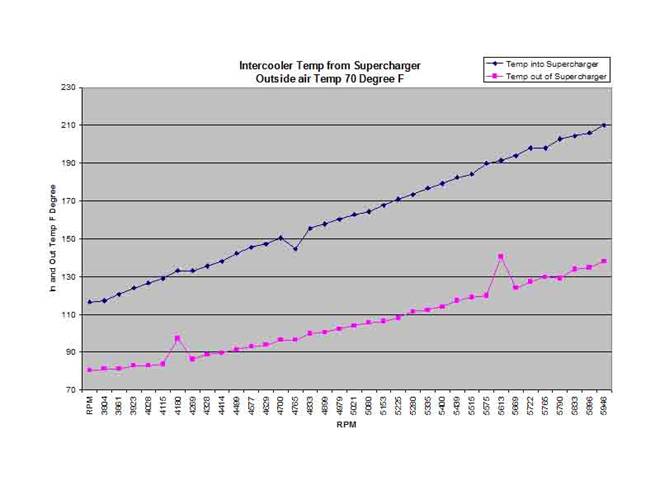
you to run higher or near stock timing, and a little leaner fuel ratio. It is also used as insurance. Below is a graph to show real-world results:
The Fuel System
As increased amounts of air is pumped into the engine with the supercharger, so
too must increased amounts of fuel be delivered. This is where the power gains
come from. Most stock fuel systems are not up to the task of delivering the
increased volumes of fuel demanded by a supercharged engine. Without a proper
fuel system, your engine may run lean, detonate, and obviously perform below
its potential. Because every engine is different, the fuel system requirements
vary greatly with different vehicles and with different supercharger systems.
Sometimes larger fuel injectors and a larger fuel pump is required. On some
applications, a fuel management unit (FMU), modifying the ECU tuning or MAF
signal, or even larger injectors are used.
See the Section on Fuel Management to understand how Fuel needs
must be met with boost.