Fuel
Management for the Mercedes Supercharger
Do I have enough Fuel for the amount of Boost
I am pushing through the engine?
Horsepower is a result of two key components: air and fuel. The
supercharger itself, whether a centrifugal, roots, or twin screw, really only
provides one of the two major ingredients for making more power. A supplemental fuel system upgrade must be
included with any forced air induction installation.
Getting the Fuel You Need:
In about every vehicle made today, the A/F is controlled by the
Engine Control Computer (ECU). The ECU
attempts to keep the A/F at 14.8:1, give or take a little. Most all ECUs
operate in 2 modes; Closed Loop and Open Loop.
In Closed Loop mode the ECU reads the 02 sensors rapidly then
dynamically adjusts the fuel injector pulse width to keep A/F at the right
spot. The car tries to stay in closed
loop mode as much as it can, but it depends on a lot of things, Load, Gas
Peddle Position, etc. For practical
purposes, if you are not racing around your engine is in closed loop.
Open loop is another story, and the ECU’s tuning of A/F is done
using loop-up tables. This is how the
MAF sensor comes into play. Assume you
floor-it. At this time the ECU reads the
MAF value. Based upon that value, the
ECU goes to a lookup table to find out how much fuel to give the car. Pretty simple process, but how did the table
get to be those values? Well, in the
R&D process, Mercedes put the engine on its dyno
to find the best values for performance and engine safety. They also drove it a lot, while dynamically
tuning.
OK, this is when it starts to get more complex. Suppose you have a blower on your car at 5psi
boost. At this level, your air flow is
higher so you need more fuel to keep stable.
To get the A/F to the proper location, you need to do something.
1)
Have
someone tune the ECU with a new look-up table.
This is what all the tuning software does for the GM, BMW, Ford,
etc. We have a PROBLEM. We in the Mercedes world do not have an easy
place to get ECU upgrades without paying both legs for it. In addition, most tuning facilities have no
tuning SW. Tuning a car properly
requires an O2 reader and a dyno (or a long
road).
2)
The
other option is to influence the ECU. In
this case, we need to somehow interfere with the fuel flow, but how??
The FMU Explained
There are several methods used by various supercharger kit manufacturers to
deliver supplemental fuel to the engine under boost without changing the ECU
software. An FMU, or “Fuel Management Unit”, is the chief component used for
one of these methods. An FMU is often referred to as a boost-dependant fuel
pressure regulator. The FMU is essentially a variable fuel-pressure regulator
that automatically raises fuel pressure as boost rises.
Depending on the capabilities of the stock fuel pump, a booster pump may be
used in conjunction with the FMU (Boost-a-pump). The FMU is downstream (after)
of the stock regulator. As boost pressure begins to rise, the FMU starts
restricting the flow of fuel returning to the gas tank. Like a garden hose, if
the flow is restricted, the pressure increases. The increase in restriction
results in an increase in the pressure of the fuel being delivered to the
factory fuel injectors. Higher fuel rail pressure enables the fuel injectors to
deliver more fuel in the same amount of time than they do at the static stock
fuel pressure.
So in summary, this is how you trick the ECU with a blower.
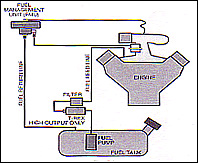
The FMU is calibrated for each supercharger system - a rise in
fuel pressure equals a directly proportional rise in boost. The ingenious
simplicity of the system means that no computer recalibration is required.
Without the FMU, the stock fuel system would not be able to maintain an
air-to-fuel ratio low enough to prevent a lean condition. FMU-based systems are
the most popular with supercharger kit manufactures.
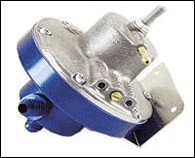
However, that is only half the solution!!
A FMU is some
cases fixes everything, but most of the time it is a rough adjustment. An additional method is used to ‘fine tune’
the A/F. This can be done by modifying
the MAF signal that the ECU reads. In my
case, I used a unit from Split Second.
This electronic unit taps into the MAF signal wire. Using a PC and software, you edit the value
output by the unit in relation to boost.
Let me say that again, a signal from the MAF come in, 4.6Volts for
example. The Split Second unit has a PC
edited look-up table that says, for 5psi Boost, let me offset that 4.6V signal
by .02Volts.
As you would
guess, to fine tune your car, you need a good O2 reader and a dyno. (the O2 sensors in the car are only for Closed Loop and not
accurate enough for Open Loop). Most dyno facilities offer O2 reading during a run. In order to tune, you make a dyno pull, look at the results, then make another pull.
At this point
you could be fat and happy, but maybe not.
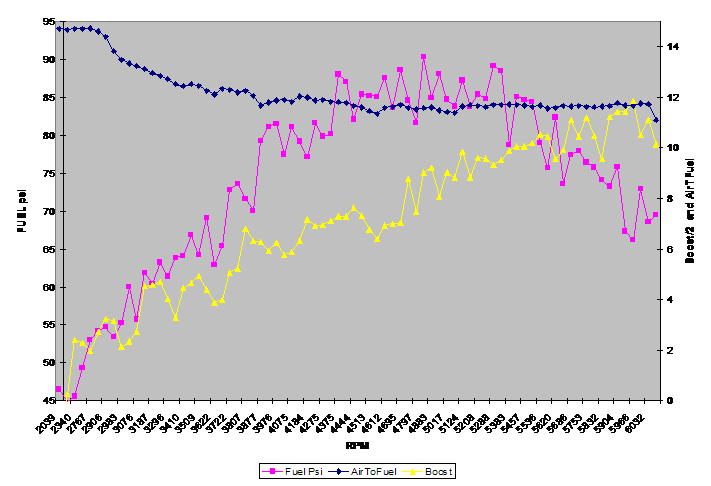
Look at the graph below. What you
see is the fuel pressure rise, then start to fall off
with boost. This could be OK or a
problem. What you are seeing is the Fuel
Pump NOT being able to push enough gas through the injectors while also pushing
through the added boost from the blower.
To solve this problem you may need to upgrade you fuel pump. In many cases this may work or help the
situation. The other solution is to
increase the Voltage to the pump itself.
This forces more fuel out of the pump to overcome the restrictions. Do not worry, as long as you are not floored
all the time, you pump life is fine.
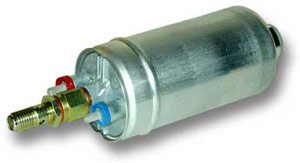
The Bosch fuel pump # - 0580254982-390
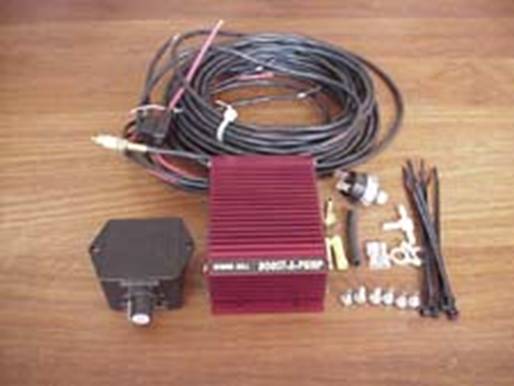
Below is a
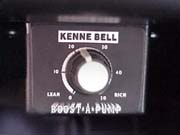
picture of the Kenne-Bell Boost-a-Pump. I installed a Kenne-Bell
Boost-A-Pump (BAP). The BAP works by increasing the voltage to the fuel pump
under boost causing it to spin faster and deliver a greater volume of fuel. The
BAP has a control knob that allows you to adjust the percentage of voltage
increase to the pump. The BAP is activated by a pressure switch mounted in the
supercharger plenum that activates at 3 PSI of boost. I adjusted the voltage
with the control knob so that once the FMU kicked in I could maintain the XX
PSI of fuel pressure.
This is what
I used for my car, in addition to an upgraded fuel pump to be safe. (At least, upgrade your pump with any
supercharger installation)
Graph results to come later. What I want is a steady fuel pressure as
boost increases. The FMU is at the same
time increasing pressure to force more fuel through the injectors. It is a triple process: More boost = more fuel needed = more FMU
pressure = more voltage at pump to stay constant psi. All of this is working together, while you
fine tune the MAF single.