Results of a Custom Intercooler Install
on 2002 CLK55 HPS Gen1 System
The Eaton MP90 Supercharger
is not a good fit for a CLK55 engine.
With a 2.095 inch pulley, the blower is spinning at 17,000RPM just to
deliver 3.5 psi(with intercooler). A
sure sign that the blower can not flow the needed air requirements is revealed
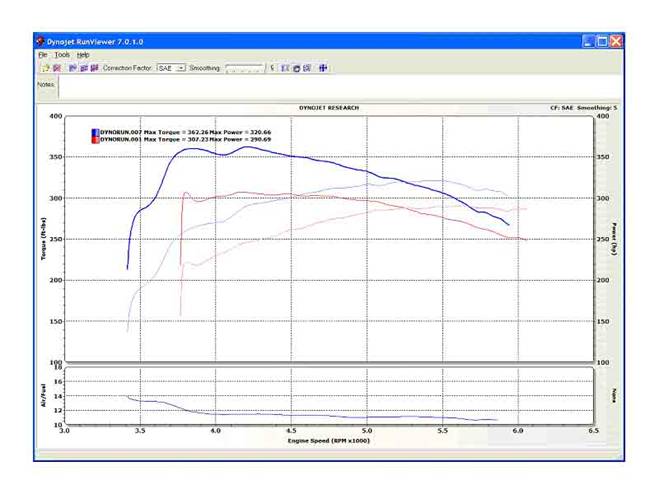
in the HP numbers. Improvement results:
18% more Torque, 10% HP. These are
terrible numbers and show that putting the wrong supercharger on a car gives
you nothing.
This set-up installed on a
CLK430 4.3L would probably be OK. (I did see a just a little belt rubber on the
pulley, so that means the belt is slipping some. I have no idea how much, probably 1-1.5psi
loss.)
Some may it is the
intercooler, and yes they are somewhat correct.
Testing revealed almost a 3.0 psi drop across
the intercooler. WOW, that means the
cooler I selected is probably a little small!
However, that is the largest I could fit in the area. (Even so, 6psi total max is all the Eaton can
push through a CLK55)
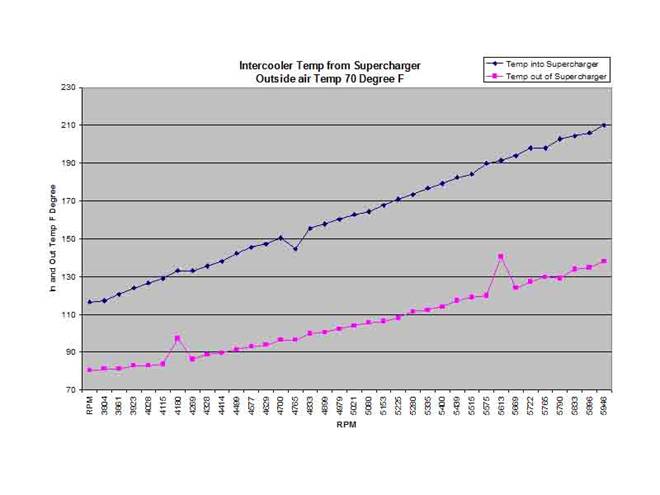
Even with the boost drop,
look at real improvements in intake temperature as the blower spins. Inter-cooling allows for a safety margin to
reduce possible detonation. With these HPS
kits at full timing, inter-cooling is a must as far as I am concerned. Those Eaton roots blowers run HOT.
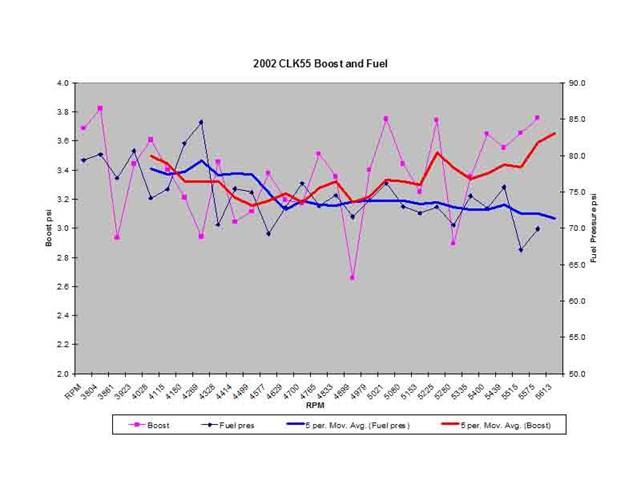
The final graph is a data
collected on fuel and boost pressure during the dyno
run. See the fuel pressure drop? That is another issue that needs to be
addressed.
So what should you do if you
have the HPS Gen1 System? If you want to
up boost a little over the factory 3-4psi to about 5,6,7psi
you will need, besides a .1in smaller pulley, a larger fuel pump, water
injection system, and tuned MAF signal (use Split Second PSC-001 unit). In my case, I added a Keene Bell
Boost-a-pump, which allowed me to reduce the FMU size to 4:1 from 12:1(may not
be needed).
Intercoolers help reduce the chance of
Detonation. I would never own a
supercharger of turbo without an intercooler, be it air-to-air, water-to-air or
water injection.
The fuel pressure drop as boost increased shows that
the fuel pump can not flow enough fuel.
Boost reduces the flow rate of a pump because it must fight through the
boost to keep flow constant.