Ketura zichronah livrachah
Shalom l'kulam,
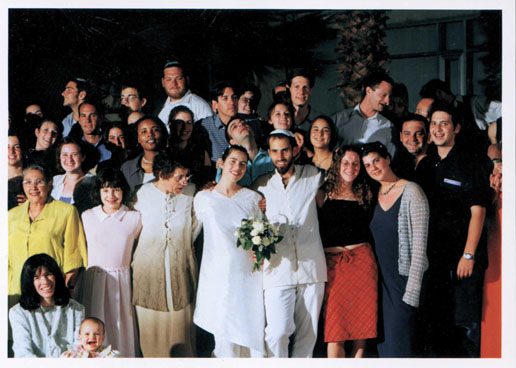
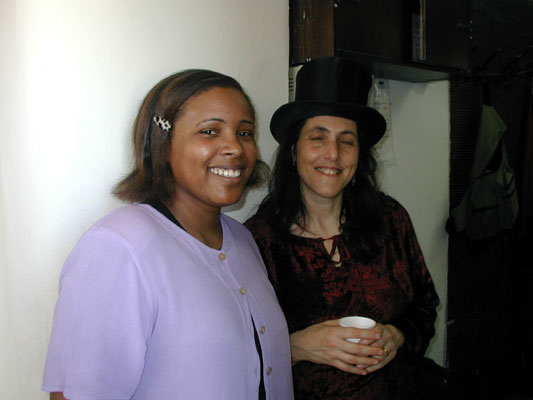
It is with deep sadness that I must stop with the updates and wedding memories to tell you that Keturah, a friend of ours and fellow student at the yeshivah, whom many will have met at the wedding, and will remember because that was the kind of person she was, died on Monday morning. She had been struggling with illness all year, although that would not show to anyone who spoke with her, but it seemed as if she was over the worst. Then last week, she went in for what was supposed to be a technicality, but became complicated - she had surgery, developed an infection which turned out to be meningitis and she passed away on Monday. For those who knew her this was such a shock - we saw her energy, her positiveness, her smile, her taking on any and every task with vigour, and we never thought that she could possibly be in anything like life danger.
Our community, those who studied at the yeshivah over the year, have been,
since our term ended in June, scattered all over the world, but everyday someone
sends in another e-mail letter, filled with tributes, memories, grief…she
connected with so many people in her modest, unassuming way. Andi and I want
to pass on our love and memory of Keturah in this e-mail and to share some of
what people have written in the hope that we can all learn something from her
memory. Keturah was a light for so many people and we are only finding out how
much now that the stories are coming. And she was for us too, not only at our
wedding, but that is what is closest to us now - we have photo's of this smiling
Keturah in so many dances and group shots, a video of her dancing and celebrating,
and most pertinently, our memories of her helping prepare, of her enthusiasm
and anticipation for the day, and of her energy at the simchah. What energy!
All the more amazing considering that she was still struggling with her illness
- that, we didn't know.
I (Greg) met Keturah the first week of yeshivah when we davenned (prayed) together
in Rabbi Lebeau's learner's minyan (service). We swapped the usual "why
are you here" stories and Keturah wanted to know how to lay t'fillin. We
shared mine, but I told her that I had my grandfather's set at home and would
bring them in for her to use, which I did and she did and then the next day
she came to me with a sympathetic face and said that she wanted to thank me
for lending her the t'fillin, and hoped that I wouldn't be offended as she had
found out that they probably weren't kosher anymore and she would prefer to
wait for a set of her own. She said it with such concern for my feelings, I
was so moved - how could I have been offended in front of such caring and dignity?
I want to include some of what people have written, though there is so much
more and I presume more coming, but this is just some idea of how special she
was. Here is what Josh Fine, another student, wrote:
"I first got to know Ketura at the Shabbaton on Har Gilo (back in the very
recent past when Har Gilo was a peaceful retreat). We chatted for a while and
I peppered her with questions about her unusual background -- her homeschooling,
life in the Arab village, her journey towards Conservative Judaism, her roots
in Indiana. It didn't take long for me to realize I was talking to an extraordinary
person. Every story she told she related with a bright, wide smile. She told
me that after the first Intifada started, when her family was still living in
the arab village, her family brought arba minim into the house on sukkot and
the neighbors began questioning the family about it. "We soon had to leave,"
she laughed. "You know with everything going on, it was time to leave the
village." Then another chuckle. Here Ketura was telling me how she and
her family were being forced out of their home because of religious hatred and
with no place to go -- and somehow Ketura managed the story without the slightest
tinge of resentment or judgment. There was no anger against her former village.
There was no taking sides, there was not even controversy in her story; just
a laugh, a big smile and zehu.
Later that week, Rabbi Goldfarb delivered the devastating news of Ketura's illness.
He said she had felt the headaches even as she was chanting the haftara that
shabbat (which means she must not have felt 100% at lunch during our long chat).
This was Ketura: whether suffering from sleepless nights of shooting by her
house or what must have been an intensely terrifying illness, to everyone around
her she was boundless warmth.
One mitzva we can all learn from Ketura is guarding our tongues from lashon
hara. (Although I will not even pretend that I can ever fulfill that mitzva
as amazingly as did Ketura.) In the year that I was blessed to know her I do
not remember Ketura ever saying anything even slightly uncomplimentary about
anyone. This was the amazing thing -- she talked to me about the village she
had to leave, the rabbanut that rejected her family's desire to convert, the
difficulty in obtaining medical care before Haddassah took her on. It wasn't
as though she didn't talk about these things. For it is one thing simply not
to talk about these things. It is another thing completely to talk about these
things without saying anything judgmental or unkind. To simply not talk about
one's oppressors in order to avoid slandering them is a praiseworthy thing.
But Keturah's example is even greater. For in Ketura's stories there was a level
of forgivemess and understanding of people's shortcomings that was truly inspirational."
This is what Marc, my chavrutah, and one of the few people who was still in
Israel when she died, wrote:
"Ketura's parents are such good, loving people and hearing them talk about
their daughter was so moving. They described, in detail, the development of
her condition leading right up to Monday morning when her short, precious life
was snatched away from her. Netanya, Ketura's mother, told us how, from age
4 or 5 upwards, Ketura was always helping out with her younger brothers and
sisters and running of the home, never complaining, never resenting it for a
moment, simply doing what was needed with that big, infectious smile of hers
that we all remember and miss. Her mother also told us that every time there
was a chag, Ketura would tell her parents that it had to be that extra bit special,
and she would take money from her savings to give to her parents so that they
could buy nuts, or extra fruit in honour of yomtov. Half of Ketura's earnings
went to the family and the household as a matter of course and her parents told
her she had to save the rest - "one day you'll go to America!". Yet
she was always, without any grudging, taking money out of this other half to
buy extra treats or clothes for her siblings. Always giving, never complaining.
There is so much we can continue to learn from Ketura, whose life was so hard
in so many ways, yet she saw beauty and love everywhere and never showed any
of her suffering to the world."
And finally, this is what Sam Andorsky, another student wrote:
"Ketura and I were often chevruta for Menachem's halacha class, and while I was always peripherally aware of it, I now realize how truly amazing it was that she was never in a bad mood! Now and then I would come to chevruta
tired or cranky for some trivial reason that I have long forgotten, and there she was--with all the difficulties she had to face in life-- with that beaming, contagious smile of hers. How did she do it? Occasionally I would try to ask her how things were, or say something like "I heard the fighting in Gilo last night, how is everyone doing?" and she would sigh and say "It's rough, but Mah La'asot?" and then we'd go on learning."
Keturah touched many people and I know that her memory will go on to inspire others to pursue their dreams with the same energy that she pursued hers.
Zichronah livrachah
May her memory be a blessing
Greg