Two American Experiences With Classrooms in Japan
1. An American Parent's Perspective
Excerpts from Chapter Five of T. R. Reid's book,
Confucious Lives Next Door: What living in the east teaches us about living in the west. Random House, 1999.
~ ~ ~ ~
... When the Japanese students get older, there is clear educational tracking. But in elementary school, and to a large extent in junior high, everyone is expected to succeed in every class.
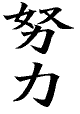 The secret to success is considered to be hard work. Why does one student get straight A's in math, science, geometry, and language, while her best friend gets all C's? In the United States, almost everybody answers that question by saying that the all-A student is smarter. In Japan, almost nobody would answer that way. The reason some kids do well in school and others don't is almost universally considered to be effort.... I've visited hundreds of Japanese classrooms over the years, and virtually every one has the word doryoku framed on the wall. The word means "effort"....
... Japanese schools are famous around the world for their achievements in math, science, and geography.... For my money, though, the greatest achievement of Japan's school system is teaching people to read and write Japanese.... Japan has a literacy rate higher than 99 percent.... The United States, with two times as many people, has about five hundred times as many teenage murders and roughly the same rate of teen suicide....
... There was no spontaneity, I complained. There was no room, not a smidgen of room, for individuality. My neighbor responded politely, of course, but with a rather pointed question: How do American students learn the multiplication tables? Isn't that drill and memorization? Some things have to be memorized, Matsuda-san said... It not only teaches the children to read and write but also helps them realize, day in and day out, that it's important to stick precisely to the rules....
... There is no conception in East Asia that music and math belong in schools but moral values do not. Learning to do right is considered just as important as learning to add right. Every day at Yodobashi No. 6, the rules of life in a civil society were given at least as much attention as the rules of grammar or long division. Academic training and social training were blended in almost everything the students did....
... Many teachers wrote the goals for the day on the blackboard each morning before class. The interesting thing was that most goals said nothing much about academics. They were about building good citizens.... The overall mission of Yodobashi No. 6 was set forth in three phrases on the wall of the central entryway: "A child who is energetic and friendly," "A child who warmly helps the whole group succeed," "A child who thinks carefully before acting." These schoolwide goals were echoed in the classroom goals set forth on the walls of my girls' classes.... "Let's work persistently until the job is done," "Let's make a new friend at recess," "Let's not waste anything at lunchtime," "Let's work together on the road to junior high school," "Let's remember the rules and follow them." Each student was supposed to have three sharpened pencils in her desk--not four, not two--and there was a designated place inside the desk where the pencils were to be kept.. The student leaders in each class went around the desks now and then to make sure these rules were followed.... She told us how the children should take their shoes off at the school's entryway, and how they should align their shoes (toes in, heels out)... The school gave us directions on how our children's homework desk at home should be set up and equipped (including the number of pencils).... The school never subjected us to a home inspection, standard for all other Yodobashi families, to make sure we had complied....
...It was while our kids were at Yodobashi that the Ministry of Education began its controversial initiative to phase out school on Saturday.... Yodobashi, like most other schools, scheduled early-morning field trips, sports leagues, and other activities to keep kids busy. All the various plans involved spending the day off with others who would be spending it the same way....
... In view of this inordinate emphasis on rules, and the regimented orderliness of Japanese life overall, it would be natural to assume that Japanese educators are control freaks and their students are subject to the strictest discipline if they do anything but sit quietly in their seats and study their brains out.... In fact, many times when I dropped by the classroom of one of my girls I was amazed at the disorder, the rowdiness, the sheer noise that confronted me. At regular intervals, say eight or ten times each school day, the teacher would assign some problem to solve or some job to do and just sit back while the students seemed to go wild....
... In the fifth-grade classroom one day, three boys were standing on their desktops throwing books at each other. Girls were running around from one desk to another playing some kind of slapping game. Another kid was trying to lob a soccer ball into a trash can across the room. The most amazing thing of all was that Yamada-sensei was sitting calmly at his desk at the front of the room, grading papers or something, evidently oblivious to the bedlam breaking out in his classroom.... After this went on for ten minutes or so, the teacher gave an almost imperceptible arm signal to one of the students--who was, it turned out, the designated class leader for the week. This boy walked up to the front and shouted, "It's time!" Nobody could hear him at first, but he kept saying "It's time." And within thirty seconds or so, the disorderly mob was once again an orderly class, quietly looking up at Yamada-sensei to see what he wanted the class to do next. I learned later that this kind of temporary wildness in the classroom is specifically prescribed in the Education Ministry's Guidelines for Elementary Schools, so that the children can let off steam. The key point is that the teachers feel perfectly safe letting it happen, because they have complete confidence they can gain control again at any time...
... I never entirely figured out how they do it. But one key factor, I concluded, is that keeping control in a Japanese classroom is not strictly the responsibility of the teacher. The students share responsibilities like that, and they consider this perfectly normal. Even in first grade, Japanese students have much greater responsibility for the daily activities of the classroom, and the school as a whole, than do their counterparts in Western countries. Unlike American teachers, for example, elementary school teachers in Japan do not have to dread that moment in the morning when they have to get the kids into their seats, quieted down, and ready to work. In a Japanese classroom, these preparations are not the job of the teacher. It is up to the student leaders--generally one boy and one girl, who hold the position for about a week--to do these things...
... In Katayama-sensei's second-grade class, for example, two seven-year-olds would stand up in front of their noisy, giggling, squirming classmates at eight forty-five in the morning and urge them to straighten the rows of desks, to pick up all the hats, gloves, umbrellas, and butterfly nets strewn on the floor, and to get out the text and the notebook for the first subject of the day. Frequently, the two young leaders would make a quick inspection, to see to it that all their peers had the requisite number of pencils in the approved spot on the desk and had the correct book open to the proper page. When all was prepared, one of the leaders would pronounce the words "All rise". The students would stand and face the teacher. The leader would say, "Bow." The students would bow to the teacher and recite, "Good morning, Katayama-sensei." The leader would say, "Take your seats." And only then would the teacher deign to rise from her desk and take over direction of the classroom....
... Starting with the first grade, it was students--not the teacher, not parents--who were responsible for managing the permission slips, and collecting the money for field trips. It was students, not teachers, who were responsible for the care and feeding of Yodobashi's farm animals, and for the maintenance and cleaning of that unicycle fleet. So much responsibility is left with students that Japanese schools rarely call in a substitute teacher. If the first-grade teacher is going to miss a day or two, she provides a detailed plan for the day and lets the two student leaders direct studies. The teacher in the room next door pops in now and then to make sure things are okay. And this seems to work....
... In Japanese schools the students are the janitors; a certain amount of time is allocated each school day for the activity known as oh-soji, or honorable cleaning. Kids wash blackboards, empty trash cans, clean toilets, and mop those shiny pine floors in the hallway. It isn't exactly fun, but it isn't exactly a chore either. It is just something the students are expected to do, and they do it.... One advantage of oh-soji, of course, is that it gives the students a built-in incentive to keep their school clean from the start.... At Yodobashi, as at other Japanese schools, lunch was served to the students in their classrooms--and all the work was done by fellow students. Each day at twelve-fifteen, the teacher would leave the room. The group assigned to "honorable mealtime" detail would put on clean white smocks and white chef's caps and scoot down the hallway to the school kitchen. They would come back laden with industrial-sized pots... Each student ate at his desk, while the student Broadcast Committee played the latest rock songs over the PA system....
... The small group of four or five children is the basic unit of learning, in every subject, in every classroom.... Group learning is considered the pre-eminent strategy for academic topics, and , of course, the constant small-group interaction also teaches the children the essential Confucian skills of cooperative group membership. The use of small groups, by the way, helps explain why Japanese and American educators have completely different theories on the subject of the teacher-to-student ratio... In Japan, too few students in the classroom is considered a serious impediment to learning. On the average, Japanese schools have thirty-five to forty students per teacher; the ratio is largest in the lowest grades.... A good elementary class needs forty to forty-five kids, she said, so the teacher can build a lot of groups and the various groups can work with each other....
... Each han [group] had a leader, a duty that rotated weekly.... The teacher would present a problem... Then the various hans would gather for noisy, animated discussions, with the teacher stopping by each group's table now and then to listen in. Eventually the results would be presented, with each han-cho [group leader] coming to the front and describing his group's answer....
... "The nail that sticks up gets hammered down." Nobody in Japan likes a deru kui, a protruding nail.... "You don't want to be the one that everybody laughs at." ... "If any branch was sticking out, they took their big sharp clippers and cut it right off." ...
... "It's too bad that Ryutaro won't work productively with the rest of the Orange Group," Yamanaka-sensei said curtly. "That means that the Orange Group won't get its work done, and nobody in the group will have recess today." ...
... And so we rated Yodobashi Dai-Roku Shogakko as a complete success. Our kids learned some Japanese, some math and science, some music. And they also learned, along the way, the Confucian lessons considered just as essential: working hard, following rules, respecting authority, taking responsibility, and getting along with the group....
~ ~ ~ ~
2. An American Teacher's Perspective
Excerpts from Bruce S. Feiler's book,
Learning To Bow: An American Teacher In A
Japanese School. Ticknor & Fields, 1991.
Excerpts from Chapter 14: "Baseball, Apple Pie, and Dragon
Mothers: The Teacher In Japan"
| |
"To honor the teacher is a means of honoring the
Way. Therefore, the teacher shall possess the justice
that reigns between a ruler and his subject and the love that
exists between a parent and his child."
Itō Jinsai,
Japanese philosopher, 1666.
|
...."Motherhood doesn't have the warm image in Japan that it has
in America."
"Okay, what is the image of mothers?" I asked.
"Kyōiku Mama," he said. "The Education
Mother."... Other nicknames for overbearing mothers
include Onibaba, "Devil Woman," and Mamagon, "Dragon
Mother."...
..."Last night a mother called me at eleven P.M. to talk about
next week's exams," complained Hongo-sensei, a physical
education instructor.... "I think the problem is that parents don't
like to teach their own children," Machida-sensei said when
the saber-rattling was done. "Even if it's using
chopsticks or getting dressed, they expect the school to do
everything. Several mothers even called the principal
over the New Year's holiday and complained that we were not giving
students enough to do."
..."We have to go to every one of our students' homes at least
once a term," he said. "Next week I have to visit
forty-five houses in three nights and write a report on each one.
The report has to say how much time students study,
how much television they watch, and what their rooms look
like. The principal makes us do it. He
thinks we are the education police.... We have to do too
much. We hardly have time to teach."
...The word sensei, though commonly translated as
"teacher," in truth has no equivalent in English.
The two Chinese characters that make up the word literally mean
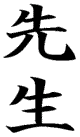 "one who was born before."
The essential ingredient for a
sensei is the wisdom he or she has gained through
experience, not through reading books.... Any valued advisor or
mentor can earn the respect inherent in the word sensei.
"one who was born before."
The essential ingredient for a
sensei is the wisdom he or she has gained through
experience, not through reading books.... Any valued advisor or
mentor can earn the respect inherent in the word sensei.
...Teachers often complain that they have little freedom over
what material to teach. With curricula written and
approved in Tokyo, all classes follow predetermined schedules which
ensure that all students in Japan study the same material at
roughly the same time.... Yet despite the solid state control of
classroom content, teachers still feel responsible for the lives of
their students. In the week leading up to our Friday
night conversation, Machida-sensei had to be called away
from class twice to retrieve a student who had returned home during
the day. Denver had to cancel dinner plans with me because of a
special meeting with the principal to handle an incident in which a
student had been caught drinking at home by a neighbor.
...Japan has an essentially homogeneous culture, with a common
moral and religious heritage. Parents are more willing
to give schools the authority to teach their children the common
"Japanese" values of hard work, self-sacrifice, and national pride.
Teachers, the ones who assume this burden, are thus
given responsibilities that stretch far beyond their classroom
door. As Machida-sensei said after he retrieved
his student from playing hooky, "If I don't get him now, who
will? If I don't help him today, who can?"
This type of teacher,
one who takes responsibility for the personal
development of his students, who not only teaches science by day
but coaches tennis in the afternoon and makes house calls at night,
is lauded in Japan as a Nekketsu Sensei, roughly translated
as a "Hot-Blooded Teacher. "
...Especially in small communities like Sano, teachers
have genuine stature in the community. But sadly,
intangibles like respect from parents and love for children have
become the last job benefits to attract young people into
education. As in the West, more and more people in
recent years have been turning to the more lucrative and "exciting"
careers of international business and finance.
Although Japanese teachers earn high marks for their community
service, they also must work painfully long hours, teach in
overcrowded classrooms, and earn low wages.
...After class I asked these seventh graders who they thought
did the most to prepare them for everyday life. The
results were overwhelming: one student said his father,
six said their mother, and the rest of the class--thirty five
students--chose their teacher. While mothers remain at
home, pushing their children to study hard for exams, teachers take
over at school, mothering their students to work with others and
develop strong moral values. This arrangement breeds
tension between parents and teachers, who often have different
goals. A well-known expression in Japan warns, "Any
nail that sticks up must be hammered down." This means that any
student who shows exceptional ability must be muted to fit in with
the group. In the classroom, students are taught not
to flaunt their talents, "but," Denver explained, "mothers want
their children to succeed, to earn merit--to be protruding nails."
The Kyōiku Mama is born of this system.
...Parents may provide the flesh and blood, but teachers provide
the powerful example of their own commitment to serving the state.
In our discussion after class, Denver put it best when
he told me that the prevailing icons in Japan are not baseball,
apple pie, and motherhood, but yaku, miso shiro, and
Nekketsu Sensei, baseball, miso soup, and the Hot-Blooded,
Warm-Hearted Teacher.
~ ~ ~ ~
Excerpts from Chapter 9: "Trash Day: Pledging Allegiance in
Japanese Schools"
The forty-five students in the first homeroom class of the ninth
grade were all seated at their desks when the opening notes of the
Brahms symphony roared from the loudspeaker at precisely 8:30
A.M. Soon the violins faded and a slow, synthesized
pulse spread across the room, numbing the mind with its smooth,
hypnotic gait.... In a moment, a soothing, resonant voice began to
speak. "Good morning, boys and girls.
Let's begin another wonderful day. Please close your
eyes..." For ten minutes every morning, the students
at Sano Junior High sat in quiet meditation to prepare themselves
for the day ahead. The principal,
Sakamoto-sensei, had introduced this system, known as Method
Training, several years earlier in an attempt to quell the growing
incidence of school "violence", mainly minor scuffles and hair
violations. The program consisted of a sequence of
twenty-five tapes for total mental and physical
conditioning. Each day a different tape was
played. After a pause, the breathy voice
returned. "Concentrate on relaxing your
body. Allow your right arm to hang loose by your
side...." After ten minutes the music dissolved, the
voice disappeared, and Mrs. Negishi, standing erect before the
class, took control of the homeroom meeting. "Stand
up," she commanded, and the students rose to their feet.
"Attention," she said, and they dropped their arms to their thighs.
"Bow." It was 8:42 in the morning.
... Because the government allows no tracking of students based
on ability, the members of this class reflected a true cross
section of the west side of Sano. Future scientists
learned alongside future truckdrivers, future poets along with
future store clerks. While this system presents
countless problems for teachers, who at any given time are speaking
over the heads of some students and under the heads of others, the
government feels the advantages for social relations are more
important. The future doctor learns early to give
assistance to those who are less capable.
... The classroom that the students inhabited had been, in
effect, leased to them by the school, in an arrangement not unlike
the way a feudal lord lent land to a group of serfs.
By taking possession of this plot, the students were able to
practice tending their own home, cultivating their own
garden. They made posters of their class motto to hang
on the wall; they kept plants on the balcony rail; and
they sometimes brought flower arrangements from home to put on the
cabinet in the corner. Every morning before school,
students rummaged around the room, sponging down the blackboard,
replenishing the supply of chalk, and writing the day's schedule on
the board. The chores changed on a rotating schedule
and gave each student a chance to practice "preparing the farm" for
a day. At 2:30 every weekday afternoon and at noon on
Saturdays, classes officially ended and the daily ritual of cleanup
began.... Cleaning time, like lunchtime and homeroom before it, was
often frenetic and fun. A group of boys would stop to
arm-wrestle while some girls arranged a tournament to find out who
could crawl the fastest across the floor with a dampened rag.
It was hard work, but as one student said, "If the
room is clean, we like to study more." Although many
teachers resented having to mop the floor when they had more
important work to do, they still viewed their role as vital.
Mrs. Negishi also changed out of her skirt and into a
sweat suit (although not in the classroom), wrapped a kerchief
around her head, and scrubbed the floor alongside her students.
She taught by example. "If I don't clean,
the students don't clean," she told me. "It's part of
my responsibility." ... Students and teachers have
clear roles, but the success of each depends on the cooperation of
the other.
~ ~ ~ ~
3. Update
Excerpts from Bennett Richardson's article,
"Japan's Schools: Now Too Lenient?".
Christian Science Monitor,
August 4, 2005.
A survey... showed a drop in reading ability of Japanese high school
students in 2003 from three years before.... Japanese eighth-graders had
slipped from fourth to sixth in science rankings.
These results were trumpeted in the local media as evidence that recent
reforms to make curriculums more lenient were shortchanging children and
putting Japan's future prosperity in jeopardy....
The policy was also partly a response to increasing truancy, vandalism,
and other juvenile crimes that were seen as fallout from strict teaching
methods.... The five-day week, implemented in stages since 1992,
has reduced total class time over the first nine years of a child's
education from 6,964 hours to 6,475 hours, while the cross-disciplinary
class resulted in another 30 percent drop in regular lesson time....
[In another survey] in January and February of 2004, average scores were
higher for all grades in all 23 subjects tested, with the exception of
first year junior high social studies and math....
Some parents simply don't want to look after their kids for one extra
day as it means a loss of time at the workplace. ...
"I would prefer that they have classes on Satudays," says Yuriko Kano,
a mother of two children. "Otherwise, we have to send our kids
to expensive cram schools to keep up." ... Some parents ... say
their children appear more engaged and have a more positive attitude
since Saturday schooling ended.
"Parents ought to be more cooperative and not leave the entire
responsibility for educating their children to schools," says Tatsuya Otsuki,
a section chief at the ministry working on junior high school curriculums....
Schools have tried to compensate for the loss of teaching hours on Saturday
by increasing classroom time on weekdays.... Many teachers also say
life was easier under the old system.... "Some say that classroom
time during weekdays has in fact become less lenient... and that having
the extra day to teach was actually more relaxing," says Fusegi....
Some lawmakers hope that a plan to reduce class sizes to 30 students from
the current 40 will let teachers focus more on the learning style of
individual students and help boost overall results.... It has
also become easier for children at risk of dropping out to survive
in school, says Mr. Fusegi.
~ ~ ~ ~

