
Choosing Nocks
There are a lot of different nocks available to choose from. I've gradually
come to use Bohning Classic Nocks on all my arrows. My favorite supplier
has a great price and selection of them, they have a good look, I like the
index that lets me know how the arrow is oriented without looking at it, and
most of all: they fit my strings just about perfectly.
The best description I have seen for good nock/string fit is where the nock
will support the weight of the arrow, but fall off when the string is
lightly tapped.
Gluing the nock on the shaft is simplicity itself. Dab a little bit of glue
on the nock taper of the shaft, put the nock on and give it a little spin to
distribute the glue all 'round, and push it on snugly. Now, figuring out
how the nock's groove should sit in relation to the shaft's grain, that take
a little more care.
You'll want to be sure the bowstring is going to be perpendicular to the
wood grain and orient the nock accordingly. This gives the shaft the most
uniformity for spine as it is shot and the most strength when the string
pushes the arrow upon release. Many fletchers like to also orient the shaft
so the points of the grain point towards the tip of the arrow. The theory I
have seen advanced is that if the arrow should shatter upon release it will
most likely break along the grain lines. With the grain points directed
towards the arrow tip the breaking wood will be directed away from the bow
hand. I personally don't know if this is true or not but it is a generally
accepted practice and I like to follow it, if only to give my arrows greater
uniformity. If you're using nocks with an index this is the time to
determine if you want the index on the inside or the outside of the nocked
arrow. I think most people prefer them on the outside and that is how I
make my arrows. However, I know a pretty experienced archer who builds his
arrows the other way so take your pick.
The amount of glue used to fasten a nock is a matter of personal experience.
Too much glue and it squishes out from the bottom of the nock and doesn't
look good. Not enough glue and your nock could fall off; that doesn't look
good either and can be quite inconvenient when you're trying to shoot the
arrow.
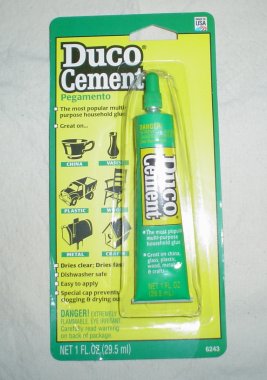
I like to use Duco glue for both nocks and feathers. It's good glue and is
compatible with the finish I use. It's also readily available for less than
a dollar a tube at my local Wal-Mart. For nocks I give about one half hour
curing time before I start fletching. More time is needed for curing if I'm
going right to shooting.
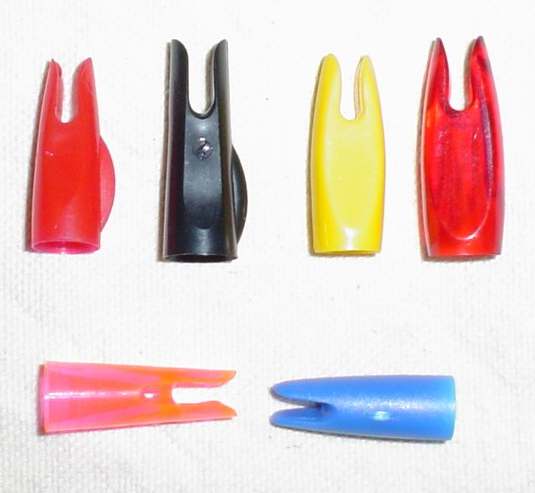
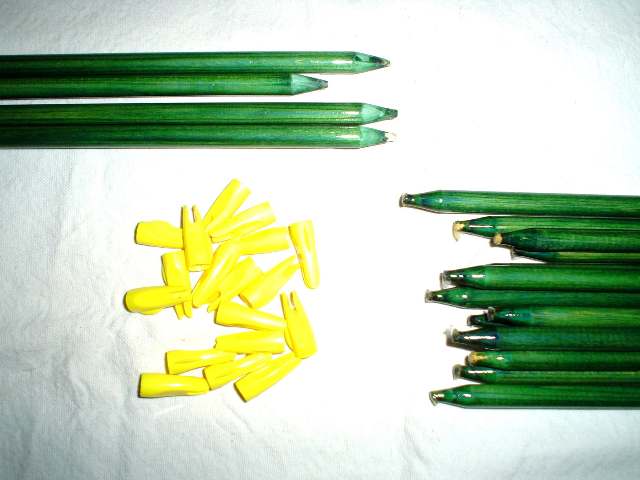
available. Find what you like and use them. I've come to depend on the
Bohning Classic nock. It's the red one at top left.
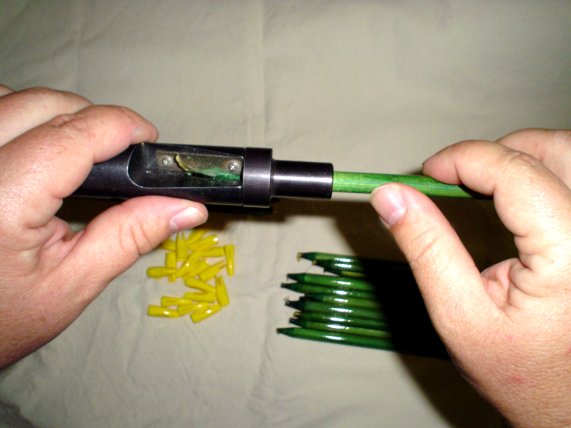
If the nock taper has any lacquer built up on it that needs to be removed to
glue the nocks on. I use the Tru-Center tool for this and just gently cut
off the lacquer. Wait too long to do this and the lacquer is hard and
difficult to remove. Do it too soon and it's still gummy.
Duco works good for me, I buy it at Wal-Mart by the handful. That little
applicator bottle I'm using was actually made for applying gutta for silk
painting. I never got to the silk painting but that little bottle is
fantastic for Duco on arrows.

