
Coloring Shafts
going to cover the ones I use the most. Don't even begin to think that
there aren't more ways to color arrows! On this part of arrow building your
imagination is about the only boundary you'll have. I tend to use dyes
pretty frequently because I believe the beauty of wood is one of the joys of
shooting wood arrows. Dyes don't hide that beauty as paint does.
If the shaft isn't smooth, you'll want to take care of that right now.
I like to sand lightly to about a 220 grit sandpaper. A lot of sanding isn't
normally necessary. Many shafts come from the supplier with a nice
burnished surface. You'll occasionally come across a shaft with a little
bit of a sap deposit on the surface. If this isn't removed it may interfere
with the color's appearance or the finish we'll be putting on later.
Rubbing the sap deposit with denatured alcohol on a rag takes it off pretty good.
One of the easiest dyes to use is plain old Rit fabric dye. Either the
powder form or the liquid will work well. Instead of water we'll mix it
with denatured alcohol. You can adjust the dye/alcohol mix for varying
intensity of color but I usually do about 6 oz of alcohol to one package of
powdered dye. Don't worry about the sludge in the bottom of the container,
not all the Rit dissolves in the denatured alcohol. When it is mixed like
this not all the Rit colors turn out exactly as we may expect. For
instance, black powdered Rit actually ends up being a beautiful burgundy
color on the wood. Point is, be sure to test the dye on some scrap before
actually applying it to the shafts.
Cheap 1" foam brushes make applying the dye pretty easy. Be sure to do this
either outside or over a surface you don't mind dripping dye on. I can
almost guarantee that not all the dye will actually end up on the shafts and
it's pretty pervasive stuff; as well as permanent. If you want the color on
the shaft to be darker, let what you have applied dry for a bit and then
apply another coat.
Aniline dyes are specialty woodworking dyes available in catalogs like Lee
Valley and at some specialty retail stores. Don't even try to find it at
Home Depot, all you'll get is a blank look. Aniline dyes are purchased in a
powdered form and then mixed with a carrying agent like water or denatured
alcohol. The water types have the greatest color fastness and resistance to
UV rays so that's what I use. These dyes may be found in a great selection
of colors. Anything from traditional walnut or mahogany wood colors to
bright blue, rich red, and brilliant yellows are available.
Mix the aniline dye powder with hot water according to the directions on the
container. After it's cool, apply it like the Rit with a 1" foam brush.
Color intensity can be manipulated in both how much dye is mixed in the
water and in additional coats. The water won't evaporate as fast as alcohol
so keep that in mind and wait for the dye to dry before you apply another
coat.
Rit and aniline dyes should both be lightly scuffed after they dry but
before they are coated. I like to use a fiber pad similar to a Scotch
Bright pad. You can find these in the sandpaper section of the store.
I get the best use from the one equivalent to 4/0 steel wool. After very
lightly going over the dyed shaft with the pad, use a rag to dust it off.
This practice will minimize the dye that gets into the dipped finishes.
Regular wood stains like Minwax or Behr can also be used for coloring the
shaft. I use both and get great results. Water-based dyes will raise the
grain a little on the wood and could do with a very light polish with that
fiber pad before coating with finish. Unless you want some strange looking
hands, keep some latex surgery-type gloves around when you're working with
dyes or stains.
It may seem somewhat anti-climactic after all this discussion about dyes and
stains but don't forget that you can also leave the shaft plain with no
additional colorant beyond what Nature gave it. Wood has a natural beauty
all its own that shouldn't be passed up.
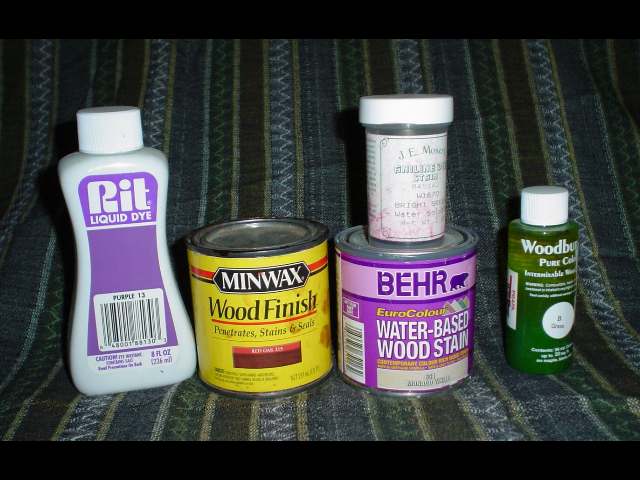
Analine dye in the bottle atop the Behr can is a powdered dye that gets
mixed with water. That's the one we're using for these particular arrows.
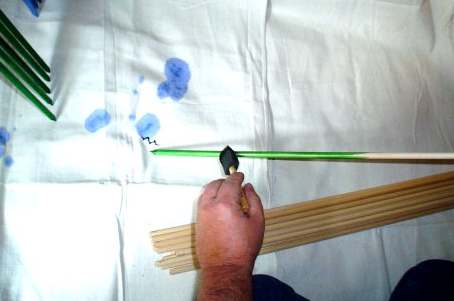
Second picture shows using a foam brush to apply the dye. For a greater
depth of color I'll be letting the first coat of dye dry and then applying a second coat.
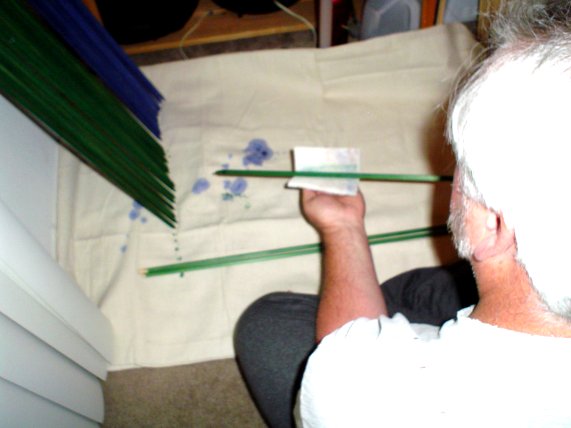
After the dye is dry you'll want to lightly sand the shaft with an abrasive
pad to remove any "loose" dye. Wipe with a rag after sanding to get rid of
sanding debris and keep it out of your finish. That abrasive pad is like a
Scotch-Brite pad, it's the equivalent of 4/0 steel wool and doesn't leave
any metal fibers to worry about.

