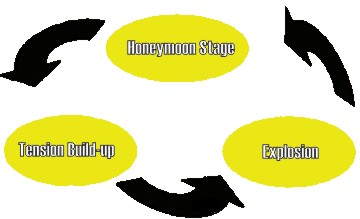
| Obstacles preventing a victim from leaving The victim of abuse fears that when she tries to leave, she cannot make it on her own, for a variety of reasons such as lack of finances, lack of resources (i.e., housing), inability to care for the children without assistance, fear of what he will do when he finds the children and her, his pleas and promises that he will change if she just gives him one more chance, her desire to have a lasting marriage/relationship and father for her children, and her all-too-human desire to be with someone who loves her. Interspersed with his abusive behavior are his pronouncements of his love for her, his promise that he will change, and his statements that only she can help him change. The reality is that most people in nonabusive relationships do not immediately leave even when they believe there is a problem with the relationship. Most people leave more than once before they finally sever the relationship. Victims of domestic violence act just like everyone else: they waiver; they return; and they give it another chance. Rather than saying victims of domestic violence do not leave, it is more accurate to describe their pattern as coming and going from the relationship. Most victims of domestic violence repeatedly attempt to leave the relationship, but return when they cannot overcome the obstacles of getting away from the abuser. They will make a final separation if they are able to find a combination of resources to attend to the needs of their children and themselves, and to do so safely. The question is not: "Why does a victim stay?" But rather, "What are the obstacles that prevent a victim from leaving?" A victim may face any/or all of these, or other obstacles: Economic dependence on the abuser. Fear for her safety and the safety of her children and/or other family members. Isolation. She has no support system or others with whom to reality check. Low self-esteem, especially after years of being told by the abuser how worthless she is and how she is to blame for all the violence that occurs. Beliefs about family. She may believe that a family is not to air its dirty laundry and that all families encounter hard times. These beliefs are often reinforced by family, church members, and the legal system. Beliefs about marriage. She may believe she must stay married forever, that it is "God's will." Belief that she is the only person who can stop the abuser which is reinforced by the abuser who says that she is the only one who ever understood him. Belief that he will find her no matter what she does to try to leave. This belief is based in reality if the abuser has hurt the victim when she attempted to leave. Lack of options and resources. She does not have the money or the resources to support herself and her children. Fear of being seriously hurt or killed if she attempts to leave. This fear is reinforced by the abuser who tells her that he will kill her if she ever tries to leave. Victims know these are not idle threats as they have feared for their lives before. Threats against others if the victim leaves. The abuser frequently threatens to hurt all those whom the victim knows and loves--including children, family members, friends, and co-workers. Health concerns. A victim of family violence may experience her own health issues in later life that make it difficult for her to leave, or she may feel that she must stay to take care of the abusive partner because of his health issues. Society's ageist responses to elder victims. When elder victims of domestic violence report abuse, those to whom the abuse is reported often presume the abuse is the result of the victim's age, not the result of abuse. For example, people may blame the bruises on the victim's frail condition rather than on abuse. People may interpret the victim's silence around financial and other issues as senility and lack of ability rather than fear to speak up in the presence of the abusive person. Leaving does not mean safety Those who work with victims of domestic violence often put their emphasis on pushing the victim to leave the relationship. This approach may, in fact, put her at higher risk of danger. An appropriate response is to help her determine what her risks are and help her to problem-solve how to minimize those risks. In some cases, staying within the relationship may be the safest response. Statistics indicate that women are at a greater risk of becoming victims of domestic homicide when they attempt to leave the relationship. In fact, women who leave their batterers are at a 75 percent greater risk of being killed by their batterer than those who stay (Wilson and Daly 1993). Victims who attempt to leave are often hunted down--stalked, harassed, threatened, and pursued across county and state lines. Because abusers believe they are entitled to control the behavior of their partners, they may continue this behavior even after the petition for divorce is filed or granted. This is so common it is known as "separation violence." The rate of attack against women separated from their husbands is about three times higher than that of divorced women and 25 times higher than that of married women. Theories The Cycle of Violence. In 1979, Dr. Lenore Walker--in the landmark book The Battered Woman--identified three distinct phases that comprise the "cycle of violence." Dr. Walker determined that the phases vary in duration and intensity; as such, it is difficult to predict how long a batterer and victim will remain in any one phase or in the length of individual cycles. Phase One is described as the tension building phase in which the abuser becomes more and more prone to react to any stimulus negatively. The victim responds to the escalation in tension by trying to nurture or appease him--or to stay out of his way. In this phase, the abuser becomes fearful that the victim may leave him, which is reinforced as she avoids him in the hope of not triggering the impending explosion. He becomes more oppressive, jealous, threatening, and possessive. Victims often describe this phase as "walking on eggshells." Phase Two is the battering incident. Phase two is the shortest phase, usually lasting from minutes to a few hours. When the acute attack is over, it is usually followed by initial shock, denial, and disbelief that it really happened. Both the batterer and the victim find ways of rationalizing the seriousness of such attacks. Many victims report reactions similar to those of disaster victims. Victims of catastrophe usually suffer emotional collapse twenty-four to forty-eight hours after the disaster. Symptoms include listlessness, depression, and feelings of helplessness. Similarly, battered women often do not experience the full emotional impact of an attack until twenty-four to forty-eight hours after it has occurred. Phase Three is described as the "honeymoon phase." Just as phase two is characterized by brutality, phase three is characterized by the extremely kind, loving, and contrite behavior of the abuser. He knows he has gone too far and tries to make it up to his victim. It is a phase welcomed by both parties, but ironically it is the phase during which the woman's victimization becomes complete. In this phase, the batterer constantly behaves in a charming and loving manner. He is usually sorry for his actions in the previous phase. He conveys his remorse to the victim, promises that he will never do it again, and begs her forgiveness. He is like a child caught with his hand in the cookie jar. The batterer truly believes that he will never again hurt the woman he loves, and that he will be able to control himself from now on. He also believes that he has taught his partner such a lesson that she will never again behave in a way that tempts him to physically assault her. He is quite sincere and can easily convince anyone involved that his behavior will change. The batterer frequently begins an intense campaign to win forgiveness and to prevent his victim from separating herself from him permanently. It is common for an abuser in phase three to shower his victim with elaborate gifts and to attempt to "romance" her into forgiveness. He may enlist the aid of significant others�family, friends, clergy, even counselors�to persuade her that breaking up the relationship is a bad decision. Often everyone involved believes the rationalizations�that he is sorry and will change, that his workload or his drinking is to blame, that the children need a father, that the abuser needs the help of the victim�and somehow the victim begins to assume responsibility for his behavior. She sees herself as the one who must stand by her man while he gets the help he so desperately needs. In reality, it is very unlikely that the abuser will ever seriously seek professional help to change his violent behavior as long as the victim stays with him. Most often, the abuser will seek help only after his victim has left him and if he thinks seeking counseling will convince her to return. The battered woman chooses to believe that the behavior she sees during phase three is what her spouse/partner is really like. She chooses to believe that the contrite behavior is more indicative of the real person than the battering behavior. Victims and advocates for domestic violence victims identify several drawbacks to the use of the cycle of violence. First, not all victims experience these stages. Some abusers simply batter without any indication they are about to do so--there is no tension building phase. Many victims report they never experience a honeymoon phase--he shows no remorse or contrition in spite of the severity of abuse. Most victims report if they ever experienced a honeymoon phase, it disappears over time. Victims report their experience of violence is not a cycle: they may experience none of these phases or they may experience the phases in random order. A second problem with the use of the cycle of violence is the tendency of the legal system to use it to try to "explain" why violence occurs. In fact, it does not answer the key question the legal system needs to address: Why does the batterer engage in violence? The power and control wheel is the current tool used to explain both the why (to exert power and control) and the how (tactics used to exert power and control) of domestic violence. Another problem with the cycle of violence is its description of the third phase, in which the abuser is said to show remorse in an attempt to prevent her from leaving. In reality, since there have been concerted efforts to arrest abusers and hold them accountable through the criminal justice system, many victims report abusers as likely to use negative efforts to keep her in the relationship or to encourage her to drop the charges. For example, after an arrest he may act in a loving, begging, contrite manner or he may become more agitated and threatening, blaming her for the consequences of his behavior. He is just as likely to threaten harm to her if she attempts to leave as he is to beg her to stay. The honeymoon phase might more accurately be described as a coercion phase, the coercion may be through the use of positive and/or negative tactics. Finally, the cycle of violence fails to address the thinking patterns of the abuser and the victim. Rather, it tends to be explained in terms of their pathology--his sense of desperation and her response based on her low self-esteem. While this may be true, it also shifts the focus from the abuser's violence and makes the issue a "couple's problem," rather than focusing on his choice to use violence and other controlling behaviors to accomplish his goal of control. In spite of its limitations, the cycle of violence is commonly referred to in the criminal justice system because it is a component of what is known as the battered woman's syndrome. An attorney may use the battered woman's syndrome to explain why the victim's behavior in the incident under scrutiny is reasonable in light of this woman's circumstances. For example, a prosecutor might introduce the battered woman's syndrome to explain why the victim recants, while a defense attorney might use it to explain the victim's belief that she had to use the amount of force or violence she did that resulted in her abuser's death. The battered woman's syndrome, however, does not consider the thinking patterns of the abuser and the victim. The battered woman's syndrome requires the attorney to explain both the cycle of violence and the theory of learned helplessness and show how they apply to the victim in the legal case. The theory of learned helplessness can be even more troubling than the cycle of violence for victims of domestic violence. The Psychosocial Theory of Learned Helplessness. As detailed in Domestic Violence: A Guide for Health Care Providers, published by the Colorado Domestic Violence Coalition and Colorado Department of Health in 1994, "learned helplessness" is a psychological theory that describes what happens when a person loses the ability to predict what actions will produce a particular outcome. Because the battered woman tries to protect herself and her family as best she can, those with learned helplessness choose only those actions that have a high probability of being successful. As the battering and isolation increase, a shift in the survivor's comprehension of the situation occurs. She increasingly perceives escape as impossible. While she may continue to work at her paid job, eat, clean house, take care of the children, laugh with coworkers and appear self-confident and independent, surviving the battering relationship becomes the focus of her life. In the survivor's eyes, the batterer becomes more and more powerful. She sees police and other agencies as less and less able to help (Walker 1979). She feels trapped and alone. She will likely develop a variety of coping mechanisms that may include withdrawal, asking permission to do even trivial things, manipulation, substance abuse, and asking that criminal charges be dropped. The problem with the use of the theory of learned helplessness is it suggests/implies/requires a passive victim. In reality, victims often do shift their survival mechanisms from very assertive and community-based options to simply trying to keep the abuse and its impact quiet. This may not be a sign of passivity, as the theory of learned helplessness suggests, but rather a sign of her recognition that a more quiet response to his violence will provide the best safety for her and her children. A jury has a hard time buying into the theory of learned helplessness when presented with a victim who has used violence to kill her abuser. Recent studies on the battered woman's syndrome suggest the theory of learned helplessness has limited usefulness in the legal system. Rather, a jury can far better understand why a victim makes the choices she does when the jury is given an accurate and complete description of the batterers' abusive tactics. This information alone--without trying to fit her into a cycle of violence which may not apply to her experiences or to paint her as exhibiting learned helplessness--may be enough to allow the jury to understand she is acting in a reasonable manner in light of her experiences. Prior to making a choice to use the battered woman's syndrome, a prosecutor needs to clearly understand the pros and cons of this decision. This information can be obtained from the National Clearinghouse on the Defense of Battered Women. The Clearinghouse has a number of treatises on this issue which examine under what conditions the battered woman's syndrome may be helpful but also outline the serious drawbacks to its use. The Clearinghouse also provides information as to how to explain to a jury the victim's actions by presenting her life to the jury through the use of witnesses and police testimony. The Clearinghouse can be reached at 800-903-0111, ext. 3. The effects of Domestic Violence on children It is significant that seven out of ten persons who enter domestic violence shelters are children. In 1998, the Centers for Disease Control published a study that indicated violence against mothers by their intimate partners may also pose a concurrent risk of abuse to the victim's children. Conversely, mothers of abused children are at a higher risk of being abused than mothers of nonabused children. Concurrence of child abuse is defined as the proportion of families in the population or research sample in which women and their children are victims of abuse by an intimate. In the mother's case, the intimate is her partner; the child may be abused by either the mother's intimate or by the battered mother. A continuing controversy regarding the prevalence of this type of abuse exists, but most authorities describe the concurrence rate as approximately 50 percent (McKibben, DeVos and Newberger 1998; Ross 1996). Children are often incorporated into patterns of abuse. Batterers may also do the following: Physically or sexually abuse their children. Neglect children emotionally or financially. Threaten to harm the children. Use the children as "pawns" in episodes involving partner neglect or abuse. Attempt to get children to "take sides" in partner disputes. Degrade and humiliate their partners in front of the children. Threaten to or actually cut off financial support for children in the event that the partner leaves the battering environment. The effects on children who witness family violence or who, in some cases, are themselves victims, were summarized in Family Violence: An Overview published by the National Center on Child Abuse and Neglect (NCCAN) (n.d.). The ramifications of family violence have almost no boundaries. In addition to the obvious physical injuries and deaths that result, family violence is often cited in research and clinical case studies as contributing to numerous other individual, family, and societal problems: According to Pagelow (1984, 81), "Victims of all types of family violence share a common experience of denigration of self that results in diminished self-esteem. The shame and feeling ofworthlessness so often expressed by battered women are shared by maltreated children, as well as maltreated elderly parents." In their review of research on the effects of family violence on children, Crites and Coker (Spring 1988) report: Children learn from an important role model (the parent) that violence toward a loved one is acceptable. Children exhibit fear, emotional symptoms such as psychosomatic complaints (physical complaints created by psychological stress), school phobias, enuresis (bed wetting), and insomnia. Young children may try to stop the violence, thus putting themselves at risk for unintended harm or may respond with immobilized shocked staring, running away and hiding, or bed wetting and nightmares. After age five or six, children show strong indications of identifying with the aggressor and losing respect for the victim. Many children suffer low self-esteem, sadness, depression, stress disorders, poor impulse control, and feelings of powerlessness, and they are at high risk for alcohol and drug use, sexual acting out, running away, isolation, loneliness, fear, and suicide (Jaffe, Wolfe, and Wilson 1990, 28-29). Sons become aggressive, "act out, become disobedient and behave defiantly and destructively," whereas daughters become "withdrawn, clingy, dependent" (Ibid., 35). Some adolescent boys assault their mothers and siblings. Older children, especially girls, take on the burden of protecting their younger siblings during the father's beatings. They feel constrained from leaving home (Ibid., 30-31). Abusers who are extremely domineering and controlling frequently keep or destroy documentation (such as birth certificates and immunization records) as part of their control of the family, thus preventing or seriously delaying the family from receiving welfare benefits or housing assistance (Ibid., 28-29). When a victim of domestic violence leaves the relationship, many times she is isolated, scared, and has no place to go. The abuser has made sure she has no outside support system. Additionally, she may not have access to any funds to pay for food or shelter for her and her children. Lack of funds and long waiting lists on affordable housing may require a victim to choose between staying in the relationship or living on the streets. A number of studies have concluded that domestic violence contributes to homelessness, particularly among families with children. Recently 44 percent of cities surveyed by the U.S. Conference of Mayors responded that domestic violence is the primary cause of homelessness (Waxman and Trupin 1997). Similarly, children who are desperate to leave violent home environments run away from home, living on the streets or seeking temporary shelter relief. Developing a safety plan If and when a victim is able to leave her battering environment, it is essential that she has a "safety plan" to increase her opportunity for a successful departure. Advance planning is crucial. Start by assessing the battered-generated and life-generated risks with her. Based on this information, concerns and actions may need to include the following: Does she have family and friends with whom she can stay? Would she find a protective or restraining order helpful? Can a victim advocate safely contact her at home? What should the advocate do if the batterer answers the phone? Does she know how to contact emergency assistance (i.e., 911)? If she believes the violence might begin or escalate, can she leave for a few days? Does she know how to contact a shelter? (If she doesn't, provide her with information for future use.) Does she have a neighbor she can contact or with whom she can work out a signal for assistance when violence erupts or appears inevitable? If she has a car, can she hide a set of keys? Can she pack an extra set of clothes for herself and the children, and store them--along with an extra set of house and car keys--with a neighbor or friend? Can she leave extra cash, checkbook, or savings account book hidden or with a friend for emergency access? Can she collect and store originals or copies of important records such as birth certificates, social security cards, drivers' license, financial records (such as banking and other financial accounts, mortgage or rent receipts, the title to the car, etc.), and medical records for herself and her children? Does she have a concrete plan for where she should go and how she can get there regardless of when she leaves? Does she have a disability that requires assistance or a specialized safety plan? Does she want access to counseling for her children or herself? Are there any other concerns that need to be addressed? This information was collected from the following website: National Victim Assistance Academy. Honeymoon Stage (sorry can't get the following "unlined") Even the most abusive relationships start out romantic and loving. Many abusers act very sweet and kind, express a lot of love and make their partners feels special and cared for. Tension Build-Up Tension builds up gradually beginning with verbal abuse. Minor battering incidents occur. As the tensions builds, the victim tries to calm the abuser and anticipate the abuser's every need. The tension between the two becomes unbearable...like "walking on eggshells." Explosion This phase is shorter than the others, usually lasting from 2 to 48 hours. There is no escape once the battering has begun - only the battering can end the incident. The tension that builds up leads to severe verbal abuse, violent physical or sexual attack. The violence is usually triggered by an outside event that causes the abuser stress. The victim will often deny the seriousness of the injuries to soothe the abuser, and to be assured the violence is over. Return to Honeymoon After the explosion, there is a return to a sense of calmness. The abuser may promise it will never happen again, act apologetic and loving and beg for forgiveness. Since the relationship has been deteriorating, the abuser's loving behavior is very important to the victim. It reinforces the victim's hope the abuser can change. The victim feels responsible for her abuser's behavior and the abuser's future welfare. They may feel that if they leave, they will be breaking up the home. The victim is least likely to leave during the honeymoon phase. If the victim stays it's not long before the cycle begins over again. The cycle can cover a long or short period of time. Often as the pattern continues, the honeymoon phase gets shorter and violence increases. The assaults can also become more serious. Often a victim gets caught in the cycle and becomes isolated form family and friends. The victim is either ashamed to see them or the abuser tells her not communicate with them. The victim becomes more dependant on the abuser and has few or not other people to help. |
 |
 |
|
|