History
More Floods.
The Bay of Plenty.
(map NZ Herald)
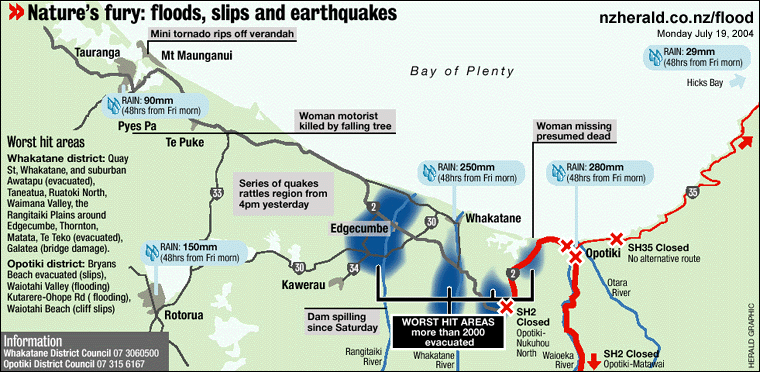
For over two weeks now, people in the Bay of Plenty have been suffering the effects of severe flooding. Whole communities are isolated and homes evacuated necessitating families moving into Community Halls, Schools and Maraes. The floods continued growing and spread across a huge area. As if this wasn�t enough to cope with, a swarm of earthquakes hit the region, causing slips and unstable areas to become more hazardous. This sadly caused loss of life as a woman who was working on her property was caught in a landslide.
I quote from the NZ Herald, right at the start of the catastrophe.
�In the space of a few short minutes, Bob Freeman lost everything. His house, his car, his campervan - and the woman he loved.
Entombed in the mud after a huge mudslide and a large pohutukawa crushed her home at Bryans Beach, it is difficult to imagine the terror of Beverley Freeman's final moments.
Minutes before, the 67-year-old retiree had been doggedly digging a drain at the back of the property to clear her mud-clogged section after 48 hours of torrential rain.
Then the earth came crashing down.
Police and rescuers were quickly on the scene. But with fading, desperate hopes that a voice, a whimper or a sigh might be heard from deep beneath the silt and sludge, they too had to run for their lives as a second landslide smashed down on the Freemans' home.
The body of Beverley Freeman was eventually recovered on Monday, two days after the landslide. Her funeral is today. Friends of Bob Freeman have no idea how he will cope with his loss. All they know is that it will be tough. As it will be for the dozens of families left counting their losses after the worst floods to hit the eastern Bay in more than 50 years.
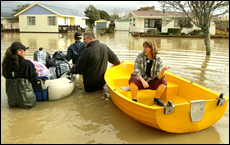
Some have lost everything. At least 700 houses were damaged. Some will have to be torn down. At least half were not insured.
(photo Alan Gibson)
Of 184 flooded houses inspected, 104 are too badly water-damaged for people to live in. Of 40 properties hit by slips, eight are uninhabitable and 11 are livable, but residents will have to be re-evacuated should moderate or heavy rain fall.
An early, conservative estimate of the cost to fix road damage stands at $5.5 million.
The storm, accompanied by a string of earthquakes, has delivered a devastating one-two blow to the swamped residents of Edgecumbe, Whakatane, Ohope, Awakeri, Ruatoki, Ruatuhuna, Opotiki and Waimana.
The huge clean-up operation has begun in earnest, but for many it will be months before they are back on their feet.
"I have no idea how many of these people are going to cope," says Leanne Taia, a resident of sodden Awatapu. "The worst hit have been the low-income families. It's not as though they can go to the bank and get a loan."
The cost is expected to run into tens of millions of dollars. Already the Earthquake Commission has received claims totalling $7 million. There will be many more to come.
Ray Burton is among those who have lost their homes. "I'm going to have to tear my place down and rebuild it," he says. "It's devastating. I've lost a lot of things I can never replace."
Work and Income New Zealand has already provided around $10,000 in emergency grants. Its regional commissioner, Carl Crafar, expects staff to deal with around 150 people a day for the next two weeks.
For farmers, the floods that swept over much of the Rangitaiki Plains and other low-lying areas of the eastern Bay of Plenty could not have come at a worse time, with calving well under way.
Federated Farmers estimates between 400 and 500 dairy farms will have suffered to varying degrees from the deluge, which began on Thursday night and finally stopped on Sunday. About 200ha of farmland and 200ha of orchards have been affected.�
The Matata Straights became a sodden time bomb when two days of heavy rain exploded into an avalanche of slips.
By the end of Saturday there had been one casualty: Ohiwa's Beverley Freeman. There were incredible tales of survival.
Colin Ratlidge and his king charles spaniel Chelsea had set off on Saturday afternoon to join his mate down Ohiwa Harbour Rd near Opotiki to watch the All Blacks play the Wallabies. Less than 20m along the way, the pair were caught by a mudslide and carried across the road into the harbour.
It was pitch dark, cold and high tide was approaching. After several hours trapped in mud and salt water, a neighbour heard Ratlidge's cries. The neighbour grabbed a torch, headed down the hill and managed to get the frozen 74-year-old out of the mire.
Chelsea also survived. Buried in mud with the waves washing over her, she was pulled from the tide by another of Ratlidge's neighbours.
Others weren't so lucky. Apart from the Freeman home, at least four houses around Ohiwa Harbour were destroyed by landslides, while others remained in danger from slips.
One owned by Jim and Pam Greenaway is still sitting precariously on the edge of a newly formed cliff.
"The house is as stable as you can expect but it is going to be a very difficult job to retain it," Mr Greenaway said.
In Ohope, a couple were forced to make a mad dash after dozens of mature pohutukawa trees and tonnes of mud cascaded down a 70m drop towards their West End home, eventually ending up just metres from their back doorstep. But that was just the start of the multi-million dollar trail of devastation.
Driven by incessant overnight rain, the deluge tore a watery swath across the rest of the eastern Bay on Sunday forcing mass evacuations in Whakatane and Edgecumbe, and cutting off already isolated Ruatuhuna.
Thousands of hectares of farmland already under water were further inundated as huge volumes of water were spilled from the Matahina hydro-electricity dam that was filled beyond capacity.
Mother Nature still wasn't through.
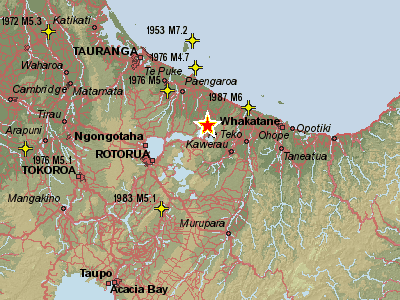
Like a bad joke, she delivered a concentrated flurry of at least a dozen quakes, centred 20km north-west of Kawerau, the biggest measuring 5.4 on the Richter scale.
(Map from NZ seismograph, see quake page for link)
Some shocks triggered landslides across the Bay of Plenty making work even harder for weary Civil Defence workers.
For already waterlogged residents the quakes were the final indignity.
"If the floods and the mess weren't bad enough, then we get all these earthquakes," said Whakatane's John Johnstone. "It's like someone has got it in for us. It's just not fair."
In a freak accident, the earthquakes claimed the life of 55-year-old Rotorua woman Marilyn Erica Robinson, who died after a large eucalyptus tree fell on her car.
By Monday the rain had stopped and the skies had cleared. Then, the true extent of the damage could be assessed.
Good fortune isn't usually the first thing you think of when floodwaters are lapping at your feet and your living room is full of mud, but many escaped relatively lightly.
"We were certainly one of the lucky ones," said Awatapu resident Devero Durham. "We are going to be damp for a while, but there's been no major damage."
Since Sunday, Awatapu had resembled a poor man's Pauanui but in the space of about 10 hours the streets were dramatically transformed when tens of thousands of litres of water were pumped into the Whakatane River, leaving behind streets of mud and silt.
The worst-hit families had been those occupying Housing Corporation rental homes. Many were uninsured and what little they had had been ruined.
"I've seen lots of people breaking down. A lot have gone home to nothing," said Awatapu resident Chris Martin.
Whakatane deputy mayor Brian Birkett sympathises. "These are low-income people. A lot are elderly. They will need the most help of anyone."
There was a further shock for residents on Wednesday morning when another earthquake struck just after 3am, measuring 4.4 on the Richter scale, triggering several new slips.
Although some settlements are still completely isolated with no road access, most of the flood victims are now back in their homes. Most children will return to school next week. But it will be a while before life gets back to normal.
The state of emergency was still in place yesterday and the cleanup efforts will carry on long into next month at least.
For many residents the grim reality of their losses are slowly beginning to sink in.�
New Zealand is a small country as far as the population goes, but in its generosity, it is huge. People are rallying and helping those whose lives have been turned upside down, giving practical help, money, household and personal goods, as well as in some cases, offering accommodation until such time as the homes which had to be abandoned can be inhabited once again. The loss of farmland will prove critical. New Zealand bases its economy on the produce for which it is famous. Dairy/beef cattle, sheep and all associated products and fruit are exported all over the world. Some farmers are facing a year with no income, while they rebuild and recover all that has been lost or damaged, so the crisis will be prolonged for them and even longer for the economy of this beautiful country.