What is Acid Rain and What Causes It?
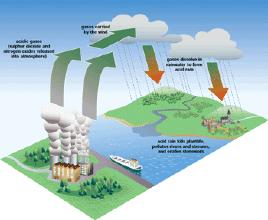
"Acid rain" is a broad term used to describe several ways that acids fall out of the atmosphere. A more precise term is acid deposition, which has two parts: wet and dry.�Wet deposition refers to acidic rain, fog, and snow. As this acidic water flows over and through the ground, it affects a variety of plants and animals. The strength of the effects depend on many factors, including how acidic the water is, the chemistry and buffering capacity of the soils involved, and the types of fish, trees, and other living things that rely on the water.�Dry deposition refers to acidic gases and particles. About half of the acidity in the atmosphere falls back to earth through dry deposition. The wind blows these acidic particles and gases onto buildings, cars, homes, and trees. Dry deposited gases and particles can also be washed from trees and other surfaces by rainstorms. When that happens, the runoff water adds those acids to the acid rain, making the combination more acidic than the falling rain alone. Prevailing winds blow the compounds that cause both wet and dry acid deposition across state and national borders, and sometimes over hundreds of miles. Scientists discovered, and have confirmed, that sulfur dioxide (SO2) and nitrogen oxides (NOx) are the primary causes of acid rain. In the US, About 2/3 of all SO2 and 1/4 of all NOx comes from electric power generation that relies on burning fossil fuels like coal.Acid rain occurs when these gases react in the atmosphere with water, oxygen, and other chemicals to form various acidic compounds. Sunlight increases the rate of most of these reactions. The result is a mild solution of sulfuric acid and nitric acid. How Do We Measure Acid Rain?Acid rain is measured using a scale called "pH." The lower a substance's pH, the more acidic it is. Pure water has a pH of 7.0. Normal rain is slightly acidic because carbon dioxide dissolves into it, so it has a pH of about 5.5. As of the year 2000, the most acidic rain falling in the US has a pH of about 4.3. Acid rain's pH, and the chemicals that cause acid rain, are monitored by two networks, both supported by EPA. The National Atmospheric Deposition Program measures wet deposition, and its Web site features maps of rainfall pH (follow the link to the isopleth maps) and other important precipitation chemistry measurements.The Clean Air Status and Trends Network (CASTNET) measures dry deposition. Its web site features information about the data it collects, the measuring sites, and the kinds of equipment it uses.
Effects of Acid Rain:
Acid rain causes acidification of lakes and streams and contributes to damage of trees at high elevations (for example, red spruce trees above 2,000 feet) and many sensitive forest soils. In addition, acid rain accelerates the decay of building materials and paints, including irreplaceable buildings, statues, and sculptures that are part of our nation's cultural heritage. Prior to falling to the earth, SO2 and NOx gases and their particulate matter derivatives, sulfates and nitrates, contribute to visibility degradation and harm public health.
What Society Can Do About Acid Deposition?
There are several ways to reduce acid deposition, more properly called acid deposition, ranging from societal changes to individual action. To understand acid deposition's causes and effects and track changes in the environment, scientists from EPA (US environmental protection agency), state governments, and academic study acidification processes. They collect air and water samples and measure them for various characteristics like pH and chemical composition, and they research the effects of acid deposition on human-made materials such as marble and bronze. Finally, scientists work to understand the effects of sulfur dioxide (SO2) and nitrogen oxides (NOx) - the pollutants that cause acid deposition and fine particles - on human health. To solve the acid rain problem, people need to understand how acid rain causes damage to the environment. They also need to understand what changes could be made to the air pollution sources that cause the problem. The answers to these questions help leaders make better decisions about how to control air pollution and therefore how to reduce - or even eliminate - acid rain. Since there are many solutions to the acid rain problem, leaders have a choice of which options or combination of options are best.
The next section describes some of the steps that can be taken to reduce, or even eliminate, the acid deposition problem.
Clean up smokestacks and exhaust pipes:
Almost all of the electricity that powers modern life comes from burning fossil fuels like coal, natural gas, and oil. acid deposition is caused by two pollutants that are released into the atmosphere, or emitted, when these fuels are burned: sulfur dioxide (SO2) and nitrogen oxides (NOx).Coal accounts for most US sulfur dioxide (SO2) emissions and a large portion of NOx emissions. Sulfur is present in coal as an impurity, and it reacts with air when the coal is burned to form SO2. In contrast, NOx is formed when any fossil fuel is burned.There are several options for reducing SO2 emissions, including using coal containing less sulfur, washing the coal, and using devices called scrubbers to chemically remove the SO2 from the gases leaving the smokestack. Power plants can also switch fuels; for example burning natural gas creates much less SO2 than burning coal. Certain approaches will also have additional benefits of reducing other pollutants such as mercury and carbon dioxide. Understanding these "co-benefits" has become important in seeking cost-effective air pollution reduction strategies. Finally, power plants can use technologies that don't burn fossil fuels. Each of these options has its own costs and benefits, however; there is no single universal solution.Similar to scrubbers on power plants, catalytic converters reduce NOx emissions from cars. These devices have been required for over twenty years in the US, and it is important to keep them working properly and tailpipe restrictions have been tightened recently. EPA has also made, and continues to make, changes to gasoline that allows it to burn cleaner.
Use alternative energy sources:
There are other sources of electricity besides fossil fuels. They include: nuclear power, hydropower, wind energy, geothermal energy, and solar energy. Of these, nuclear and hydropower are used most widely; wind, solar, and geothermal energy have not yet been harnessed on a large scale in this country.There are also alternative energies available to power automobiles, including natural gas powered vehicles, battery-powered cars, fuel cells, and combinations of alternative and gasoline powered vehicles.All sources of energy have environmental costs as well as benefits. Some types of energy are more expensive to produce than others, which means that not all Americans can afford all types of energy. Nuclear power, hydropower, and coal are the cheapest forms today, but changes in technologies and environmental regulations may shift that in the future. All of these factors must be weighed when deciding which energy source to use today and which to invest in for tomorrow.
Restore a damaged environment:
Acid deposition penetrates deeply into the fabric of an ecosystem, changing the chemistry of the soil as well as the chemistry of the streams and narrowing, sometimes to nothing, the space where certain plants and animals can survive. Because there are so many changes, it takes many years for ecosystems to recover from acid deposition, even after emissions are reduced and the rain becomes normal again. For example, while the visibility might improve within days, and small or episodic chemical changes in streams improve within months, chronically acidified lakes, streams, forests, and soils can take years to decades or even centuries (in the case of soils) to heal.However, there are some things that people do to bring back lakes and streams more quickly. Limestone or lime (a naturally-occurring basic compound) can be added to acidic lakes to "cancel out" the acidity. This process, called liming, has been used extensively in Norway and Sweden but is not used very often in the United States. Liming tends to be expensive, has to be done repeatedly to keep the water from returning to its acidic condition, and is considered a short-term remedy in only specific areas rather than an effort to reduce or prevent pollution. Furthermore, it does not solve the broader problems of changes in soil chemistry and forest health in the watershed, and does nothing to address visibility reductions, materials damage, and risk to human health. However, liming does often permit fish to remain in a lake, so it allows the native population to survive in place until emissions reductions reduce the amount of acid deposition in the area.
Look to the future:
As emissions from the largest known sources of acid deposition - power plants and automobiles-are reduced, EPA scientists and their colleagues must assess the reductions to make sure they are achieving the results Congress anticipated. If these assessments show that acid deposition is still harming the environment, Congress may begin to consider additional ways to reduce emissions that cause acid deposition. They may consider additional emissions reductions from sources that have already been controlled, or methods to reduce emissions from other sources. They may also invest in energy efficiency and alternative energy. The cutting edge of protecting the environment from acid deposition will continue to develop and implement cost-effective mechanisms to cut emissions and reduce their impact on the environment
Take action as individuals:
It may seem like there is not much that one individual can do to stop acid deposition. However, like many environmental problems, acid deposition is caused by the cumulative actions of millions of individual people. Therefore, each individual can also reduce their contribution to the problem and become part of the solution. One of the first steps is to understand the problem and its solutions.Individuals can contribute directly by conserving energy, since energy production causes the largest portion of the acid deposition problem. For example, you can:Turn off lights, computers, and other appliances when you're not using them� Use energy efficient appliances: lighting, air conditioners, heaters, refrigerators, washing machines, etc. Only use electric appliances when you need them.Keep your thermostat at 68 F in the winter and 72 F in the summer. You can turn it even lower in the winter and higher in the summer when you are away from home. Insulate your home as best you can.� Carpool, use public transportation, or better yet, walk or bicycle whenever possible�Buy vehicles with low NOx emissions, and maintain all vehicles well.� Be well-informed.
Effects of acid rain on plant life:
 Both natural vegetation and crops are affected by acid rain. The roots are damaged by acidic rainfall, causing the growth of the plant to be stunted, or even in its death. Nutrients present in the soil, are destroyed by the acidity. Useful micro organisms which release nutrients from decaying organic matter, into the soil are killed off, resulting in less nutrients being available for the plants. The acid rain, falling on the plants damages the waxy layer on the leaves and makes the plant vulnerable to diseases. The cumulative effect means that even if the plant survives it will be very weak and unable to survive climatic conditions like strong winds, heavy rainfall, or a short dry period. Plant germination and reproduction is also inhibited by the effects of acid rain.
Effects of acid rain on aquatic life:
The action of acid rain causes harmful elements like mercury and aluminium to be leached from the soil and rocks and it is then carried into the lakes where aquatic life may be affected. Warning signs have been posted at several lakes, telling about the dangers of eating fish which may have been poisoned by mercury. Just as the soil has a natural ability to neutralise the acidity of rain water, within a certain limit, so also lakes and other water bodies can to a certain extent nullify the effects of acid rain. However as the acidity increases, the natural mechanisms are no longer able to cope. As the water gets more acidic its pH goes down. As the pH reaches 5.5, plankton, certain insects and crustaceans begin to die. At a pH of around 5.0, the fish population begin to die. When the pH drops below 5.0, all the fish have died, and the bottom of the lake lies covered with undecayed material. Every year during the spring thaw, there is a sudden increase in the acidity of the lakes as frozen acid is suddenly deposited in them. This "Acid Shock" prevents the reproduction of aquatic species, or results in the deaths of the hatchlings. \par Both natural vegetation and crops are affected by acid rain. The roots are damaged by acidic rainfall, causing the growth of the plant to be stunted, or even in its death. Nutrients present in the soil, are destroyed by the acidity. Useful micro organisms which release nutrients from decaying organic matter, into the soil are killed off, resulting in less nutrients being available for the plants. The acid rain, falling on the plants damages the waxy layer on the leaves and makes the plant vulnerable to diseases. The cumulative effect means that even if the plant survives it will be very weak and unable to survive climatic conditions like strong winds, heavy rainfall, or a short dry period. Plant germination and reproduction is also inhibited by the effects of acid rain.
Effects on animals and birds:
All living organisms are interdependent on each other. If a lower life form is killed, other species that depended on it will also be affected. Every animal up the food chain will be affected. Animals and birds, like waterfowl or beavers, which depended on the water for food sources or as a habitat, also begin to die. Due to the effects of acid rain, animals which depended on plants for their food also begin to suffer. Tree dwelling birds and animals also begin to languish due to loss of habitat.
Effects on human beings:
Mankind depends upon plants and animals for food. Due to acid rain the entire fish stocks in certain lakes have been wiped out. The economic livelihood of people who depended on fish and other aquatic life suffers as a result. Eating fish which may have been contaminated by mercury can cause serious health problems. In addition to loss of plant and animal life as food sources, acid rain gets into the food we eat, the water we drink, as well as the air we breathe. Due to this asthmatic people and children are directly affected. Urban drinking water supplies are generally treated to neutralise some of the effects of acid rain and therefore city dwellers may not directly suffer due to acidified drinking water. But out in the rural areas, those depending upon lakes, rivers, and wells will feel the effects of acid rain on their health. The acidic water moving through pipes causes harmful elements like lead and copper to be leached into the water. Aluminium which dissolves more easily in acid rain as compared to pure rainfall, has been linked to Alzheimer\rquote s disease. The treatment of urban water supplies may not include removal of elements like Aluminium, and so is a serious problem in cities too.
Other effects:
All living things, whether plants or animals, whether living on land or in the water or trees, are affected either directly or indirectly by acid rain. Even buildings, bridges and other structures are affected. In cities, paint from buildings have peeled off and colours of cars have faded due to the effects of acid rain. From the Taj Mahal in India to the Washington Monument great buildings all over the world have been affected by the acid rainfall which causes corrosion, fracturing, and discoloration in the structures. In Europe, structures like The Acropolis in Greece and Renaissance buildings in Italy, as well as several churches and cathedrals have suffered visible damage. In the Yucatan peninsula in Mexico, and in places in South America, ancient Mayan Pyramids are being destroyed by the acid rain. Temples, murals, and ancient inscriptions which had previously survived for centuries are now showing severe signs of corrosion. Even books, manuscripts, paintings, and sculpture are being affected in museums and libraries, where the ventilation system cannot eliminate the acid particles from the air which circulates in the building. In some parts of Poland, trains are required to run slowly, as the tracks are badly damaged due to corrosion caused by acid rainfall.
Solutions:
The bottom line is that all things on earth are being affected by this problem and the good news is that something is being done to solve it. Pressure from the environmental groups, and public has increased as the effects of the havoc caused by acid rain become more apparent. Governments all over the world have drawn up plans to tackle this problem. Lakes that have become highly acidic, can be treated by adding large quantities of alkaline substances like quicklime, in a process called liming. Although it has worked in several places, it has not been successful where the lake is very large, making this procedure economically unfeasible, or in other lakes where the flushing rate of the lake waters is too large resulting in the lake becoming acidic again. The best approach seems to be in prevention. To this end environmental regulations have been enacted to limit the quantity of emissions released in the atmosphere. Several industries have added scrubbers to their smoke stacks to reduce the amount of sulphur dioxide dumped in the atmosphere. Specially designed catalytic converters are used to ensure that the gases coming out from exhaust pipes of automobiles, are rendered harmless. Several industries which use coal as fuel have begun to wash the coal before using it thereby reducing the amount of Sulphur present in it, and consequently the amount of emissions. Usage of coal with a low Sulphur content also reduces the problem. We as individuals can take several steps to alleviate the effects of this problem. A reduction in use of vehicles will reduce the amount of emission caused by our vehicles. So do not use the car unless it is absolutely required. For going short distances, walk or try to use a bicycle. This will not only protect the environment but also improve your health. If the distance is greater, try using public transportation. If you must use your vehicle try forming a car pool and share your vehicle with someone else. Ensure that your vehicle is properly tuned, and fitted with a catalytic converter, to reduce the emissions. Reduce use of electric power. Switch off lights, and other electrical appliances when not required. Do not leave your Televisions, VCRs, Microwave Ovens or Music Systems on Stand-by when not required. Switch them off. Reducing power consumption will reduce the amount of coal burnt to produce electricity, and thus reduce the amount of pollution. This is true even if your electricity company does not use coal for producing electricity, but some other more environmentally friendly way. This is because the electricity you have saved can now be used elsewhere, thus benefiting nature. Speak to others about this problem. Increasing awareness is one way of ensuring that things are done to solve this global problem. Find out what fuel is being used by your electricity company to produce electricity. If they use coal, ask what methods they use to contain, if not eliminate, the problem of sulphur emissions. Washing the coal used, or using coal having a low sulphur content, is costly and therefore some companies try to avoid this. If you have the option, switch to a utility that shows more concern for the environment. Write to your representative in Government. Pressure from people can make Governments enact suitable legislation, to ensure that industries keep their emissions within limits. Join some group which works to protect the environment. When people get together and speak with one voice they are more likely to be heard.

