
 |
Mysteries
The mysteries consisted of purifications, sacrificial offerings, processions, songs, dances, and dramatic performances. Often the birth, suffering, death, and resurrection of a god were enacted in dramatic form. The aim of the mysteries seems to have been twofold, namely, to give comfort and moral instruction for life on earth, and to inspire hope for life after death. The earliest and most important Greek mysteries were the Orphic, the Eleusinian, and the Dionysiac. The Orphic mysteries were those of a mystic cult founded, according to tradition, by the legendary poet and musician Orpheus, to whom was attributed a great mass of religious literature (see Orphism). Far more celebrated were the Eleusinian mysteries, connected with the worship of the goddesses Demeter and Persephone at Eleusis in Attica; with these divinities were associated Pluto, god of the underworld; Iacchus, a name of the youthful Dionysus, god of vegetation and of wine; and other gods. |
| Dionysus |  |
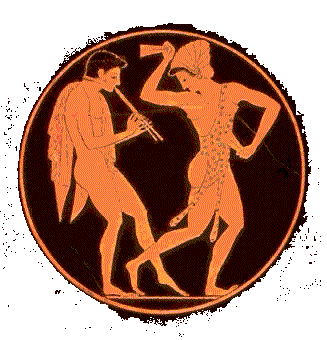
Secret rites were a part of the worship of several Greek deities, such as Hera, queen of the gods, Aphrodite, goddess of love, and Hecate, goddess of the underworld. Many foreign religions adopted by the Greeks and Romans had mysteries connected with the worship of the divinity; these religions included the worship of the Phrygian goddess Cybele, the "great mother" of the gods; the Egyptian Isis, goddess of the moon, nature, and fertility; and the Persian Mithras, god of the sun. The worship of these deities spread throughout the Graeco-Roman world and was extremely popular in the early centuries of the Roman Empire. Isis, who at an early date had been identified with Demeter, was worshipped in Italy as late as the 5th century AD.Dionysus, in Greek mythology, god of wine and vegetation, who showed mortals how to cultivate vines and make wine. A son of Zeus, Dionysus is usually characterized in one of two ways. As the god of vegetation-specifically of the fruit of the trees-he is often represented on Attic vases with a drinking horn and vine branches. He eventually became the popular Greek god of wine and cheer, and wine miracles were reputedly performed at certain of his festivals. Dionysus is also characterized as a deity whose mysteries inspired ecstatic, orgiastic worship. The maenads, or bacchantes, were a group of female devotees who left their homes to roam the wilderness in ecstatic devotion to Dionysus. They wore fawn skins and were believed to possess occult powers. Dionysus was good and gentle to those who honoured him, but he brought madness and destruction upon those who spurned him or the orgiastic rituals of his cult.According to tradition, Dionysus died each winter and was reborn in the spring. To his followers, this cyclical revival, accompanied by the seasonal renewal of the fruits of the earth, embodied the promise of the resurrection of the dead. The yearly rites in honour of the resurrection of Dionysus gradually evolved into the structured form of the Greek drama, and important festivals were held in honour of the god, during which great dramatic competitions were conducted. The most important festival, the Greater Dionysia, was held in Athens for five days each spring. It was for this celebration that the Greek dramatists Aeschylus, Sophocles, and Euripides wrote their great tragedies.By the 5th century BC, Dionysus was known to the Greeks as Bacchus, a name referring to the loud cries with which Dionysus was worshipped at the Orgia, or Dionysiac mysteries. These frenetic celebrations, which probably originated in spring nature festivals, became occasions for licentiousness and intoxication. This was the form in which the worship of Dionysus became popular in the 2nd century BC in Roman Italy, where the Dionysiac mysteries were called the Bacchanalia. The indulgences of the Bacchanalia became increasingly extreme and the celebrations were prohibited by the Roman Senate in 186 BC. In the 1st century AD, however, the Dionysiac mysteries were still popular, as representations of them on Greek sarcophagi testify.
Back Home