An
introduction to Iaido
"As
you yourselves have often certainly experienced, a warrior especially
needs these three things--he must guard his person with strength,
shrewdness and care; he must be free in his movements, and he must
be quick to draw his sword."
St. Bernard of Clairvaux, Liber ad milites Templi: De laude novae
militae
Iaido
is most often translated as the way of harmonious living, the art
of adapting to circumstance, or the way of being here and now. Iai
is an art, or perhaps training method, using a real (or almost real)
sword in solo practice. Katas start and end with sheathed sword, and
hence involve the drawing and sheathing of the sword.
Most traditional sword schools primarily use partner practice with
wooden swords as training method, and solo practice with the sword
(which may or may not be referred to as iai) is usually a minor part
of the curriculum.
Iaido as an art that focusses on iai as its major component, is usually
attributed to Hayashizaki Jinsuke Shigenobu (1542-1621). Little is
known about him, but his supposed students originated most of the
Iaido styles practiced today.
While many consider Hayashizaki as the father of Iaido, it is nevertheless
mistaken to attribute the invention of Iai to him. The Tenshin Shoden
Katori Shinto ryu (1447) for example predates him by about a century,
and its curriculum contains several iai sets. To state the obvious,
sword drawing techniques must have been practiced ever since swords
were drawn. Already in Kormac's saga, a millenium before Hayashizaki,
Skeggi gives extensive instructions to Kormac on how to draw his sword
Sk?fnung (Kormac ignores the advice and damages the ancient sword).
Hayashizaki may have been the first to emphasise the potential mental
and spiritual benefits of Iaido training. One of his best-known students
was Tamiya Heibei Narimasu (founder of Tamiya ryu ).
The
style we practice is Muso Shinden Ryu, which also derives from Hayashizaki.
The iai techniques form three sets, Shoden, Chuden and Okuden. The
Okuden techniques are the oldest and most advanced, and attributed
to Hayashizaki Jinsuke Shigenobu. The Chuden set was added later and
consists of techniques attributed to Hasegawa Chikara-no-Suke Hidenobu
(founder of Eishin ryu). The Shoden set consists of techniques attributed
to Omori Rokurosaemon Masamitsu (founder of Omori ryu) and was merged
into the style by Hayashi Rokudayu Morimasa (1661-1732).
Then the ryu split into two branch school, the Tanimura ha and the
Shimomura ha. The Tanimura ha is known today as Muso Jikiden Eishin
ryu, while the Shimomura ha was renamed to Muso Shinden ryu by Nakayama
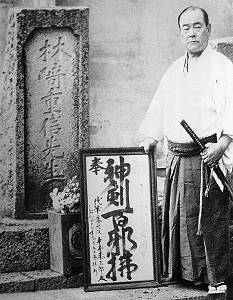
Hakudo (therefore he is often named as the "founder" of
Muso Shinden ryu).
ZNKR
Iaido
In the 20th century the Zen Nihon Kendo Renmei created
a set of iaido katas, known as the seitei gata (standard forms). The
purpose was probably to encourage Kendo practitioners to experience
the handling of a real sword. Whether this was effective, or whether
kendo has influenced the seitei gata to a greater extent than vice
versa, is debatable. Not all kendoka practice Iaido, and many iaidoka
don't practice Kendo. The Zen Nihon Kendo Renmei also created the
Kendo no kata, a set of partner forms using wooden swords, which are
required for kendo promotion (although whether this is observed in
practice is also debatable).
The ZNKR seitei gata are practiced so Iaidoka can obtain ZNKR-recognized
grades. They also make competition possible. Again this is debatable,
since advanced practitioners are not only allowed, but actually required
to include non-seitei ("koryu") katas in grading tests or
matches. The "standard" seitei gata also change a bit each
year (though some may argue the changes aren't really changes).
Many Iaido practitioners, especially those not involved with Kendo,
would rather be affiliated with an actual ryu and obtain ryu gradings
instead of dealing with the seitei gata. Unfortunately opportunities
to do so are scarce. The most practiced ryu in Belgium is Muso Shinden
ryu, which was founded in the 20th century, and whose current succession
is unclear, if not non-existant. Muso Jikiden Eishin ryu and Tamiya
ryu for example at least have a headmaster, but you have to go to
Japan to train with them. The seitei gata have the advantage that
they form a decent introduction to iaido that can be learned from
any iaido teacher, almost anywhere, with little variation.
Associated
disciplines
One can't fully understand the sword by solo practice
exclusively. Muso Shinden ryu contains two sets of partner forms,
the tachi uchi no kurai (standing forms) and the tsumi ai no kurai
(seated forms), However, these are not very widely practiced, and
there is some doubt on their authenticity, given the important differences
with the iai part of the ryu. There was also supposedly a now supposedly
lost jujutsu component contained in the ryu. Another related practice
is iai giri or tameshi giri, cutting objects (mostly inanimate) to
improve cutting technique. And one can of course spar with bamboo
sticks in Kendo.
What
is training like?
Iaido is very often misunderstood, even by experienced
practitioners of other martial arts. Quite often it is interpreted
as a kind of sterile sword dance, a "moving meditation"
somewhat like Tai Chi but much slower, in which practitioners numbly
perform the same 4 movements (nukitsuke, kiritsuke, chiburi, noto)
over and over like a kind of physical mantra, until they are overcome
by terminal boredom. Even people who think they have a pretty good
idea what Iaido is about, are surprised to hear there exist other
katas besides ZNKR seitei mae.
While the term "meditation" is often associated with the
practice of Iaido, I think it is an unfortunate choice of words; "intense
focus" or "concentration" are probably much more appropriate.
Iaido practitioners obviously don’t train with the aim of becoming
proficient swordfighters. Rather, gaining skill with the sword is
the means by which the practitioners achieve their purpose. Thus,
while the ultimate aim of Iaido is not how to learn to kill with a
sword, during practice the practitioner is totally focussed on eliminating
the imaginary opponent as efficiently as possible within the parameters
of the kata.
The mental plane in Iaido is undoubtedly where most of the action
takes place, yet the apparent simplicity of the physical movements
is extremely deceptive. Remember that the simplest things are always
the hardest.
You may have heard that Iaido consists of solo training. This may
be slightly misleading. In a typical class, there will be many times
you might wish you were alone. You are constantly watched, and told
in no uncertain terms about all the things you are doing wrong, that
your feet are positioned incorrectly, that you are looking in the
wrong direction and completely missed the enemy with your cut, that
you are going to lose your balance in the next five seconds, and that
additionally you should concentrate on your opponent and not let yourself
be distracted by being verbally torn apart, ... In less than 10 minutes
of this "moving meditation" your clothes are drenched with
perspiration and you are out of breath.
Casual observers are often confused by the many moments where nothing
seems to happen and the swordsperson is apparently taking a little
break. People seem to expect a wild rush of activity, swords being
torn out of their scabbards and opponents cut down as fast as the
laws of physics permit, maybe followed by some flashy twirls as seen
on Highlander. Iaido practitioners, however, try to anticipate the
opponent and time their actions correctly, so that no rush is needed.
Correct technique and spirit is much more important than speed. And,
as Ishido Shizufumi sensei says: "if you are so very fast, you
should rather be running away."
Iaido is a primarily mental activity, demanding extreme focus, control,
and alertness. None of which is readily apparent to the uninitiated.
Sakura Ternat trains weekly in the ZNKR seitei gata. Katas from Muso
Shinden ryu are practiced depending on class composition.
Those who wish to participate in partner practice with wooden swords,
can join the training in techniques from Hyoho Niten Ichi ryu , with
long, short and two swords. ZNKR Jodo training is also available and
highly recommended as "contact" weapons training.
Attending seminars is considered very important in Sakura Ternat.
Practitioners are encouraged to attend as many seminars as they can.
Besides the extra training, this allows the practitioners to compare
what they learn from us with the styles from other teachers.
Grading
All ZNKR grading tests from first kyu and up are taken
either before the ABKF national grading commitee, or during an international
seminar like the Nakakura cup or the Ishido summer seminar. Currently
grades below first kyu are internal "club grades" and not
obligatory. Sakura Ternat has never used the kyu grading system. We
employ a system of three levels called jo, ha and kyu (not related
to the Tatsumi ryu system which uses the same level names) with kyu
being the level where people are considered ready to try their first
kyu grading test.
Competition
In Iaido competition, two competitors perform several katas side by
side. A jury compares the performance and declares a winner. Obviously
the attraction of such competition is rather limited. While in kendo
competition for example, you can look forward to meeting exciting
new opponents, few iaidoka consider travelling to a big international
taikai worthwhile, since what you get to do in iai competition is
not qualitatively different from what you can do in your own dojo:
there is no meaningful interaction with the opponent.
Equipment
Beginners should consult with their teacher before
purchasing equipment. Iaido is not very well known, and we know of
martial arts stores selling totally unsuitable equiment to uninformed
beginners. Equipment can be borrowed during the first stages of your
training.
An important piece of equipment for the beginner is the obi or belt.
The Iaido obi is very different from the usual karate or judo belt,
because it must securely support the sword. It must be at least 6cm
wide, and must be long enough to pass three times around the body
and make a proper knot. The color of the belt is unimportant, Iaido
doesn't use external marks of grade (but no fluo colors please). The
uniform consists of a jacket and a hakama. The jacket should be of
the Kendo or Kyudo model, with short sleeves and a split in the back
instead of on the sides. Trousers (zubon) are not worn under the hakama,
so the jacket must be long enough to decently cover the upper legs
(and again, not have splits at the sides!).
A wooden sword can be had cheaply for around 300Bf. This will eventually
break or shatter, and will have to be converted to a tanto or something
similar. For jodo practice a higher quality bokuto is recommended.
Hyoho practice requires a special type of wooden swords, which will
cost around 2000BF for a daisho pair.
For seminars, a pair of kneepads is recommended (these should allow
one to sit in seiza-consult your teacher first).
Your major, and most expensive training tool is of course your sword.