History of the Giants
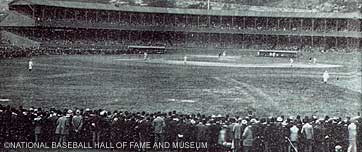
1883 John B. Day and Jim Mutrie,
owners of the American Association's New York Metropolitans, form a National
League team called the New York Gothams. On May 1, they play their first game
at a field once used for polo matches at 110th Street and Sixth Avenue.
1885 Jim Mutrie becomes the manager of the Gothams,
and he and John Day move some of the star players from the pennant-winning
Metropolitans over to the National League franchise.
1888 After two seasons of .550-plus records that
nevertheless result in finishing more than 10 games back, the Giants capture
their first National League pennant and then defeat the American Association's
St. Louis Browns to claim the world championship.
1889 Despite three changes of address, the Giants
successfully defend both their N.L. title and the world championship before
the upstart Players League (started in 1890) and the ownership of Andrew Freedman
decimates the squad for the next decade.
1893 George Davis' 33-game hitting streak establishes
the franchise record as he leads the team with a .355 average and 119 RBI.
His 27 triples also remain a team record. Two years later, at the age of 24,
the third baseman becomes the youngest manager in Major League history when
he is named skipper for 33 games.
1894 With the demise of the American Association
two years earlier, the National League pits the first-place Baltimore Orioles
against the runner-up Giants. The New Yorkers surprise everyone by sweeping
the best-of-seven series to win the championship. Pitchers George Meekin and
Amos Rusie, who combined for 69 victories in the regular season, each win
two games in the championship series.
1895 Pitcher Cy Seymour pitches both games of
a doubleheader (the nightcap called after seven innings because of darkness)
— and wins both. He allows seven hits total. The achievement is especially
remarkable because of Seymour's reputation for wildness; he would issue 13
walks in a game two years later and led the league in free passes for three
straight years.
1902 Suffering the most miserable
finish in the team's 20-year history (48-88, 53 1/2 games back), New York
still makes a move that would prove to be one of the most significant ever:
signing John McGraw as player-manager.
1904 After crushing the rest of the league with
a franchise-best 106 victories to capture the National League title, the Giants
decline to participate in the newly created World Series because manager John
McGraw and owner John Brush consider the American League a minor league.
1905 Satisfied with the adoption of certain postseason
rules, the Giants agree to play in the World Series after successfully defending
their N.L. championship. Christy Mathewson authors one of the greatest pitching
performances in history, tallying three shutout victories in New York's four-games-to-one
triumph over the Philadelphia Athletics for the Giants' first World Series
title.
1908 A monumental error ends up costing the Giants
the pennant, as the "Merkle Boner" is the lowlight of a late-season
faltering that forces a one-game playoff with the Chicago Cubs.
1911 Adversity strikes early in
the season, as a fire destroys the Polo Grounds, forcing the Giants to play
home games at Hilltop Park until June. But New York still captures the pennant
and, in a rematch of the 1905 World Series, faces Philadelphia for the championship.
1912 Following the dedication of the fully renovated
Polo Grounds, the Giants roll to the second of three straight National League
pennants. Even with a host of individual achievements, New York again falls
to the American League in the World Series.
1913 Three 20-game winners lead the Giants to
another N.L. title, but the New Yorkers again come up short in the Fall Classic.
Christy Mathewson pitches a phenomenal 68 straight innings without walking
a batter before issuing a free pass to the Cardinals' Ed Konetchy.
1917 After three disappointing seasons with one
of the few highlights being a major-league-record 26-game winning streak in
1916, New York returned to the top of the National League. However, the postseason
jinx continued, with the Giants losing their fourth-straight World Series.
1921 After several turbulent years,
which included the dismissal of two players for throwing games and the death
of Eddie Grant (the first major leaguer killed in World War I), the Giants
capture the pennant and break their World Series losing streak in the first
Subway Series.
1922 The Giants stay hot, again winning both
the National League title and the World Series, their second-straight postseason
triumph over the cross-town Yankees. Seven of the eight Giants starters bat
better than .320 during the regular season.
1923 Following the enclosure of the Polo Grounds,
the Giants' dynasty rolls on with their third consecutive trip to the World
Series. This time, the Yankees overcome their National League rivals to win
their first world championship.
1924 For the Giants, the year is like the past
three, culminating in a trip to the World Series. While the opponent is different
(with Washington supplanting the Yankees), the result from the previous season
is the same: a loss to the A.L. champs.
1930 With baseball experiencing an offensive
explosion (the National League batted .303 for the season), the Giants' .319
team average sets a baseball record. Bill Terry establishes a franchise record
with a .401 average, making him the last National Leaguer to hit .400 or better.
He also sets a franchise record and ties for the league lead with 254 hits.
The team, however, finishes five games back in third place.
1932 John McGraw's reign as the
Giants' skipper comes to an end, as the frustrated and ailing manager steps
down in June. He turns the team over to first baseman Bill Terry, who would
manage the team for the next 10 years.
1933 The dead ball is introduced, and pitching
propels the Giants to another world championship. "King Carl" Hubbell
wins the N.L. MVP as the anchor of a staff that includes four pitchers with
at least 13 wins.
1936 Carl Hubbell again wins the MVP Award and leads the league in
wins and ERA as the Giants advance to the World Series. Mel Ott bashes a league-best
33 home runs, but the American League New Yorkers top the Giants for the championship.
1937 Bill Terry drops the player part of his
player-manager title and leads the Giants against the Yankees in the fifth
all-New York World Series. Carl Hubbell, who won his last 16 decisions the
previous year, strings together eight more wins for a record 24 straight victories.
1942 Mel Ott, who would spend his
entire 22-year playing career with the Giants, takes over the managerial reins
during the difficult war years.
1943 After holding Spring Training in New Jersey
to help conserve resources for the war effort, the Giants finish a miserable
49 1/2 games out. Carl Hubbell wraps up his Hall of Fame career with 253 wins.
1946 The first post-war season should be bright
for the Giants, but the rogue Mexican League lures away many of the top New
York players. The exodus hits the Giants harder than most N.L. squads, and
they lose 93 games. Mel Ott hits his 511th and final home run.
1948 In a stunning July development, hated Dodgers
manager Leo Durocher replaces Mel Ott as manager of the Giants and starts
the rebuilding process.
1951 The Giants' revitalization
under Durocher comes to fruition in a storybook finish. After trailing the
Dodgers by 13 1/2 games on Aug. 11, the Giants end up forcing a three-game
playoff, culminated by the most famous home run in history.
1954 After a season without Monte Irvin (who
broke his leg in a 1952 preseason games) and two campaigns without Willie
Mays (who entered the Army), the Giants are back at full strength and capture
the world championship.
1957 Following two disappointing seasons and
increasing dissatisfaction with his tenure in New York, owner Horace Stoneham
considers moving his club to Minnesota before being convinced to join the
rival Dodgers in a historic move to the West Coast.
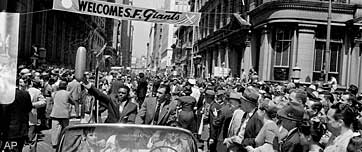
1958 San Francisco greets its new baseball team
with a huge parade and a raucous opener at cozy Seals Stadium. more>>
1959 Future Hall of Famer Willie McCovey goes
4-for-4 in his Major League debut en route to Rookie of the Year honors. Sam
Jones and Mike McCormick both toss rain-shortened no-hitters.
1960 Another move — the last one for 40
years — takes place, as the Giants relocate to what is known at the time
as their new gem of a stadium, Candlestick Park.
1961 Willie Mays smacks four home
runs in one game at Milwaukee's County Stadium. He is also chosen to start
in the outfield for the All-Star Game, held at San Francisco's new ballpark.
1962 Skipper Alvin Dark leads perhaps the greatest
team in San Francisco Giants history to its first World Series by the Bay.
The team again downs the Dodgers in a three-game playoff and nearly pulls
out the championship against the Yankees.
1963 Juan Marichal establishes himself as one
of the premier pitchers of all time with a 25-win season, including two of
the greatest games ever pitched at Candlestick Park.
1965 The Giants continue to string together stellar
seasons (their second of four in a row with at least 90 wins) only to fall
short by two games. Willie Mays wins his second MVP Award.
1967 Lefty Mike McCormick wins the franchise's
only Cy Young Award as well as Comeback Player of the Year. Despite Willie
McCovey's 31 homers (including three grand slams) and 91 wins, the Giants
finish 10 1/2 games behind the remarkable St. Louis Cardinals led by former
Giant and N.L. MVP Orlando Cepeda.
1968 While the team again settles for a runner-up
finish, several Giants enjoy dramatic personal achievement, including Gaylord
Perry's no-hitter, Juan Marichal's 26 wins and Bobby Bonds' brilliant debut.
1969 Willie McCovey wins the MVP Award, leading
the league in home runs, RBI and slugging percentage, but the Giants finish
second for the fifth year in a row.
1971 The "Year of the Fox"
produces the Giants' first division title despite having neither a .300 hitter
or a 20-game winner.
1973 Although the team finishes 11 games out of first place, three
players win major honors. Bobby Bonds, who misses becoming baseball's first
40-40 man by one home run, is named The Sporting News' Player of the Year,
while southpaw Ron "Bear" Bryant is named Pitcher of the Year after
winning 24 games, the most ever by a San Francisco lefty. Outfielder Gary
Matthews wins Rookie of the Year honors as one of three Giants to hit .300
or better.
1975 After bidding farewell to stars Willie McCovey
and Juan Marichal and mired in a string of sub-.500 seasons, the Giants enjoy
two refreshing pitching performances, John Montefusco's colorful Rookie of
the Year performance and Ed Halicki's no-hitter.
1976 Bob Lurie saves the Giants from a possible
move to Toronto by heading a group that buys the team and keeps them in San
Francisco.
1977 Willie McCovey returns to the Giants and
wins the Comeback Player of the Year Award with a team-best 28 home runs at
the age of 39.
1981 Frank Robinson becomes the
first black manager in the National League when he is named to head the Giants.
1984 A 96-loss season is brightened somewhat
by the 1984 All-Star Game at Candlestick Park, which includes Chili Davis
and Bob Brenly as Giants representatives. Crazy Crab makes his one-year appearance
as the Giants' "anti-mascot."
1985 Bad goes to worst as the Giants falter to the only 100-loss season in
their history. Reliever Scott Garrelts leads the staff with a measly nine
wins, and the team bats a league-worst .233.
1986 Manager Roger Craig and GM Al Rosen begin
a remarkable turnaround with their crew of "You Gotta Like These Kids"
players. Rookies Will Clark and Robby Thompson jump over the Triple-A level
to earn starting jobs, and Clark cracks a home run off Nolan Ryan in his first
big-league at-bat. Pitcher Mike Krukow wins 20 games and earns an All-Star
bid.
1987 Just two years after a wretched 100-loss
season, the Giants win the division thanks to late-season pitching acquistions
by Al Rosen.
1989 "Twenty-seven years of waiting come
to an end" when San Francisco heads for its first World Series in nearly
three decades. But forces of nature put a damper on the Bay Bridge Series,
and San Francisco is swept away.
1992 Owner Bob Lurie, after failing
in numerous attempts to get a downtown ballpark built, agrees to sell the
team to a group that would relocate the franchise to the Tampa-St. Petersburg
area. But a local investment group, led by Peter Magowan, saves the franchise
by buying the team instead. Before the deal is even officially done, Magowan's
group attracts superstar Barry Bonds to the squad.
1993 Barry Bonds wins his third MVP Award, Dusty
Baker is named Manager of the Year in his rookie season and two pitchers win
more than 20 games, but the red-hot play of the Atlanta Braves forces the
Giants to settle for a runner-up finish.
1994 Matt Williams is on pace to break Roger
Maris' record of 61 home runs, and the Giants are challenging for first place
when the players' strike wipes out the rest of the season. Rod Beck, who had
saved a franchise-record 48 games the previous year, is halted at 28 for 28
in save chances.
1996 Barry Bonds joins two exclusive clubs in
an otherwise miserable 94-loss season.
1997 After two straight last-place finishes,
GM Brian Sabean faces vilification by trading fan favorite Matt Williams,
forcing him to declare "I am not an idiot" to the press. The "Team
of Dustiny" proves him right by winning the division nine days after
Brian Johnson's now-legendary 12th-inning homer to beat the Dodgers.
1998 Although they trail West winners San Diego
by nine games at season's end, the Wild Card gives the Giants hope for postseason
play. They make up a five-game deficit in the final 10 games of the season
to force a one-game playoff with the Cubs.
1999 Injuries to Barry Bonds, Jeff Kent and Ellis
Burks slow the Giants, who finish 14 games back despite a 22-6 run starting
in mid-August. But five players bash 20-plus homers and drive in at least
80 RBI. With the team out of contention, however, the focus is on the end
of the Giants' stay at Candlestick Park, now known as 3Com Park.
2000 The Giants christen the spectacular Pacific
Bell Park in inauspicious fashion, losing the first six games in the new yard
and 11 of their first 15 games overall. But with the support of 3.3 million
fans who sell out every game at the rookie park, San Francisco wins its second
division title in four years. Jeff Kent wins the N.L. MVP while Dusty Baker
captures his third Manager of the Year Award.
 |