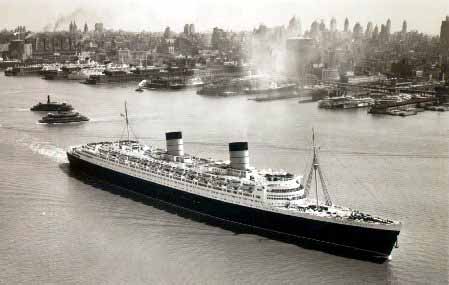
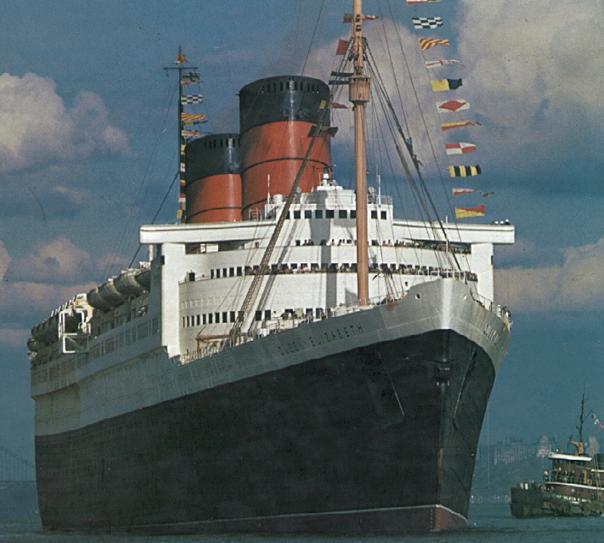
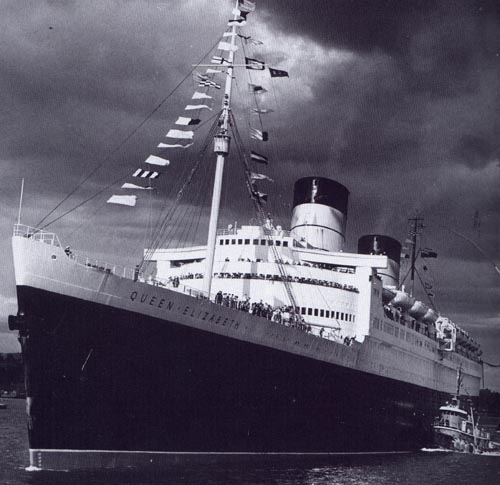
Project 535, better known as the Queen Elizabeth, was built at John Brown Shipbuilders, the same firm which had built the Queen Mary, Queen Elizabeth's older sister. Lizzie, as she was known, was also designed for Cunard's two ship service between England and America, and while the Queen Mary was the fastest ship of her time, the Queen Elizabeth was to be the largest at 83,673 tonnes and 1031 feet, a title she would hold until 1997.
On a drizzly September 27th, 1938, Queen Elizabeth travelled to John Brown's shipyards to give her name to a ship that would make history. Political problems plauged Europe and England, and in her speech, the Queen rallied England to the cause of peace, not war. Then, as she finished, the Queen Elizabeth began to move, quite unexpectedly. The Queen quickly smashed a bottle of champagne across the bows and christened the ship in her name as it sped down the slip into the water.
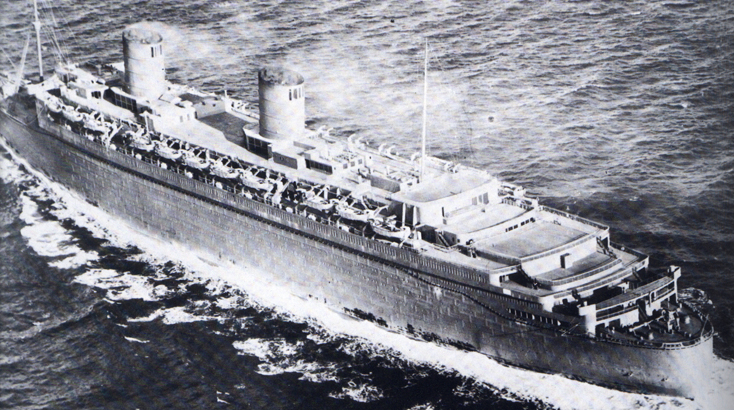
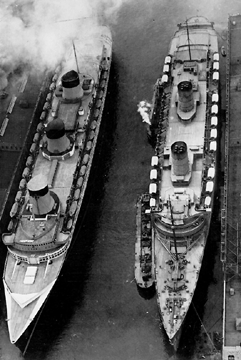
On September 1st, 1939, the tanks of Germany rolled into Poland, and ignighted the Second World War, a war which England would enter just days later. While at sea, Queen Mary was alerted to the news and sped for port. Queen Elizabeth however was still being fitted out at the John Brown yards. The largest ship in the world would make en excellent trooper, but there were grave fears that Nazi bombers would realise just how valuable the Queen Elizabeth was to Britain and destroy her, hense, a plan was hatched to get her out of John Brown's as quick as possible. To confuse any German spies, a deliberate rumour was spread; the Queen Elizabeth was to sail to Southampton for dry docking, but the ship's real destination was unknown to everyone aboard, including the captain. On March 3rd, 1940, she steamed away from the shipbuilders, painted all over grey and still with launch gear on her hull. When finally at sea, the captain opened special sealed orders. The ship was to sail to New York. It was a daring escape, especially seeing Nazi bombers were seen over the Solent that day, precicely where she would be sailing on her way to Southampton. Queen Elizabeth had never been to sea before, nor had she had any sea trials. Escaping at speed across the Atlantic were theoretically her trials. She arrived unannounced in New York on the 7th of March, the lookout at Fire Island claiming he saw a great Grey Ghost coming out of the mist. When she docked in New York, she found herself in good company. Her sister Queen Mary was in the berth beside her, and with them stood the second Mauretania and Normandie. Next to that of the Titanic, Queen Elizabeth's maiden voyage would rank as one of the most dramatic in history.
After Queen Mary sailed, the Queen Elizabeth was moved into a berth next to Normandie, and remained there until November 13th, 1940, when she left New York for Singapore where she would be converted into the largest trooper the world had ever seen. She made a troop transport voyage to the Middle East then carried soldiers from Sydney, Australia to the Suez.
In April 1942, she was transferred from Sydney to New York so her troop capacity could be upgraded to 10,000. She remained there until August, next to the capsized Normandie which rolled over after a fire in February, before sailing out and working a shuttle service between New York and Gourock, even though the threat of a U-Boat attack was extreemly high. Infact, a German press release announced that Queen Elizabeth had been torpedoed on November 11th, 1942. This, thankfully, was not the case. Infact, she never once saw an enemy or fired her guns in anger. She, and the Queen Mary were virtually invisible to German forces.
Finally, the war ended. Still used as a trooper, but for a happier cause, the Queen Elizabeth and Queen Mary brought back many soldiers from the front lines.
Back in the UK, Queen Elizabeth underwent a refurbishment both in Clyde and Southampton. During this time, a small fire was found on the promenade area. Luckily it was extinguished, and arsons blamed, though never proved. Sadly, this would not be her last appointment with flames.
On October 6th, 1946, the Queen Elizabeth set out on her first ever peace time voyage. Her captain, Commadore Sir Edward James Bisset was at the peak of his career, having served as second officer of the Carpathia in 1912 as she sped to the rescue of the Titanic. Lizzie was joined in 1947 by the Queen Mary, and together made Cunard-White Star the most powerful shipping company in the world. Nothing seemed to weigh them down, not even running aground in fog just outside Southampton in April 1947. By September 1951, Queen Elizabeth had made her 100th Atlantic crossing and had many famous people on her passenger list, past and present. Like her sister, she was fitted with stabilisers in 1955, but sadly, passenger comfort was soon to be no match for air travel. Refits and cruises were planned. A large open air swimming pool was installed on her lido deck and airconditioning installed throughout, but it was no use. In 1967 it was announced the Queen Elizabeth was to be taken out of service.
In 1968, the Queen Elizabeth was sold to a group of Philadelphian businessmen for �3,250,000 and berthed in the still undeveloped Port Everglades in Florida for use as a floating hotel, museum and convention center like her sister, but after two years attendance grew increasingly poor and the ship was again in financial difficulties as the Queen Elizabeth deteriorated in the harsh Florida weather.
In 1970, she was sold at auction to C.Y. Tung, who renamed her Seawise University (a play on his initials) and planned to repair her and make her a floating university. Just barely making the trip to Hong Kong under her own power, she was stripped down and built back up to modern standards and her exterior was painted all over grey like in her war years.
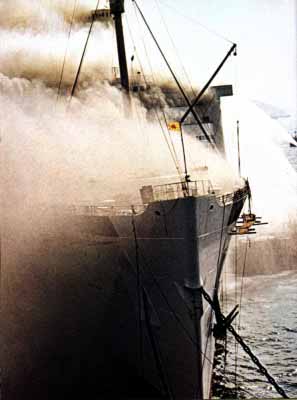
On January 9th, 1972, just as she was about to sail under her new name and colour scheme to Japan for dry docking, several fires were repoted in many areas of the ship, lit by saboteurs. The fires spread and burned through the night as the superstructure melted and began to cave in while she developed a list to starboard due to the massive amounts of water being poured into her from fireboats. Finally, she wallowed onto her side, still smoldering and disgraced. There she sat for months and years, not moving until the decision was made to take her away after her oil storage ruptured and spilled into the sea. |